
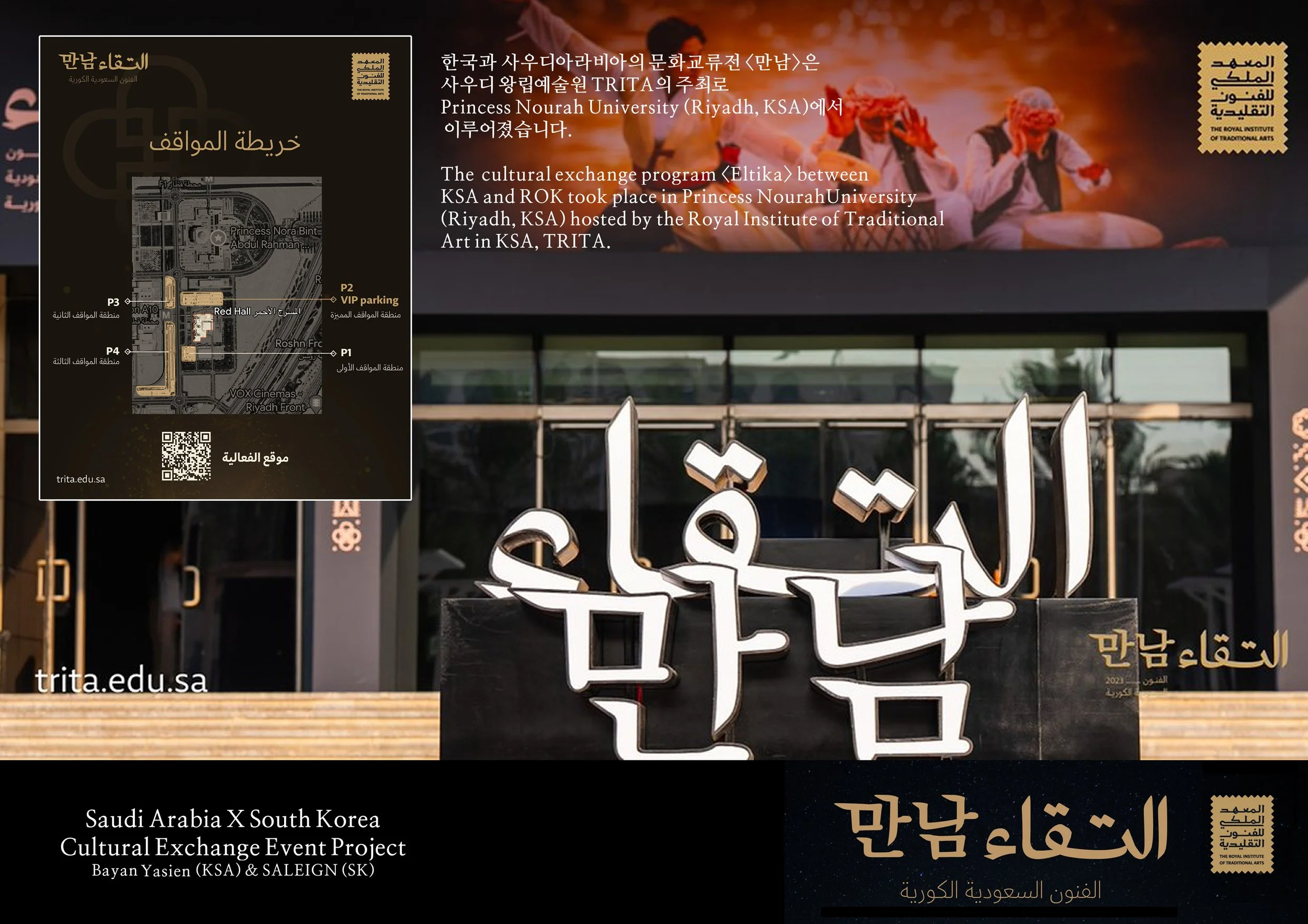
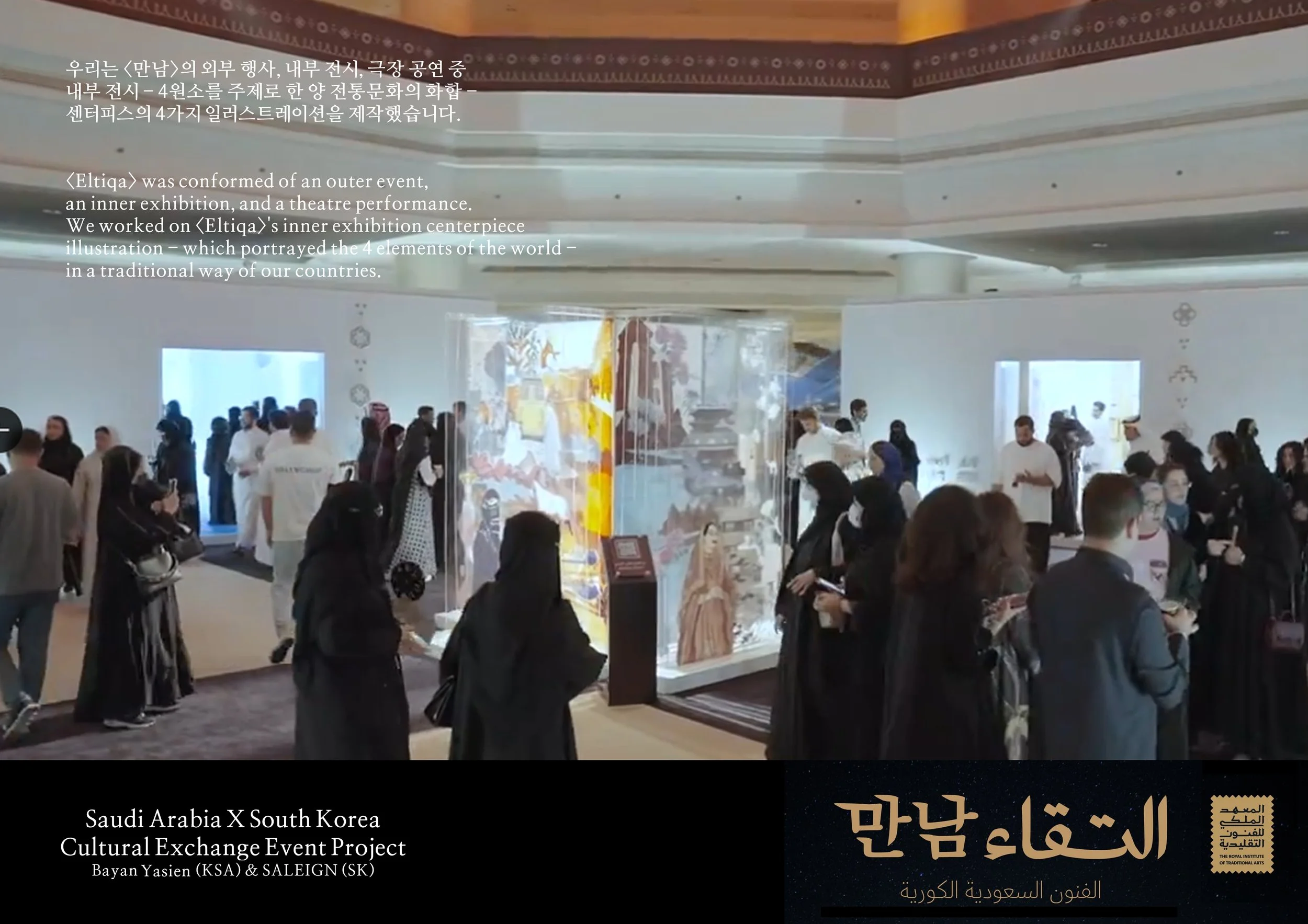
I was commissioned by WRTH - The Royal Institute of Traditional Arts (Kingdom of Saudi Arabia) to be Korea’s representative artist and a centerpiece merged-piece artist in Eltiqa (2023), a ROK - KSA cultural exchange exhibition event.
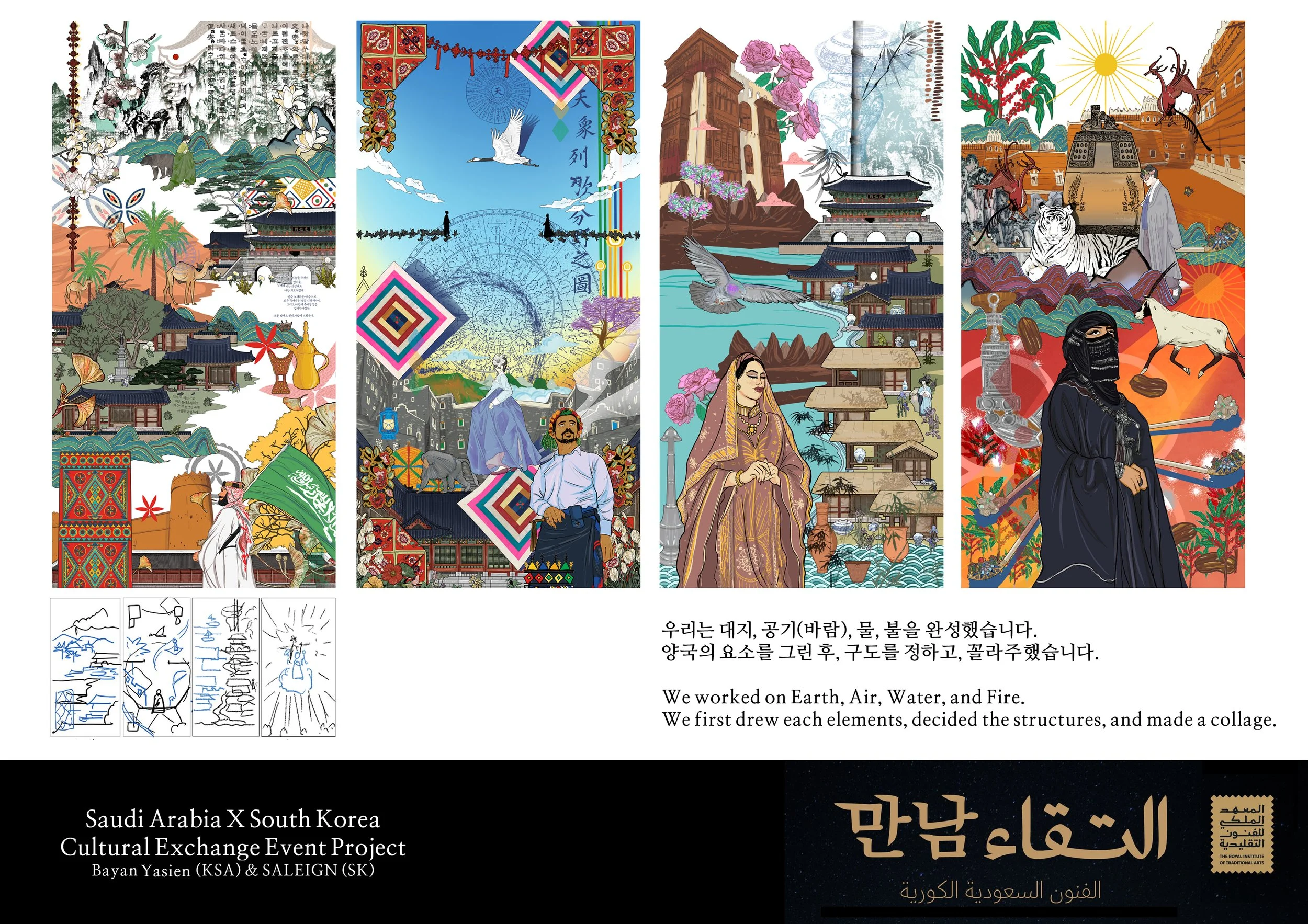
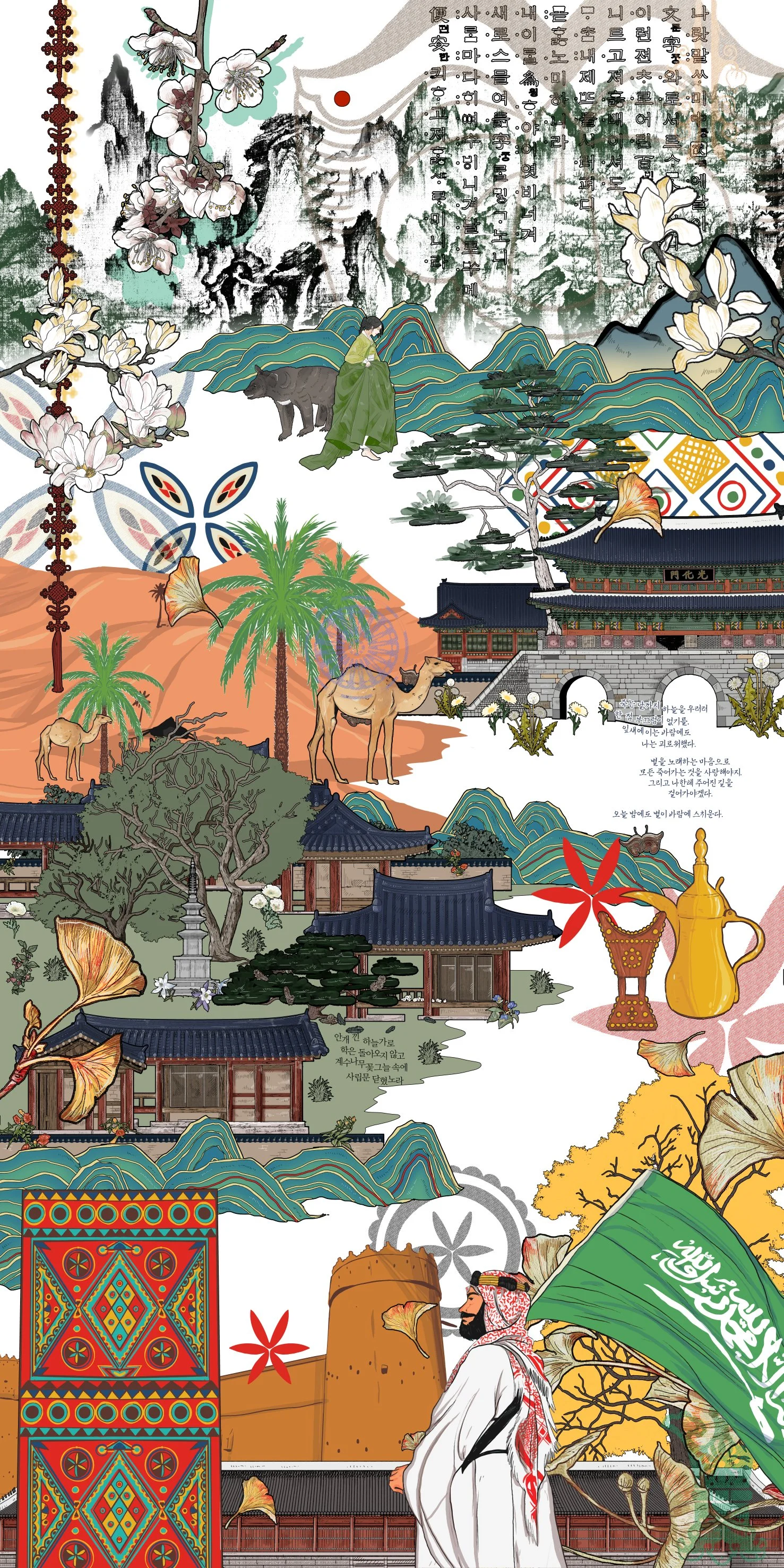
Earth
The EARTH
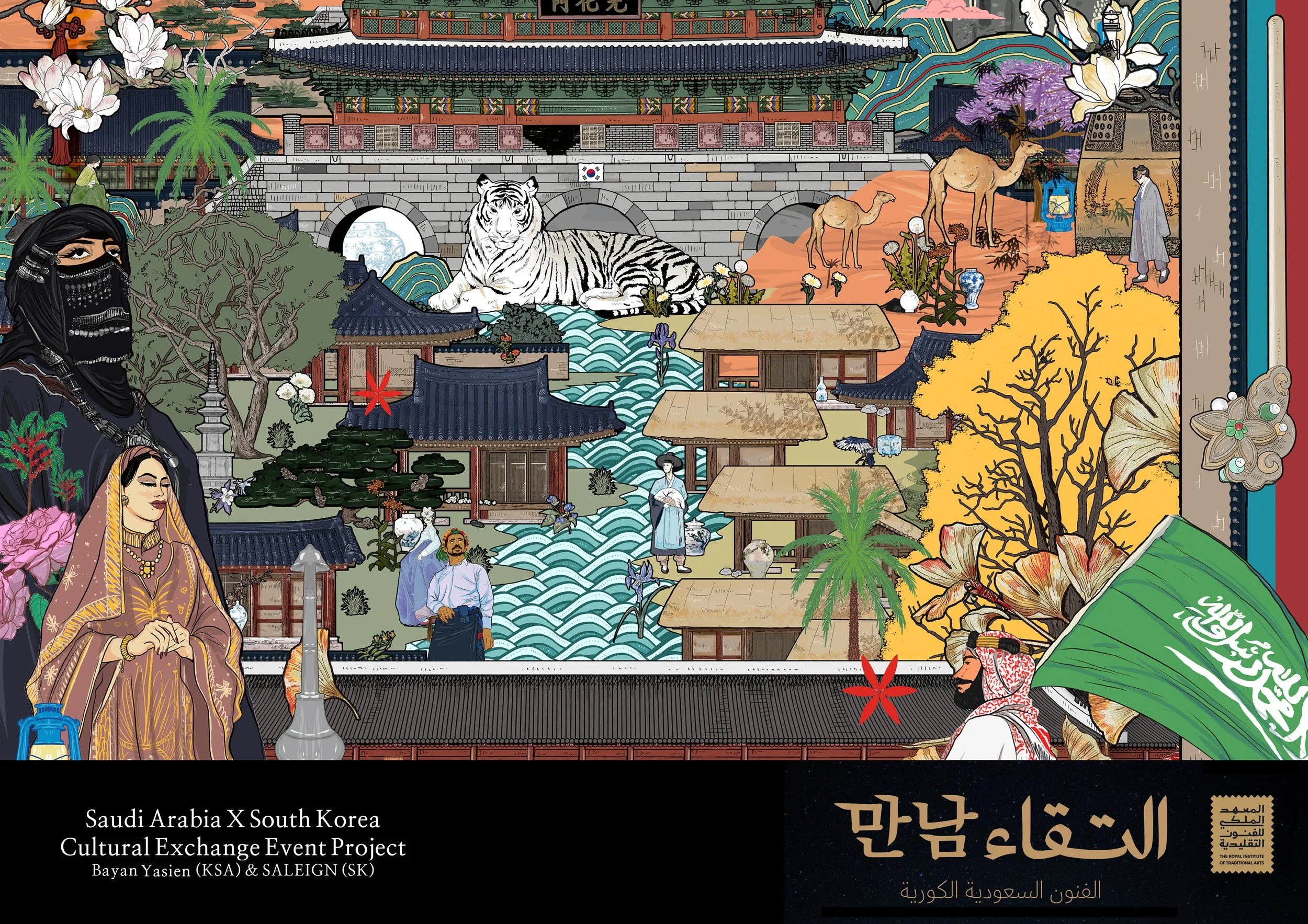
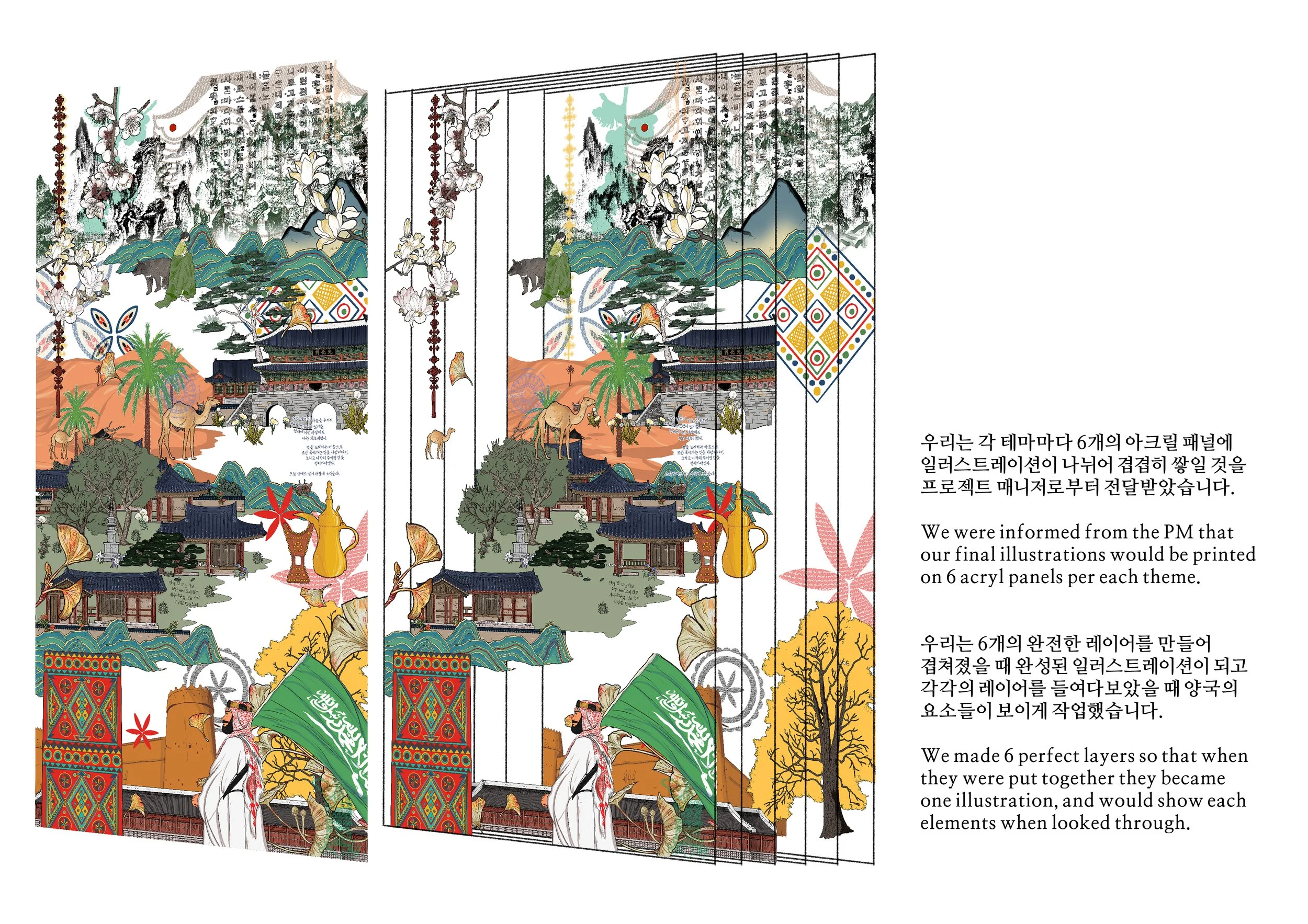
Among the four elements, this piece, Earth, is my favorite. The earth is a chaotic conceiver of the world, also meaning mother nature. However, when we talk about 'Earth' in postmodern days, we tend to think of landscapes. Thus this pieces portrays a lot of landscape of both countries. When Koreans talk about landscapes, they will say "beautiful arrays of mountains and rivers". Korea is full of mountains and rivers. It is green and sky blue.
Earth, in Korean concepts, can be linked to the Roots, the key of our culture. Hangul, the Korea characters King Sejong created in 14th century cannot be absent in talking about cultural heritage. Because we were using Chinese characters in the past days, it was hard for everyone to read and write so King Sejong created the characters that fit our own language. This is a memorial, key invention of Korean history. I also put the imaginary mountains of Prince Ahn-pyeong, he drew the dream fantasy idealistic world of Korea, so I chose this part as the background. I portrayed mountains in traditional one-tone ways and in colored versions. I put a bear and Mago, who are said to be the ancient Korean ancestors in old tales.
I put Prunus, Magnolia, Gingko, the Pines and others that represent the four seasons, also showing the geographical history of Korean peninsula.
And at the right-down there is Yoon dong-ju’s famous poetry, <The Foreword>, the most-loved poetry of modern Korean people. It says:
Wishing not to have
so much as a speck of shame
Toward heaven(Sky) until the day I perish,
I suffered even when the wind stirred the leaves.
With my heart singing to the stars,
I shall love all things that fall and die
And I must walk the road
that has been given to me.
Tonight, again, the stars shine in the winds.
This shows the key mood of Korea, the yearn to be pure and to be firm, although hardships will collide with your life. He lived in the period of Imperial Japan, and this is a very important poem that explains Korea, which, has been invaded by various countries in its history, its will to be indomitable.
On the middle-left I put traditional hanok (the houses) of gentle people (the commoners), Five angles with the wall and roofs. And inside you can see among the weeds some flowers that have stories from the old (legends and myths about poppies, the belladonna, the columbines, and the commelinas) and trees – Zelkova trees and a pine tree with cones (since we were meeting in autumn) that are famous and are classified as cultural assets. Also you can see a stone tower, which implies the medieval Korean beliefs of Confucianism and Buddhism.
You can see another poem by a famous medieval women poet,The “遊仙詞’ written in ancient Chinese and translated to modern Korean. It translates:
Over the foggy skies the crane does not return
The doors are closed behind the lilac shades
Holy rain falls over the river streams
The crane must be wet in the foggy grounds not being able to fly.
This poem is by Heo-nansulheun, a famous poet and artist. She is second to the best women artist, Shin sa-im-dang, yet her poems are important too because they convey han ‘恨‘ the sorrow and regret. Han is a key concept explaining the Korean poems. Heo-nansulheun is waiting for a crane in her dreams, but she is trapped besides the door. The door is magnificent, beautiful under the lilac shades, but in truth she is sad she is not able to be out. She wants to stretch her abilities and fly like a crane, but she is ㅌconveying her ‘han’ to not be able to. This may be because of womenhood in the middle ages of Korea, or it could also be linked to worries in a life.
You can also see creeping campsis flowers as they blossom at late summer to autumn, weeds that represent the chaotic creation of the Earth, and cotton plants on the Hanok as winter is coming, and there is a very famous tale about the cotton plants in Korea.
At the bottom we start from Jongmyo, the shrine of the Kings and Queens, and generals who have fought bravely, the government officials who are praised.
It is an important architecture that is also different from the Chinese Jongmyo, is recorded as the Unesco heritage, as a symbol of Confucian and Buddhist traditions.
The Earth piece sketch ends with Gingko trees. People will be able to watch them
turn to yellow-gold glitters as fall deepens. Some abstracts are from traditional symbols from all ages, the Three Kingdom Ages, the Koryeo dynasty, and the Joseon dynasty of Korean history.
I wish to be blessed our long relationship and friendship between two countries.
*some illustration parts are from public open-resources from traditional studies.
**Professor 이 지 of Ewha Womans University has given consultation for my works.
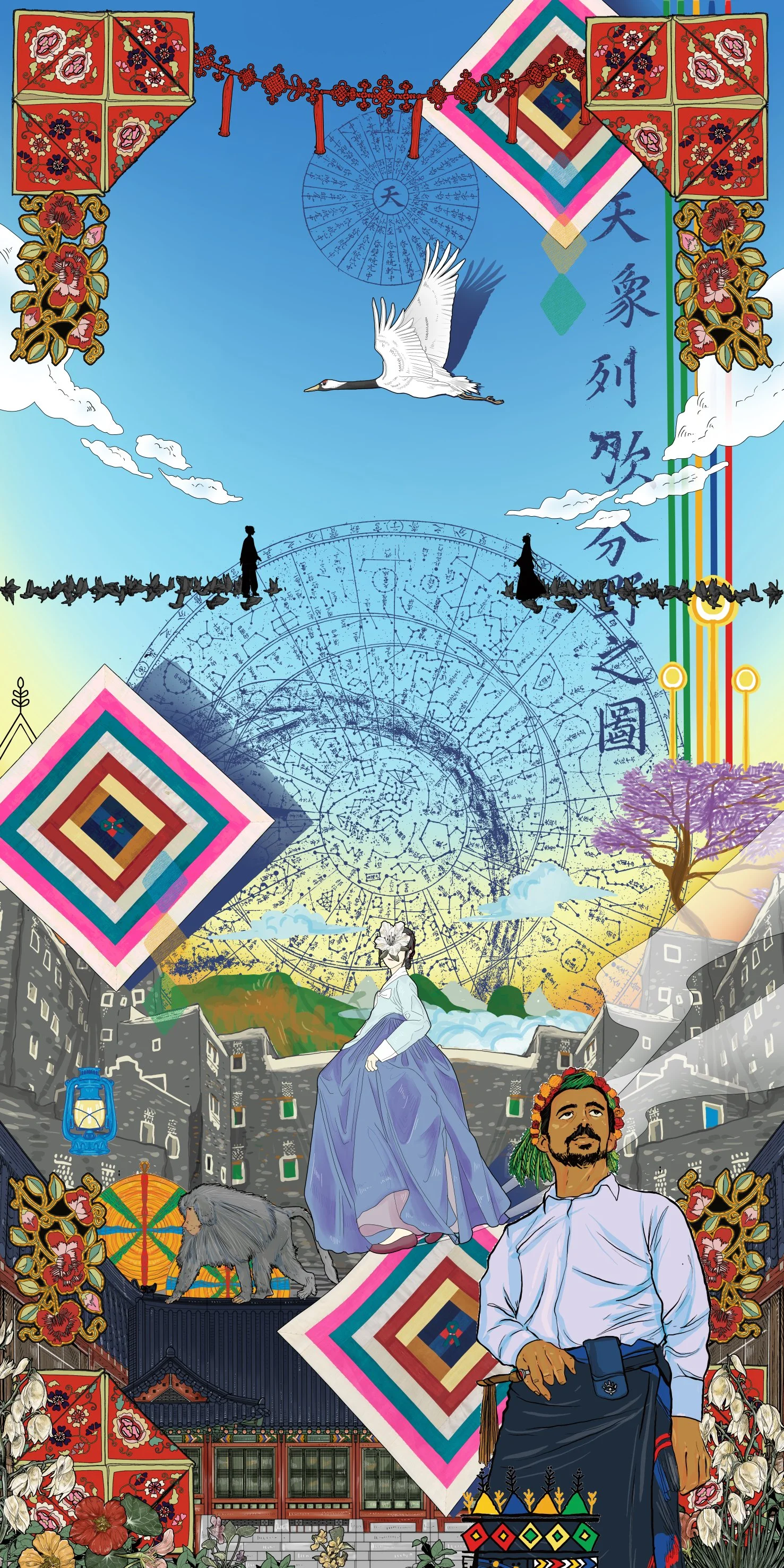
Air
The AIR
Air, in this project, means wind in general, but I could link Korean concepts like the atmosphere, the Sky, the Universe as well. The concept of the Sky is very important in Eastern cultures. Have you heard a saying that "Isn't the place between Sky and Earth like a fan!" (Daodejing, chap 5) The place is empty but also full with Ki(氣), it is the energy that transforms everything.
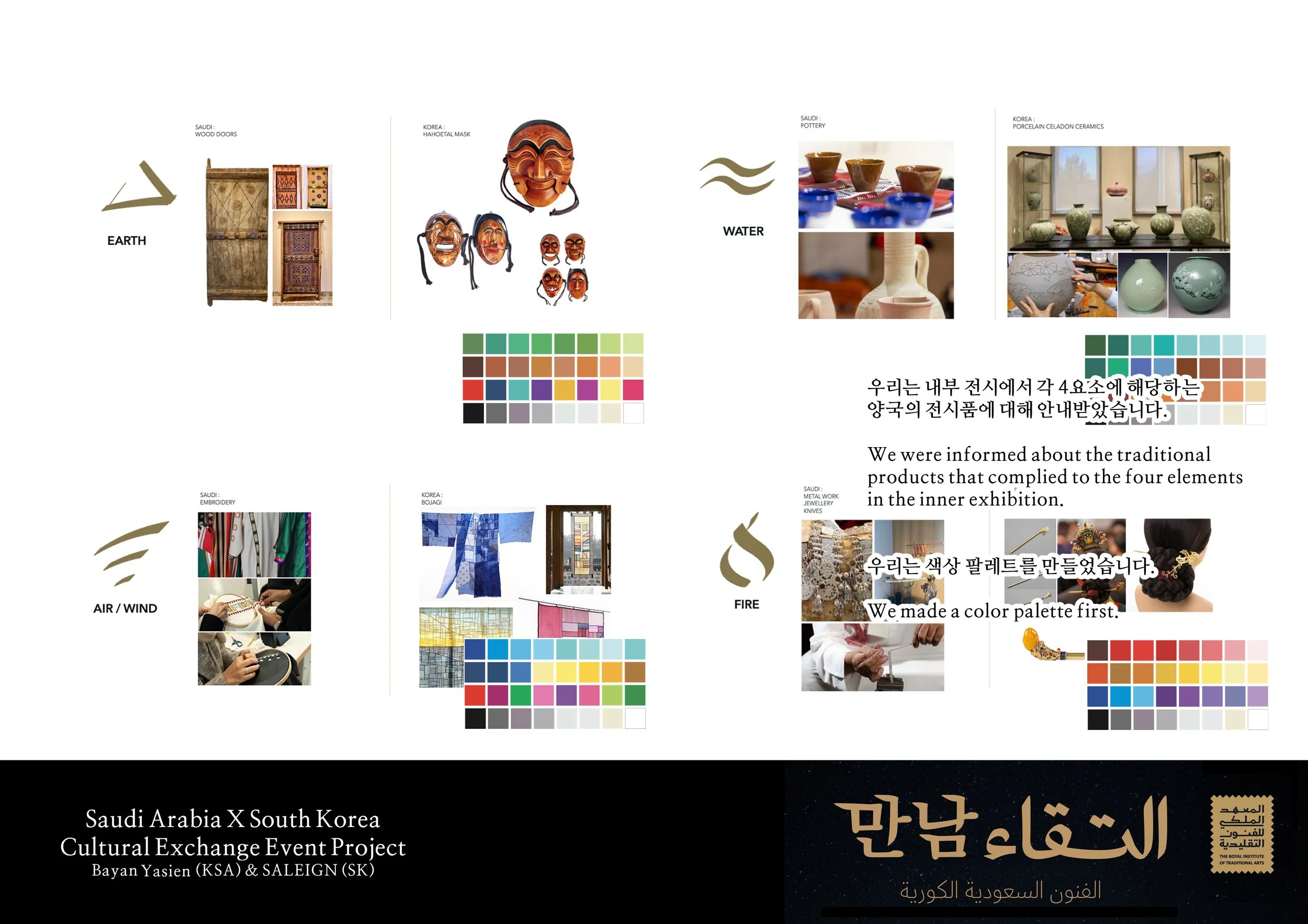
In this project I have been suggested to depict Bojagi, a traditional fabric piece in Korea, thus I put a woman whose hanbok, the traditional dress of Koreans blowing in the wind. Humans are a conceiver of Ki or the Way, the principle of how the world conceives, creates, and demolish. And I put a map of the constellations in the sky, Cheon-sang-yeol-cha-bun-ya- map, the second oldest map of the sky in human historical artifacts. Bojagi flies like a kite, and a famous tale about two lovers (the cowboy and the loom-worker girl) who are parted by their parents, and can only meet each other at Lunar Year July 7th in the midst of the sky, carried by magpies and crows. I have illustrated this part wishing for our two countries to share our experiences together.
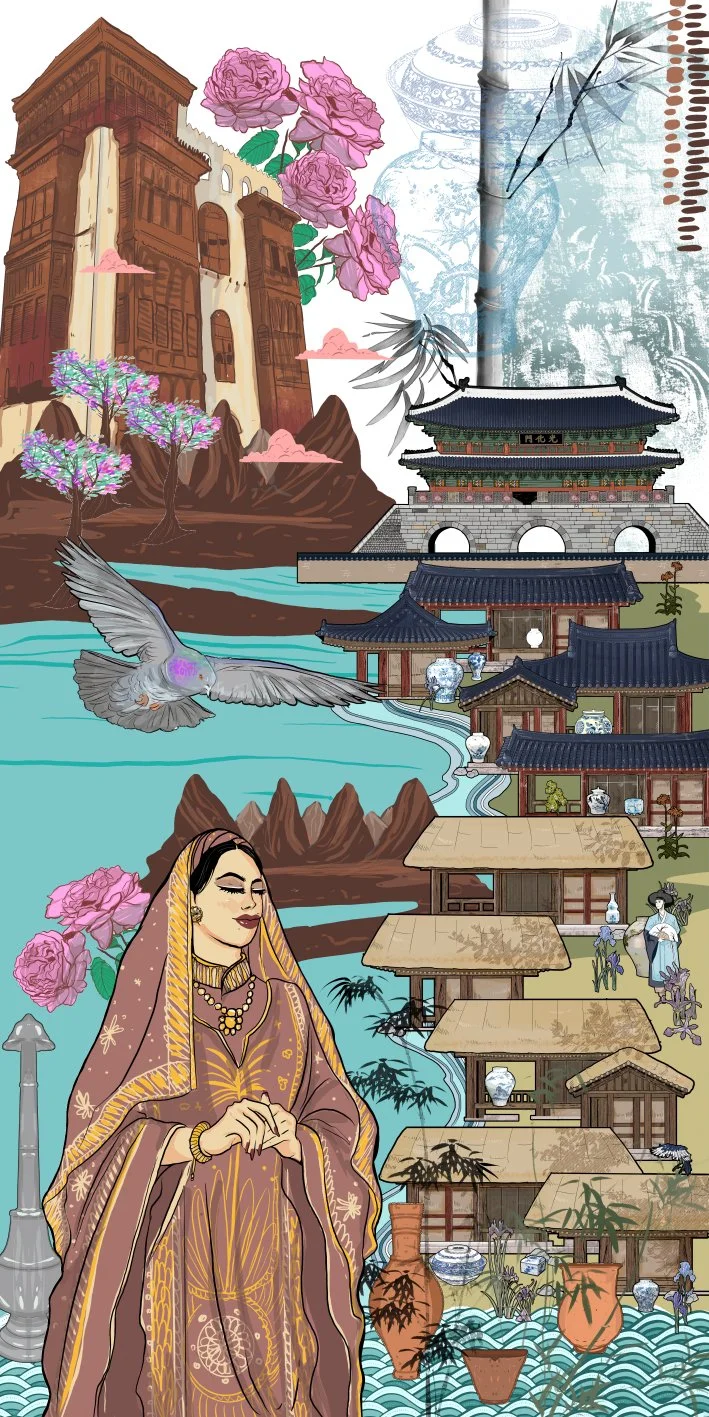
Water
The WATER
Water, traditionally, appears a lot when talking about the Way in Confucian and Daoist books of Northeastern Asia (China, Korea, Japan) as an example(道體). "The best thing in the world is like Water. Water helps everything in the world and do not fight with each other. It even exists in the lowest places people do not prefer. So it is close to the Way(of living). It does not hesitate to be with the lowest people, its mind is deep, it has mercy and shares with everyone. Sincere as it is, should rulers reign with order, works be contributed to the right persons, decisions be made in the right moments. It does not fight with one another, having no defections." (Daodejing, chap 8) is a famous saying about water. "How streams move in every minute, it does not take a break!" (Confucius) is an example of how water appears in a Confucian ideal. Water doesn't have a form thus has no limit, endlessly flows from high to low, assists everything living.
In the project, they suggested porcelain work as examples of water elements as they ate made with water. Thus I referred to our national museum's datas of traditional porcelainwork. I drew the stream of water so that it flows from high(in place, in ranks) to low, among with a traditional village of various social positions. I hoped people participating in the event could imagine how water is generously flowing in arrangement with Korean concepts and traditional lifestyles. As water flows with order I illustrated thus piece with hope to respectfully understand each other's cultures and to flourish. Also, Gunja, a Korean ideal of human, is often represented as the bamboos in my country, thus I put then and various water-related plants and orchids to help people imagine what Korean lifestyle is like.
*some illustration parts are from public open-resources from traditional studies.
**Professor 이 지 of Ewha Womans University has given consultation for my works.
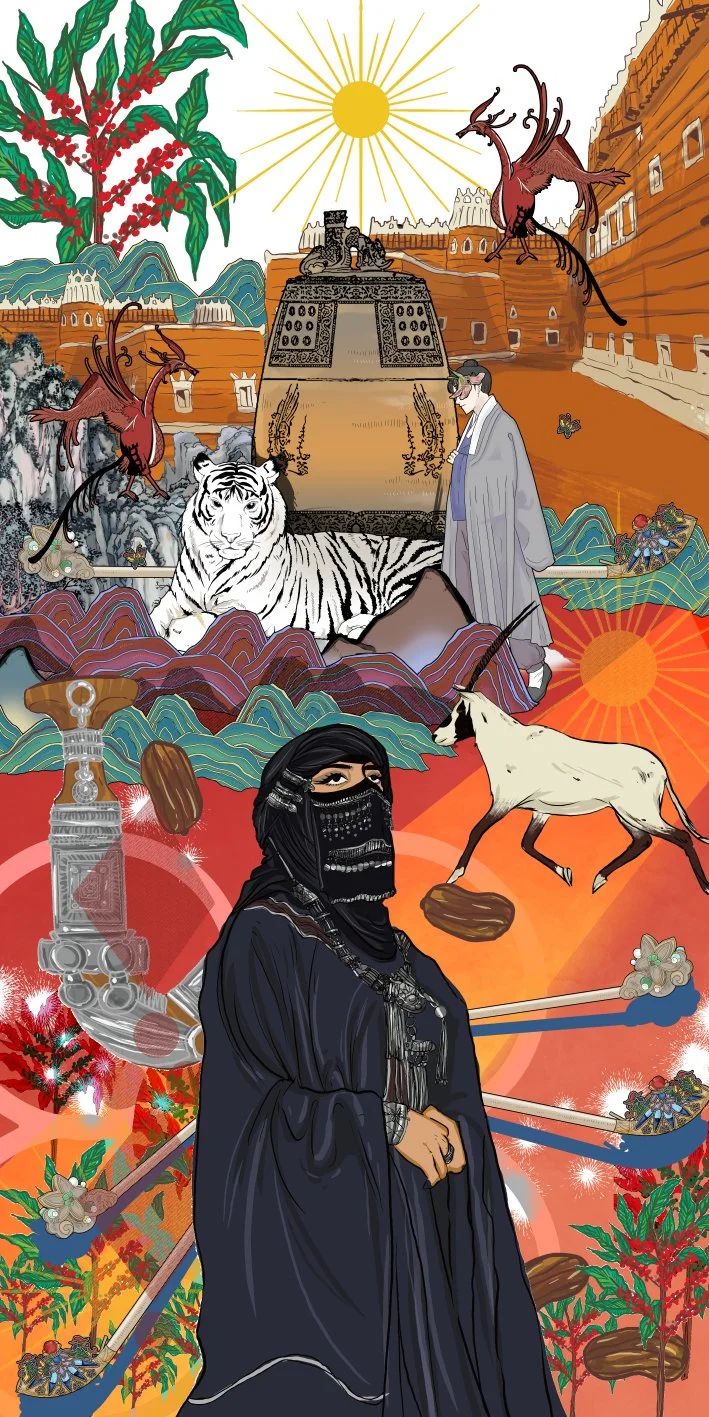
Fire
The FIRE
Earth, Air, Water, Fire are the four elements that have been thought to form the world in east-western traditions before modern science took over. As Earth is a constant conceiver of the world in Korean philosophy, Air being the transformer, Water representing the Way which the universe follows, Fire does not have a strong meaning by itself in Korea, but I could link Yin(仁), a relative energy that helps everything strive. For the project Fire section recommended me to depict metalwork on accessories like the binyeo(hairpin), but then I recalled the Giant Bells in Korea as a signature for not only the metalwork technology but also a wish to connect the sky and the ground, people with the world, etc. I put the red pheonixes, an imaginary animal with a white tiger, which are thought to protect and guard the people. I put the giant bell and a conceptual man(not a specific individual) who stands beside the bell. I also put some mountains that are slightly different from Earth pieces. As my elements convey the hope to connect between sky and the ground, people with the world, the artisan and the users, I illustrated those pieces wishing our relationship between two countries be very active.
*some illustration parts are from public open-resources from traditional studies
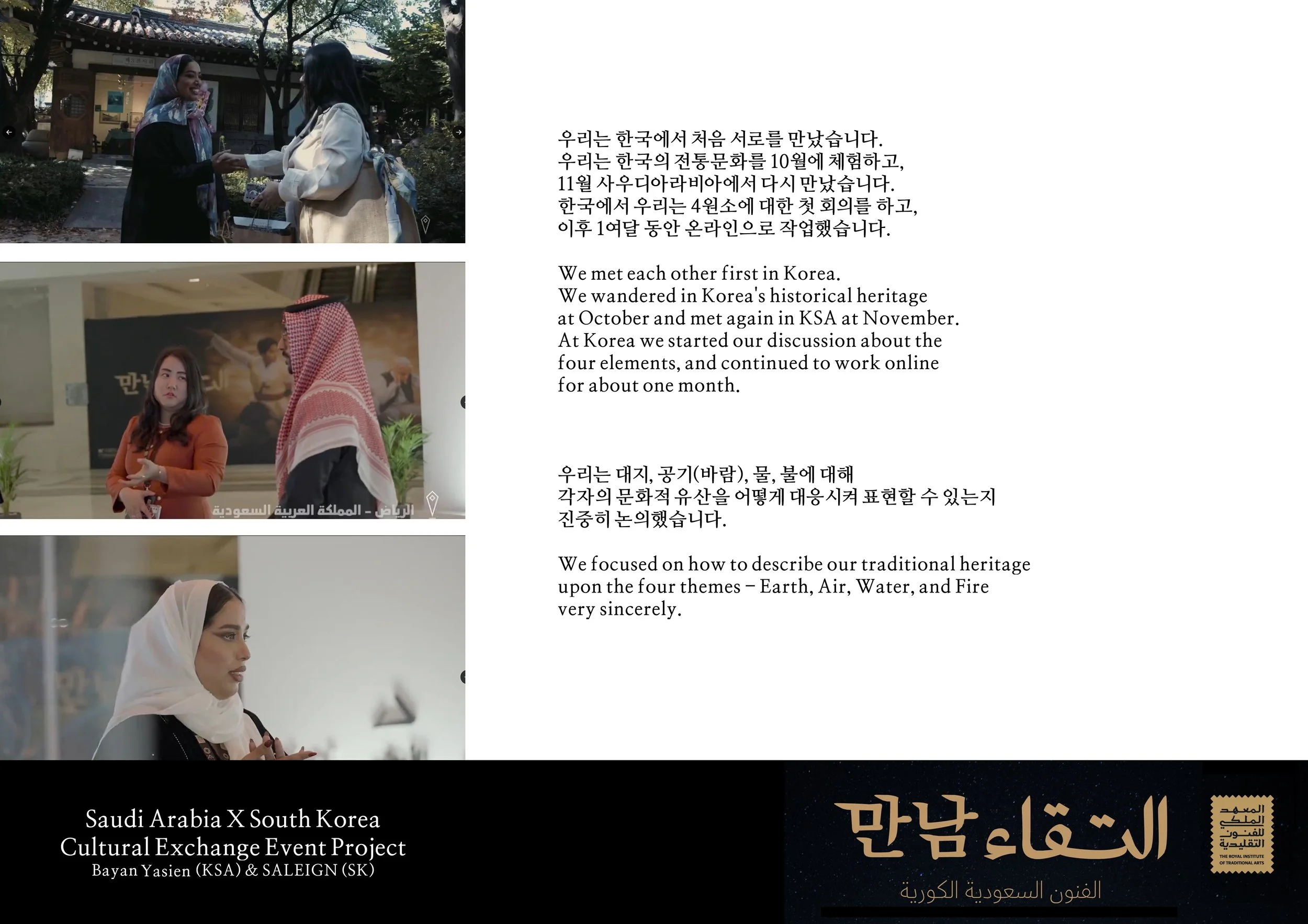
This is a video of our journey.
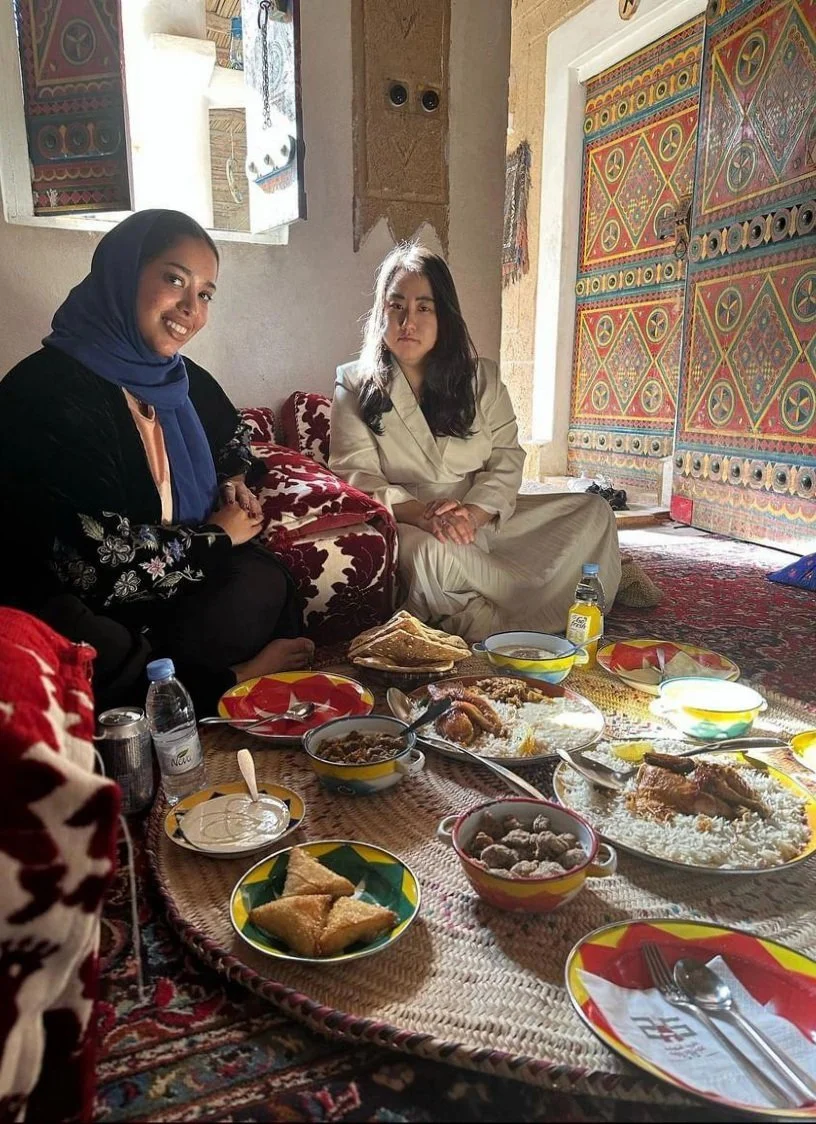
Bayan Yasien (KSA)
SALEIGN, Chaeryoung Yoon (ROK)
