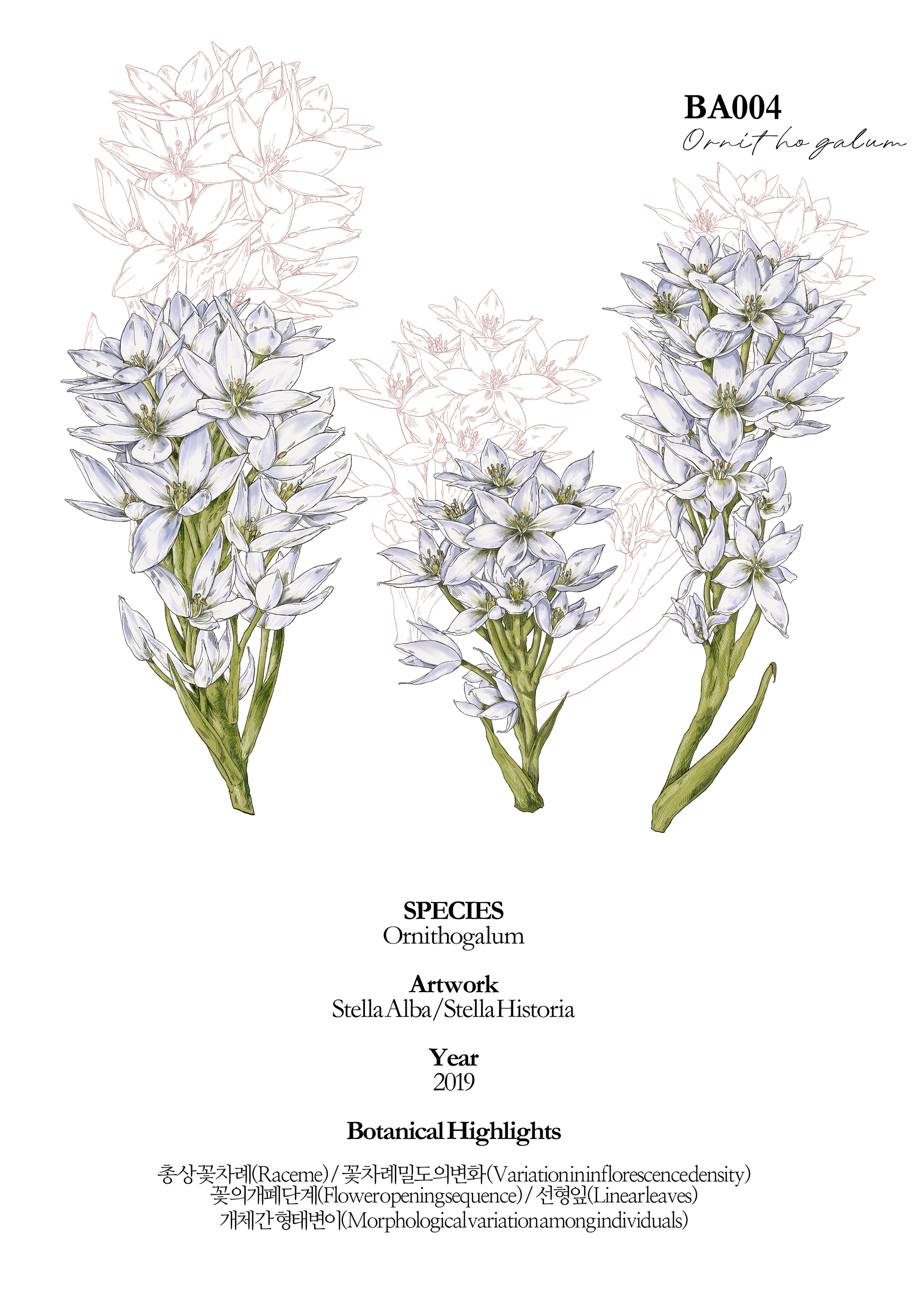
2019-BA001 - Allium
Observation
알리움은 백합과 알리움 속의 식물의 총칭이지만 화훼에서는 더 포괄적으로 쓰고 있습니다. 한국에는 13종이 납니다
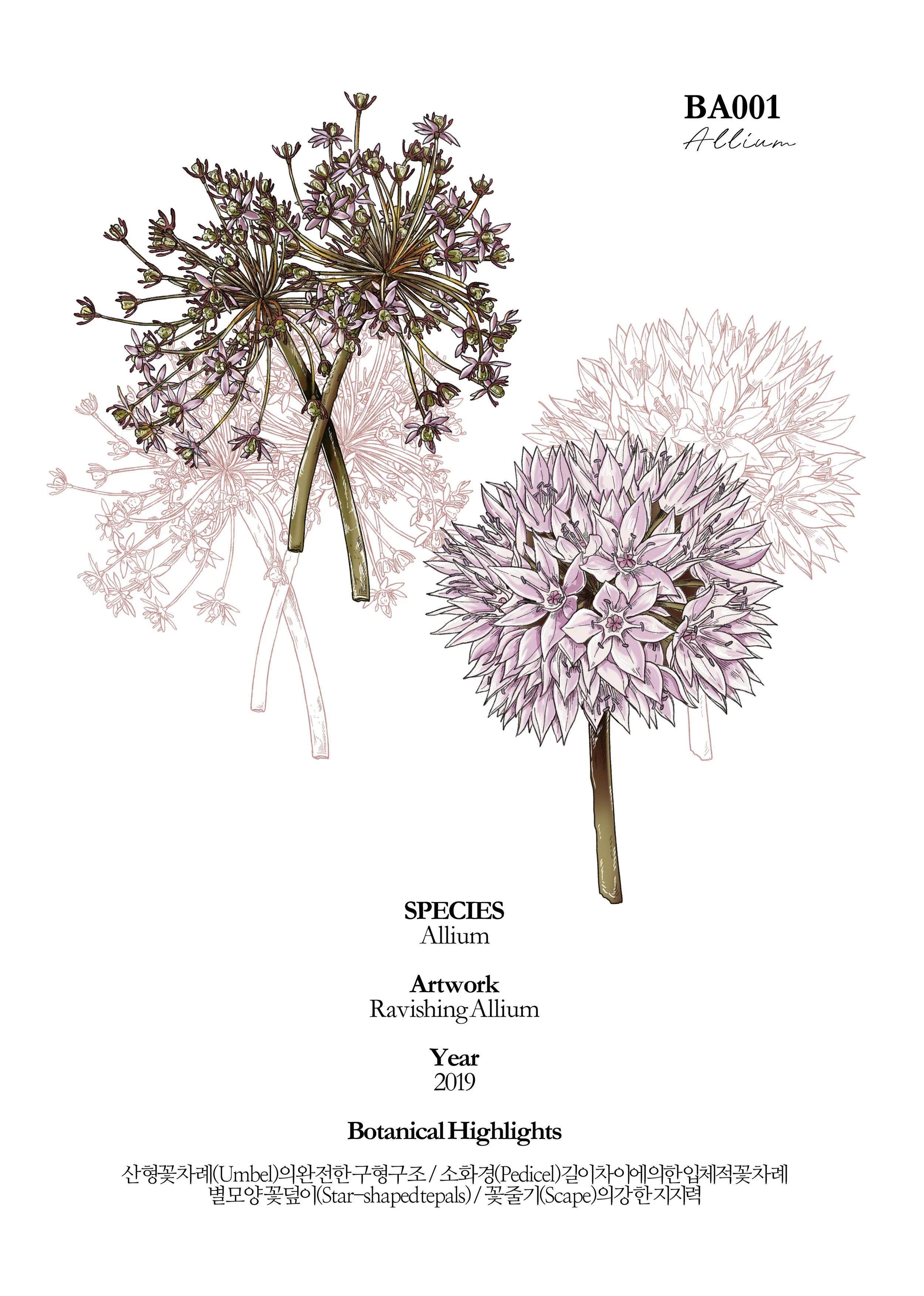
예로부터 알리움은 식문화에서 많이 사용되어 왔지만, 그 꽃의 아름다움까지 아는 이는 많지 않았습니다. 대부분의 알리움은 파, 부추 등 잎이나 구근만 다듬어져 도시의 소비자들에게 왔거든요. '황홀한 알리움(Ravishing Allium)'은 우리가 먹는 식재료로 인식하는 것들에도 식물의 과정들이 있고, 놓치고 있는 아름다움이 있다는 의미에서 그리기 시작했습니다. 화훼농가에 알리움이 오고 나서, 여러분이 알리움 꽃의 냄새를 맡아보시면 이것이 어떤 알리움인지 냄새로도 알 수 있답니다.
알리움 꽃은 동그란 구 형태로 핍니다. 여섯 개의 별 모양 꽃잎이 도드라지고, 흰색과 분홍색이 많죠. 줄기가 이 많은 꽃들을 지탱하기 위해서는 굵고 튼튼하며 길이가 길고 직립하죠. 알리움꽃은 식재료만큼 다양합니다. 꽃들을 따서 크기별로 늘어놓으면 또 재미있는 결과를 볼 수 있지요.
여러분의 식탁에서도 일부 모습만 볼 수 있는 식물들을 찾아 꽃들을 검색해 보길 권합니다.
Allium is a collective name for plants of the genus Allium, traditionally associated with the lily family, although the term is often used more broadly in horticulture. Thirteen species are found in Korea.
Alliums have long played an important role in food culture, yet relatively few people are familiar with the beauty of their flowers. Most alliums—such as onions, scallions and chives—reach urban consumers only after their leaves or bulbs have been harvested and prepared. I began Ravishing Allium with the thought that even the plants we recognize mainly as ingredients possess their own life cycles and forms of beauty that often go unnoticed.
When ornamental alliums arrive from flower farms, their scent can sometimes reveal what kind of allium they are. Their flowers often bloom in rounded, globe-like clusters. Six star-shaped tepals are particularly distinctive, and white and pink flowers are common. To support so many individual flowers, the scape grows thick, sturdy, long and upright.
Allium flowers are as diverse as the ingredients they produce. If the individual flowers are separated and arranged according to size, they reveal another fascinating visual order.
I encourage you to look again at the plants that appear only partially on your table—and to search for the flowers they produce.
2019-BA002 - Anemone
Observation
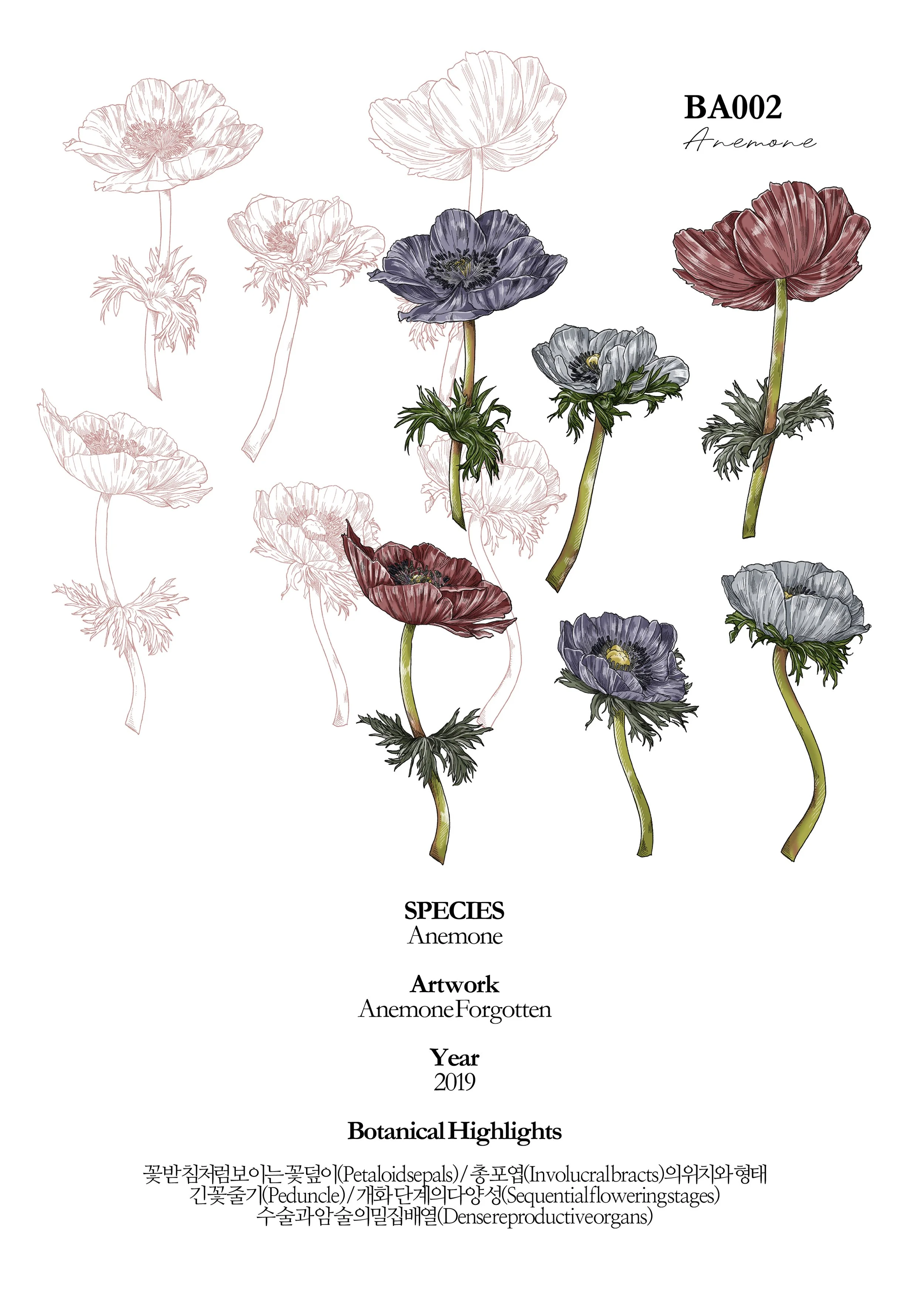
성인이 되어 꽃시장에 처음 간 2015년. 화훼계의 오랜 유행 중엔 아네모네가 있었습니다. 보랏빛, 그리고 선홍빛 아네모네는 사랑스럽고 팔랑이는 꽃잎과 두드러지게 대비되는 검푸른 수술들로 풍성하면서 색대비가 있는 꽃이었죠. 가정의 달인 5월에 많이 나오는 꽃이기도 했습니다. 한 줄기 끝에 한 꽃이 피고 옅은 부채같은 꽃잎이 6~8개 나는 아네모네. 잎은 꽃다발에서 주로 뜯어서 다발을 만들지만 잎도 갈래가 여러개로 나뉘어 꽃을 돋보이게 하고 밋밋하지 않아 아름답습니다.
다만 아네모네를 받으면 얼마 되지 않아 져버리는 것이 아쉬웠습니다. 꽃이 오래 가지 않고 줄기가 물러 쉽게 시들고 그 특성 때문에 종교적으로도 고난을 의미하는 뜻이 있으며 연관된 그리스 신화 또한 비극적이죠. 5월 가정의 달에 많이 쓰는 꽃다발에서는 붉은 장미와 흰 안개꽃 조합, 또는 여러가지 아네모네를 쓰곤 했는데 장미 줄기가 튼튼하고 안개꽃은 건조까지 되는 반면 아네모네는 늘 반대로 여리고 무른 꽃이었습니다.
그러다 2010년 중후반대에 아네모네가 잠시 봄꽃시장에서 밀려난 적이 있는데 글로리오사 백합을 필두로 수입꽃이 많이 들어오던 시기가 있었습니다. 그 때 아네모네는 싼값에 신문지에 포장되고 비싼 수입꽃들은 아름답게 포장되어 가치를 발하는 것을 보고 <잊혀진 아네모네 Anemone Forgotten>이라는 작품을 그리게 되었습니다.
비극적인 탄생과 의미만큼 현대에 와서도 다른 수입꽃들에게 밀려나는 것이 퍽 안타까웠던 기억이 납니다. 아네모네의 인기가 예전만큼 못하다고 느끼던 어린 날이었는데 실제로 전국적으로 그랬던지는 잘 모르겠습니다만 그 단상이 워낙 강렬해 2019년의 작품에 남아있네요.
미나리아재비과에 속하는 아네모네는 여러 해살이풀(다년초)이지만 꽃다발(절화)로 많이 소비되곤 했습니다. 이 꽃이 앞마당 또는 화분에서 여러 해 동안 살 수 있다는 것을 처음 알았을 때 우리는 정말 꽃의 편린만을 잘라서 소비한다 생각하는 때가 있었습니다. 틸란드시아와 같은 공기 식물(air plant)이 2016년에 대 유행을 하고 '이오난사 인간상'이라는 덧없고 관리가 편한 인간상을 생각하는 수필을 쓰기도 했는데 아네모네가 식물과 인간사를 생각하기 시작한 첫 꽃이라 저에게 의미가 깊습니다.
바람꽃이라고도 번역하지만 아네모네는 한국의 자생종 바람꽃과는 1:1대응관계로 보기엔 맞지 않습니다. 우리가 꽃시장에서 소비하는 아네모네는 유럽 지중해 연안 원산의 종인 경우가 많은데 '바람꽃'이라는 노래가 나오면서 잠깐 재조명되기도 했던 아네모네의 생애가 늘 마음이 쓰였답니다.
여러분도 특별히 마음이 쓰이는 꽃이 있다면 어떤 꽃인지 기억하시나요? 저에게 아네모네는 아픈 손가락이랍니다.
The first time I visited a flower market as an adult was in 2015. At the time, anemones were one of the long-standing favorites in the floral industry.
Purple and crimson anemones were unforgettable flowers, with delicate, fluttering petals contrasted by striking dark-blue stamens that gave them both richness and dramatic color. They appeared most abundantly in May, the Month of Family in Korea.
Each stem bears a single bloom, surrounded by six to eight soft, fan-like petals. Florists often remove the leaves when arranging bouquets, yet the foliage itself is beautifully divided into many slender lobes, framing the flower with an elegance that is often overlooked.
Yet every time I received an anemone bouquet, I felt the same disappointment—it faded far too quickly.
Its stems soften easily, the blossoms wilt sooner than most flowers, and this fragile nature has long been associated with sorrow and suffering in religious symbolism. Even the Greek myth surrounding its origin is a tragic one.
In May, bouquets were often made with red roses and baby's breath, or with colorful collections of anemones. Roses remained sturdy, baby's breath could even be dried, but anemones were always the fragile ones—the flower that disappeared first.
Then, during the late 2010s, anemones briefly lost their place in the spring flower market.
Imported flowers, led by gloriosa lilies, became increasingly popular. I remember watching inexpensive bundles of anemones wrapped simply in newspaper, while imported flowers were carefully packaged and presented as luxury blooms. That contrast stayed with me, eventually inspiring my 2019 artwork, Anemone Forgotten.
I remember feeling saddened that a flower already burdened with a tragic mythology seemed, even in modern times, to be quietly pushed aside by newer and more fashionable imports. Perhaps it was only my own impression, and perhaps it wasn't true everywhere. Yet that feeling remained vivid enough to become part of this piece.
Anemones belong to the buttercup family (Ranunculaceae) and are herbaceous perennials, although most people know them only as cut flowers.
When I first learned that anemones could continue living for years in a garden or even in a flowerpot, I realized how often we consume only fragments of a plant's life.
Around 2016, air plants such as Tillandsia became enormously popular. At the time, I even wrote a short essay imagining an "Ionantha personality"—someone who wished to live lightly, requiring little care and leaving few traces behind.
Looking back, I realize that the anemone was the first flower that truly made me think about both plants and human life. That is why it still holds a special place in my archive.
Although anemones are sometimes translated into Korean as "windflowers," they are not the same as Korea's native wildflowers that share that name. The anemones commonly found in flower markets are usually Mediterranean species from Europe.
There was even a brief period when the flower regained public attention after the release of a popular song titled Windflower. Ever since then, I have continued thinking about the quiet life of this flower, and the way it has drifted through changing times.
Is there a flower that has quietly stayed with you over the years?
For me, it has always been the anemone—my most tender, unforgettable flower.
2019-BA003 - Ornithogalum
Observation
오니소갈룸은 “베들레헴의 별(The Star of Bethlehem)”이라는 별명을 갖고 있습니다. 여섯 장의 꽃잎을 가진 꽃이 마치 별 같다 하여 붙여진 이름으로, 기독교에서 예수 탄생 때 동방박사를 인도했던 별을 의미하기도 하지요. 처음에 린네가 분류했을 때는 백합과에 있던 식물인데, 백합과는 식물분류 시스템상 가장 많은 변동을 겪었던 과기도 하지요 - 지금은 아스파라거스과로 분류되어 있습니다. 구근식물이기도 하고, 구근에넌 알칼로이드와 카르데놀리드가 포함되어 있어 반려동물을 기르는 사람들에게는 주의해야 할 식물이기도 합니다.
꽃꽂이에서는 매스 플라워(mass flower)와 라인 플라워(line flower)를 구분하여 용도를 다르게 씁니다. 오니소갈룸은 매스 플라워로 존재감 있는 덩어리를 표현하는 절화로 쓰입니다. 라인을 따라 떨어지거나 나는 꽃이 아니고 한 줄기에 여러 꽃이 존재감 있게 피어 주제(theme) 꽃으로 많이 씁니다.
오니소갈룸은 아프리카와 인근 지역 태생으로 알려져 있는데, 우리나라에도 수입된 역사가 길지 않습니다. 오니소갈룸을 처음 접했을 때는 모두 주황색이었습니다. 그러다가 다음 오니소갈룸을 그릴 때는 흰 꽃이 들어왔지요. 화훼에서는 다섯 가지 종 정도를 쓰는 것으로 알고 있습니다.
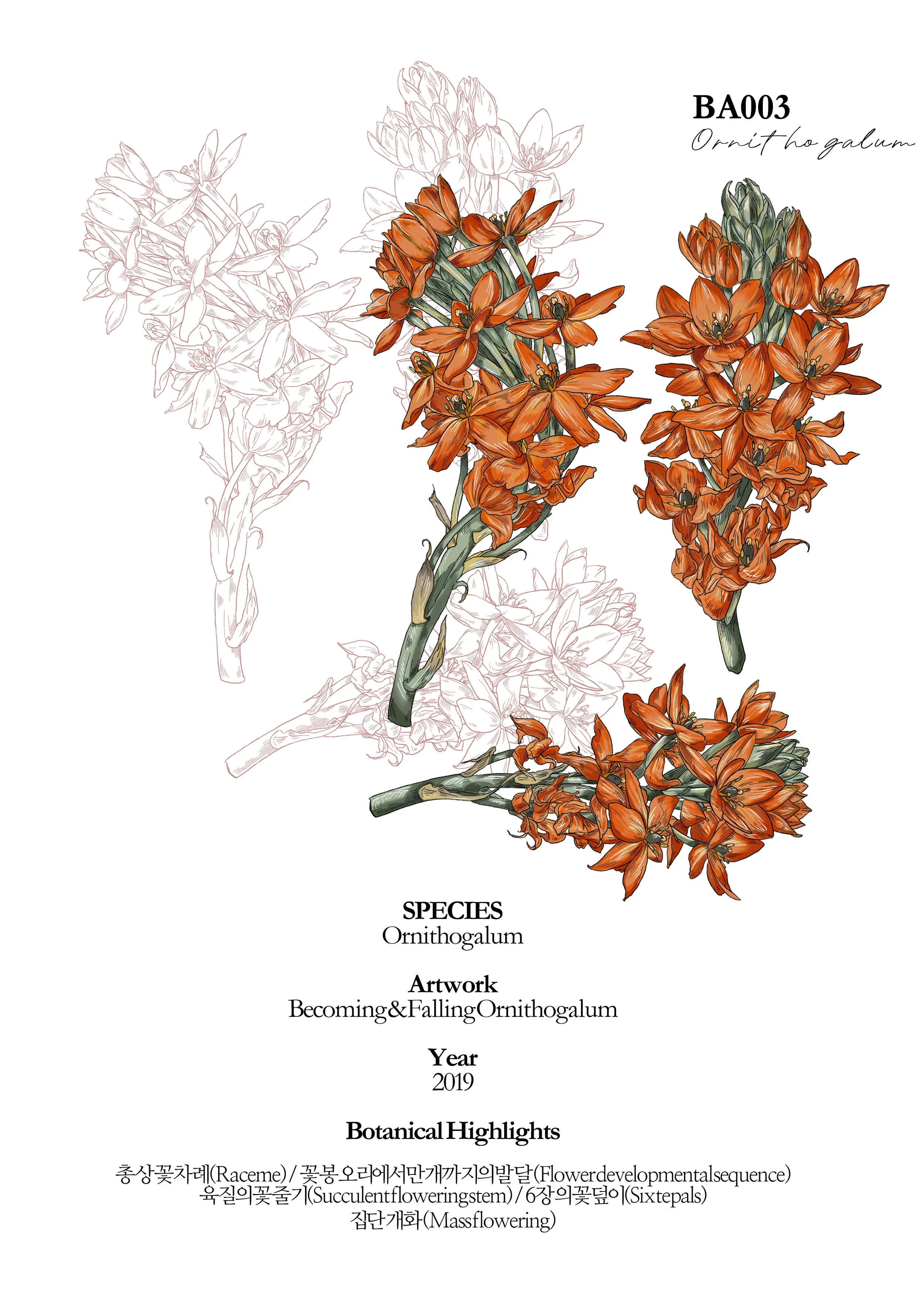
오니소갈룸을 2019년에 그릴 때는 “생멸하는 오니소갈룸(Becoming & Falling Ornithogalum)”으 로 이름지었습니다. 오니소갈룸은 줄기가 쉽게 물러, 피고 지는 것을 며칠만에 볼 수 있기도 했고, 또 제가 밤새 꽃을 지키며 피고 지는 것을 보기도 했기 때문입니다. 수국, 히아신스와 더불어 오니소갈룸은 잠을 자지 않고, 한 시간마다 시침이 이동하듯 꽃잎을 여는 꽃에게 설레어 이틀을 내리 잠 없이 지켜봤던 기억이 있네요.
저는 꽃을 잘 피우고 절화를 오래 유지하는 것으로 유명했었습니다. 오니소갈룸은 길면 5일 정도 가는 게 통상적인데, 1주 반에서 2주를 유지하기도 했지요. 수국같은 경우는 한 달까지 유지하는 것으로 유명했었는데, 친구들로부터 꽃을 오래 피우려면 어떻게 해야 하는지 짧은 식견으로 상담해 주었던 기억이 납니다. 지금은 앵무새들과 생활하기 때문에 다양한 꽃을 매주 들이진 못하고 안전한 꽃만 들이지만, 유독성으로 유명한 백합류 꽃들은 역시 아름답습니다. 독이 있는 만큼 그 아름다움을 지키고 싶어서일까요. 백합들은 하늘하늘하고 무서우리만치 아름답습니다. 오니소갈룸은 백합과는 아니지만, 백합목에 속하는 아스파라거스과라, 그 날카롭게 빠진 꽃잎이 피는 모습이 절절히 아름답습니다.
베들레헴의 별에게 느낀 것이 많지만 현재 시국으로 인해 기독교와 베들레헴 이야기를 하기에는 안타깝게도 꺼려지는군요. 다른 시간에 이야기해보길 희망합니다.
Becoming & Falling Ornithogalum
Ornithogalum is commonly known as “the Star of Bethlehem.” The name refers to its six-petaled, star-shaped flowers and, in Christian tradition, to the star that guided the Magi to the birthplace of Jesus.
When Linnaeus first classified the genus, it belonged to the lily family, Liliaceae—one of the plant families that has undergone the most extensive changes in botanical classification. Today, Ornithogalum is placed in the asparagus family, Asparagaceae. It is also a bulbous plant, and its bulbs contain alkaloids and cardenolides, which means that those living with companion animals should handle it with particular care.
In floral design, flowers are often distinguished by their functions, such as mass flowers and line flowers. Ornithogalum is used as a mass flower, creating a strong and substantial focal area within an arrangement. Rather than producing small flowers that trail or scatter along a delicate line, it bears several prominent blooms on a single stem and is often used as a thematic or focal flower.
Ornithogalum is generally considered native to Africa and its surrounding regions, and it has a relatively short history as an imported cut flower in Korea. The first Ornithogalum flowers I encountered were all orange. By the time I drew the plant again, white varieties had also begun to appear. As far as I know, approximately five species or varieties are commonly used in the floral industry.
When I drew Ornithogalum in 2019, I titled the work “Becoming & Falling Ornithogalum.” Its stems soften and decay easily, allowing the entire process of blooming and fading to unfold within only a few days. I also spent entire nights watching over the flowers as they opened and fell.
Along with hydrangeas and hyacinths, Ornithogalum remains one of the flowers I once stayed awake for two consecutive days to observe. I remember the excitement of watching its petals open little by little, almost as though the hand of a clock were advancing once every hour.
I used to be known for helping flowers bloom fully and keeping cut flowers fresh for a long time. Ornithogalum commonly lasts for around five days, but mine would sometimes remain fresh for a week and a half, or even two weeks. I was also known for keeping hydrangeas for as long as a month, and friends would often ask me for advice on how to make their flowers last longer, though my knowledge was still limited.
Now that I live with parrots, I can no longer bring home a wide variety of flowers every week and choose only those considered safe. Yet flowers related to lilies, many of which are well known for their toxicity, remain extraordinarily beautiful. Perhaps their beauty appears all the more precious because it must be approached with such caution. Lilies are delicate, weightless, and almost frighteningly beautiful.
Ornithogalum does not belong to the lily family, but it is a member of Asparagaceae within the order Liliales. The sight of its sharply tapered petals opening is no less intensely beautiful.
The Star of Bethlehem has inspired many thoughts in me. Yet, given the present circumstances, I feel hesitant and saddened to speak about Christianity and Bethlehem at this time. I hope I may return to those stories on another occasion.