2020-BA005 - Apricot
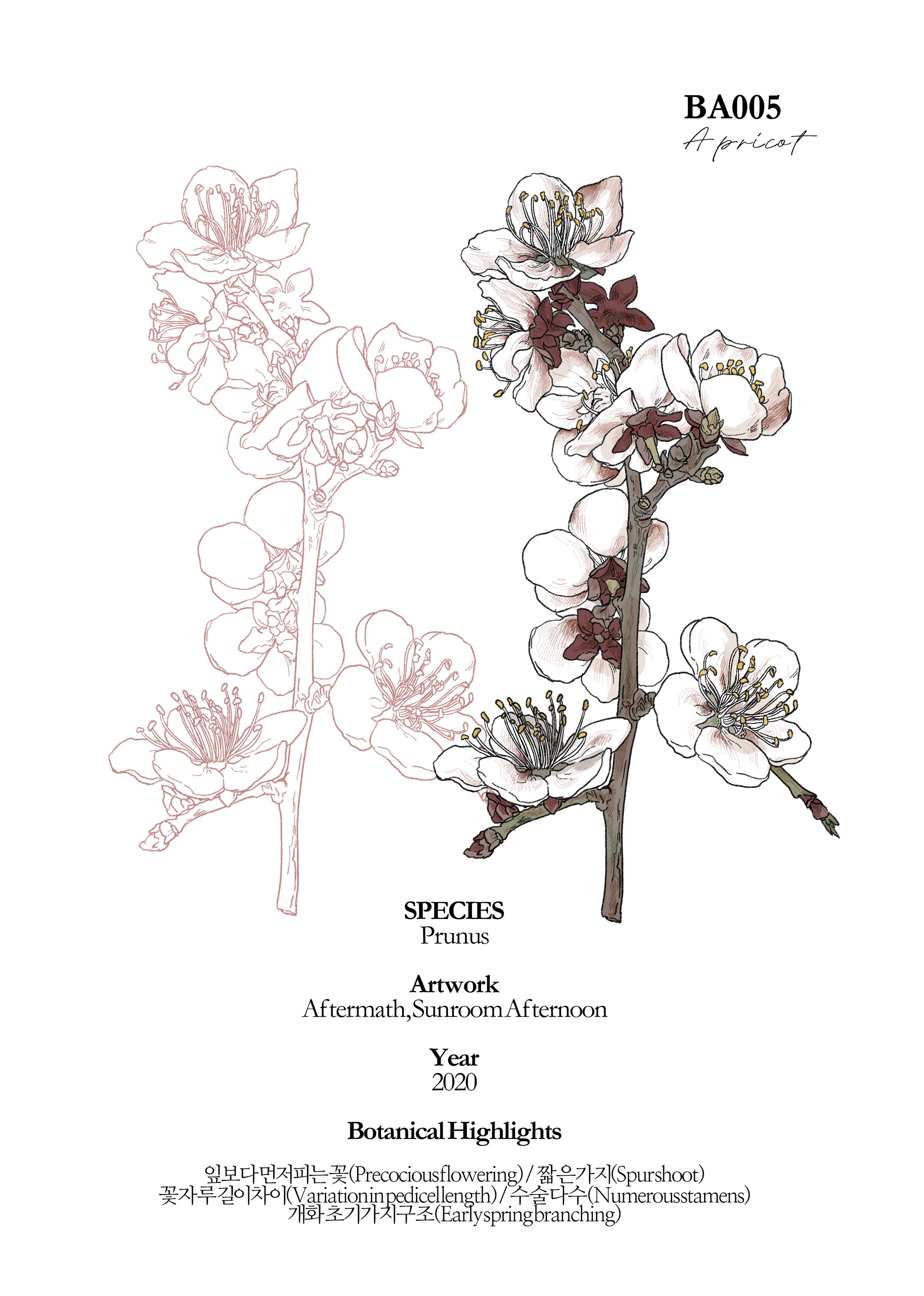
Apricot (Under I refer to Plum Blossom)
매화와 벚꽃은 동북아시아인들에게 매우 친숙한 꽃이지요. 중국과 우리나라에서는 매화가 조금 더 선비정신에 잘 부합하여 알려져 있지만, 벚꽃놀이를 한 사람들의 기록이 남아 있습니다. 매화는 겨울 끝에 가장 먼저 피는 나무 꽃이며, 절개를 상징합니다.
매화와 벚꽃은 워낙 유명한 꽃이니 별로 설명할 것이 없지만, 잘 헷갈리는 매화, 벚꽃, 살구꽃은 비교해볼만 합니다. 우선 시기를 보면, 매화가 2~3월 초에 가장 먼저 핍니다. 벚꽃은 3월 말에서 4월 초에 피고, 살구꽃은 3~4월 전후로 벚꽃과 같이 피어 많이 헷갈립니다. 비슷한 꽃 중에 배꽃은 4~5월에 피어 덜 헷갈리는데, 이 셋은 많은 사람들이 헷갈립니다.
가장 쉽게 셋을 구분할 수 있는 건 꽃자루를 살펴보는 방법입니다. 매화는 꽃자루가 거의 없이, 가지에 꽃이 딱 달라붙어 있습니다. 벚꽃은 꽃자루가 길게 떨어져 있습니다. 살구꽃은 가지에 가깝게 짧지요. 벚꽃을 보고 살구꽃을 보면, 아, 저게 벚꽃이고 저게 살구꽃이구나, 하고 바로 이해할 수 있습니다.
한편 매화의 꽃잎 끝은 둥글고 단정합니다. 벚꽃은 V자로 끝이 살짝 갈라져 있고, 살구꽃은 둥글고 크며 진한 분홍색을 띄고 있지요. 꽃받침으로 확인하는 방법도 있는데, 매화는 꽃받침이 꽃을 감싸는 형태고, 벚꽃은 꽃받침이 별모양입니다. 매화의 살구꽃의 꽃받침은 뒤로 젖혀져 왕관 모양이기도 하지요.
매화는 수술이 스프레이된 것처럼 아주 많이 피어납니다. 또 꽃이 잎보다 먼저 피고요. 늦은 눈을 맞고 나오는 설중매는 고결하고 아름답습니다. 이 매화를 그리면서 선비들의 곧은 절개를 나타내려고 많이 노력해서 가지의 각도를 정했습니다. 꽃을 그릴 때는, 관찰하는 것도 중요하지만, 어떻게 표현할 것인지 생각하는 것도 중요한 것 같습니다. 정확하고 아름답게 표현하는 것만큼 문화사를 반영하는 것도 중요하다고 생각하거든요.
Plum blossoms and cherry blossoms are among the most familiar flowers in Northeast Asia. In China and Korea, the plum blossom has traditionally been associated more strongly with the spirit of the scholar and the virtue of integrity, although historical records also remain of people enjoying cherry blossoms. The plum is one of the earliest flowering trees to bloom at the end of winter, and it has long symbolized steadfastness and moral constancy.
Plum blossoms and cherry blossoms are so well known that they hardly seem to require much explanation. Still, plum, cherry, and apricot blossoms are often confused with one another, and comparing them can be surprisingly useful.
Timing offers the first clue. Plum blossoms usually appear first, from February to early March. Cherry blossoms generally bloom from late March to early April, while apricot blossoms flower around March and April, often at nearly the same time as cherries. Pear blossoms, another somewhat similar flower, tend to bloom later, around April and May, so they are less frequently confused with the other three.
One of the easiest ways to distinguish plum, cherry, and apricot blossoms is to look at the flower stalk, or pedicel.
Plum blossoms have almost no visible pedicel, so the flowers appear to sit directly against the branch. Cherry blossoms hang away from the branch on noticeably longer stalks. Apricot blossoms also remain relatively close to the branch, with short pedicels. Once you compare a cherry blossom and an apricot blossom side by side, the difference becomes immediately clear.
The petals offer another clue. Plum petals are rounded and neat at the tips. Cherry blossom petals often have a small V-shaped notch at the end, while apricot blossoms tend to have larger, rounder petals and can show a deeper pink tone.
The calyx can also help with identification. In plum blossoms, the sepals tend to remain close around the base of the flower. In cherry blossoms, the calyx often forms a more distinctly star-like shape. Apricot blossoms are particularly recognizable because their sepals bend backward as the flower opens, creating something almost like a small crown beneath the petals.
Plum blossoms also produce numerous stamens, spreading outward almost like a fine spray. Their flowers emerge before the leaves, making the blossoms appear even more pronounced against the bare branches.
Among them, the seoljungmae—plum blossoms blooming through late snow—are especially noble and beautiful.
While drawing this plum blossom, I spent considerable time deciding the angle of each branch. I wanted the structure of the branches to suggest the upright integrity traditionally associated with scholars and the plum blossom itself.
When drawing flowers, observation is essential, but I also think it is equally important to consider how they should be represented.
To me, botanical illustration is not only about rendering a plant accurately and beautifully. It is also about understanding the cultural history that has gathered around it, and allowing some of that history to remain visible in the image.
2020-BA006 - Fuchsia
Fuchsia
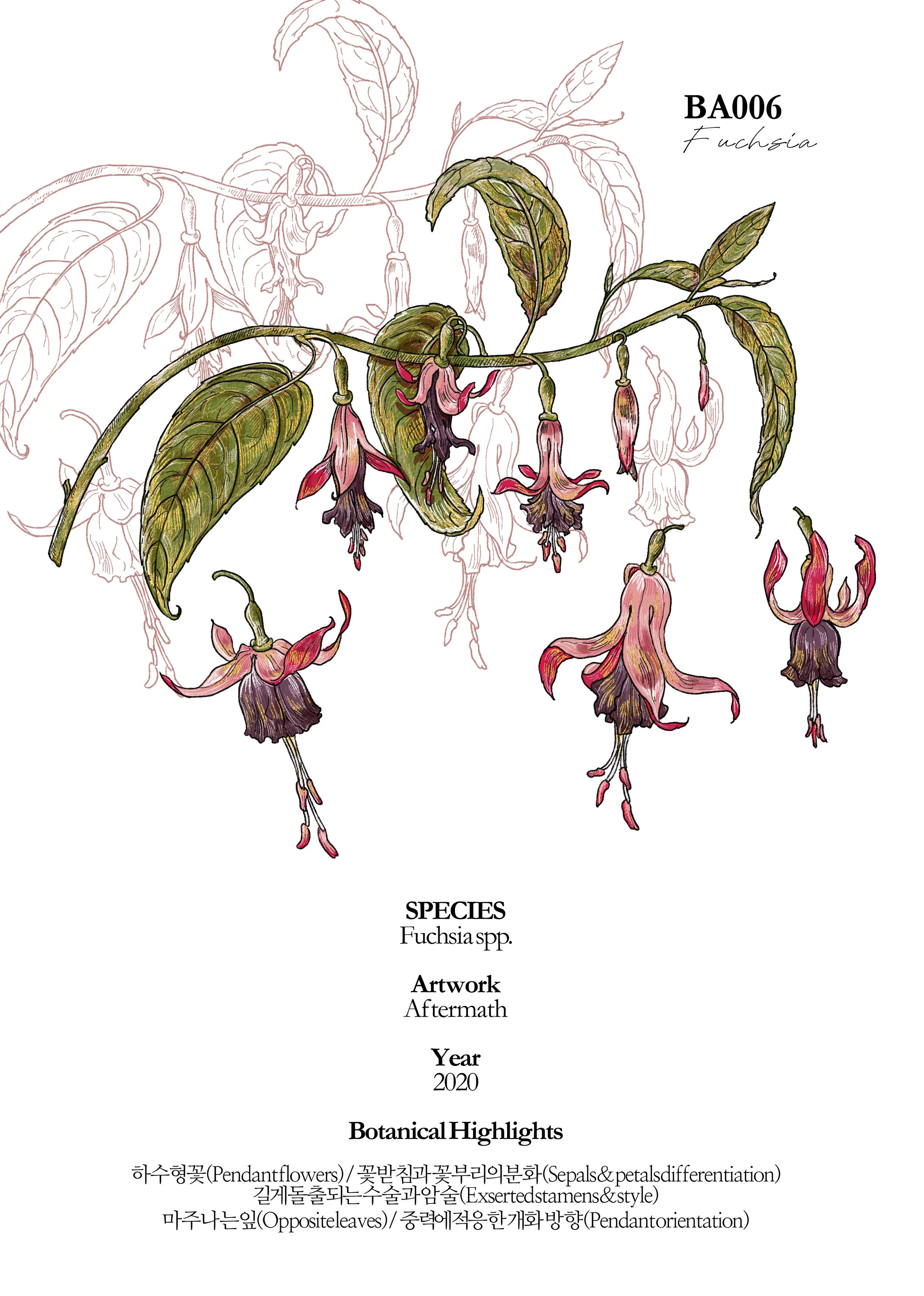
후크시아는 장식 꽃의 대표적인 예시입니다. 후크시아는 바늘꽃과에 속하는 작은 나무 꽃으로, 꽃이 아래로 처져 피는 모습이 귀걸이나 발레리나의 치마를 닮아 귀고리꽃(Lady's Eardrops)이라고 불리기도 합니다. 꽃받침과 꽃잎이 분홍, 보라, 흰색 계열의 눈에 띄는 색상을 가지고 있으며, 꽃잎처럼 보이는 것은 꽃받침입니다. 꽃받침은 긴 관 모양으로 4개로 갈라지며, 꽃잎은 그 아래로 4개가 내려오고, 수술은 8개입니다.
잎은 마주나며 달걀모양이고 가장자리에 톱니가 있습니다. 주로 남미에서 자생하며 드물게 타히티나 뉴질랜드에서도 발견됩니다. 이는 옛 지질 시대에 대륙이 연결되어있었다는 것을 뒷받침해 주는 증거로 쓰이기도 하죠. 15~25도 사이에서 잘 자라며, 무더운 환경을 버티지 못하고 과습에 취약합니다.
후크시아를 그려야겠다고 생각한 것은, 그 별명답게 귀걸이 같은 꽃을 그리고 싶다고 생각했을 때 가장 먼저 떠오른 꽃이기 때문입니다. 캐릭터 시트를 그릴 때, 화려한 꽃과 의상이 필요했거든요. 그야말로 장식적인 요소로 가장 먼저 떠오른 꽃입니다.
또, 새들 중 벌새, 제비에 심취한 시기가 있었는데, 벌새가 후크시아에서 꿀을 빠는 모습이 관련 사진에 많이 나옵니다. 서양 사람들도 이 모습이 아름답다고 생각해 많이 찍는 것 같습니다.
요정이 있다면 이런 모습이 아닐까 하는 생각을 많은 사람들이 했던 것 같습니다. 실제 꽃잎을 패션 일러스트레이션 위에 붙이는 일러스트레이션에는 후크시아가 예전부터 등장했었습니다. 패션 삽화에 어릴 때부터 보곤 했던 후크시아가 다시 그리고 싶어서 떠올렸던 기억이 납니다.
길가에서 본 꽃, 또는 선물받은 꽃에서 모양을 발견하고 다른 도상을 떠올린 적이 있나요? 하다못해 사람은 지나가는 하늘 구름에도 모양을 발견하지요. 예쁜 꽃을 보며 아름다운 개념과 연결해 본 경험이 한두번은 있지요? 어떤 대상에 연결해 보셨는지, 일상 속에서 한번 돌아봐 보아요.
Fuchsia is a classic example of an ornamental flower. It is a small woody flowering plant in the evening primrose family, and because its flowers hang downward like earrings or a ballerina’s skirt, it is sometimes called “Lady’s Eardrops.” Its sepals and petals come in striking shades of pink, purple, and white. What often appears to be the petals are actually the sepals. The calyx forms a long tube and divides into four parts, while four petals hang beneath it, accompanied by eight stamens.
The leaves grow opposite each other. They are ovate in shape, with serrated margins. Fuchsias are native mainly to South America, though they are also found more rarely in places such as Tahiti and New Zealand. This distribution has sometimes been used as supporting evidence for the idea that these landmasses were connected in ancient geological periods. Fuchsias grow best at temperatures between 15 and 25°C. They do not tolerate intense heat well and are also vulnerable to excessive moisture.
I first thought of drawing fuchsia because, true to its nickname, it was the first flower that came to mind when I wanted to draw something that looked like an earring. I needed an elaborate flower and costume elements while working on a character sheet, and fuchsia immediately came to mind as a highly decorative motif.
There was also a period when I was deeply fascinated by birds, especially hummingbirds and swallows. Photographs of hummingbirds feeding on the nectar of fuchsia flowers appear often, and I suppose many people in the West also find this combination beautiful, judging by how frequently it has been photographed.
It seems that many people have looked at fuchsia flowers and imagined that, if fairies existed, they might look something like this. Fuchsias have long appeared in fashion illustrations in which real flower petals are placed directly onto drawn garments. I remember seeing such images from a young age, and that memory was one of the reasons I wanted to draw fuchsia again.
Have you ever noticed a shape in a flower you saw by the roadside, or in one you received as a gift, and been reminded of some other image or symbol? After all, people even find familiar forms in passing clouds. Most of us have probably looked at a beautiful flower and connected it with some other beautiful idea at least once or twice.
What kinds of images, memories, or symbols have you connected with the things around you? Perhaps it is worth looking back for a moment at the associations hidden in your everyday life.
2020-BA007 - Ginkgo
Ginkgo
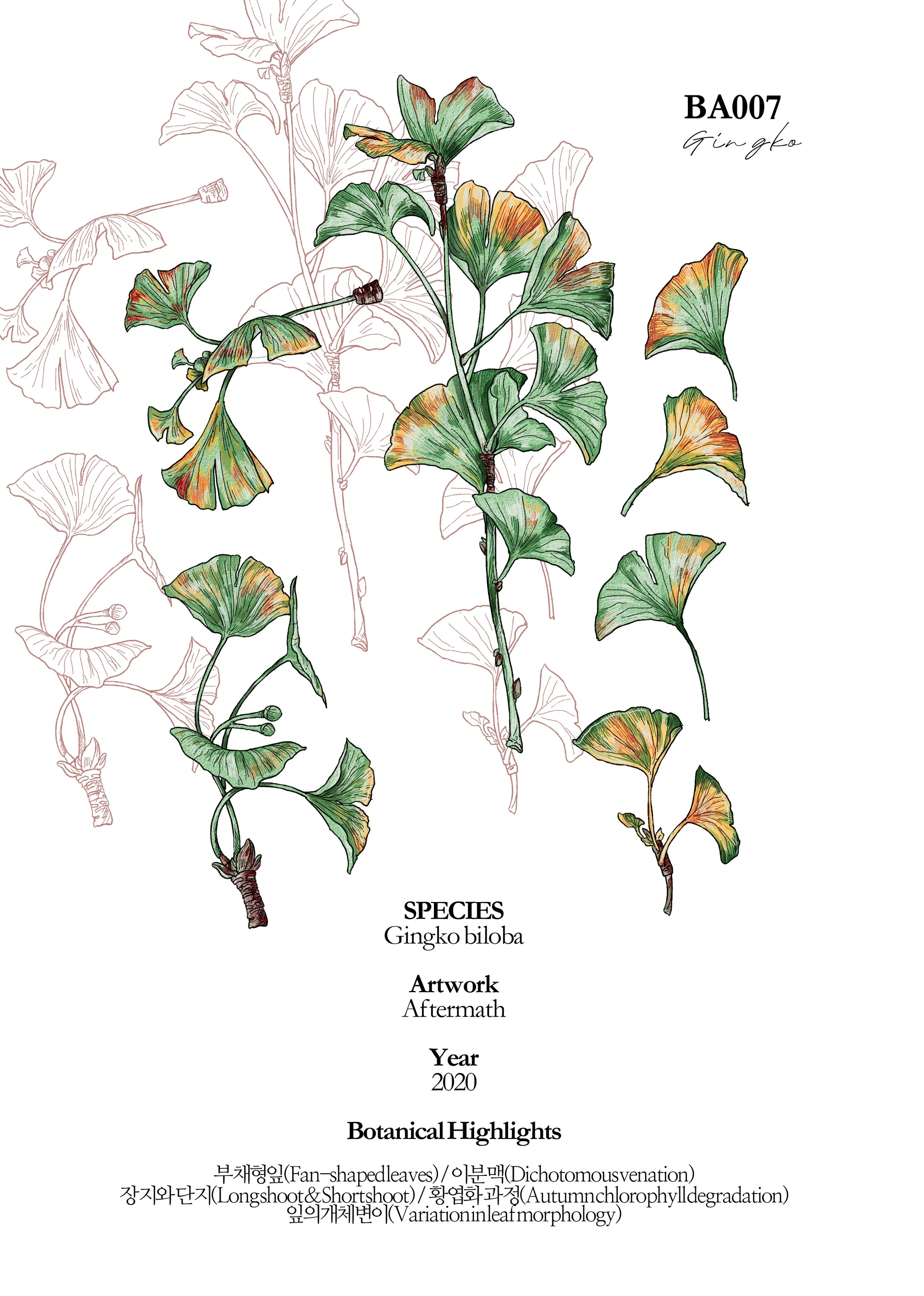
은행나무는 중국에서 퍼져나간 것으로 추정되는 낙엽큰키나무입니다. 빙하기를 살아남은 식물로, 세계에 1과 1속 1종밖에 없는 살아있는 화석이라고도 불리죠. 은행이라는 이름은 씨앗이 은처럼 희고 열매는 살구모양 가타고 하여 붙은 한자 이름입니다. 중국에서는 잎이 오리발 모양이라 하여 압각수(鴨脚樹)로 이름 붙기도 하고, 아버지가 심은 나무가 손자의 대에 가서 열매를 맺는다고 하여 공손수(公孫樹)라고도 불립니다. 많은 늙은 은행나무가 여러 전설과 얽혀 있으며 동아시아의 민속이 함께 전해져 내려오고 있습니다.
은행나무는 주로 천심(天心)을 하강시키는 신목(神木)으로 여겨져 관가 뜰에 주로 심었습니다. 관아에서 백성의 억울함을 보살피지 않고 악정을 베푸면 응징한다고도 합니다. 신목으로서 중요한 기도목이기도 했는데 전염병이 돌면 은행나무를 중심으로 기도 드려 이를 퇴치하기도 했고 아이가 없으면 자식을 내려 준다는 은행나무도 있었습니다.
또한 독성이 있어 어린아이가 열매를 먹거나 은행을 많이 먹으면 중독으로 죽고, 익혀서는 보약으로도 사용되고 있습니다. 민간에서는 진해제로 이용하기도 했고, 현재는 순환기계통의 약 원재료로도 쓰이고 있습니다. 독성이 있는 만큼 책에 넣어 두면 좀벌레가 꼬이지 않게 해 사람들이 즐겨 꼽고 있으며 벌레가 꼬이지 않는 특징을 이용해 가로수로도 심고 있습니다.
가을이 되면 단풍이 아름다워 많은 노거수 중심으로 사람들이 진풍경을 보러 오기도 합니다. 이 은행나무가 앞으로 우리와 얼마나 살 것인지, 우리가 사라진 후에도 살 것인지, 그 나이테에 지구의 얼만큼의 역사를 기록할 것인지 궁금하고, 또 자연 앞에 겸허해지는 나무이기도 합니다.
The ginkgo is a deciduous tree believed to have spread from China. Having survived the Ice Age, it is often called a “living fossil.” Today, only one family, one genus, and one species remain.
Its Korean name, eunhaeng (銀杏), means “silver apricot,” referring to the pale seed and apricot-like fruit. In China, the tree has also been called yajiaoshu (鴨脚樹), or “duck-foot tree,” after the shape of its leaves. Another name, gongsunshu (公孫樹), refers to the belief that a tree planted by one generation may not bear fruit until the generation of the grandchildren.
Many old ginkgo trees are intertwined with local legends and have carried layers of East Asian folklore through time.
Traditionally, the ginkgo was regarded as a sacred tree associated with heavenly will and was often planted in the courtyards of government offices. It was believed to punish unjust rule when officials failed to care for the suffering of the people. Some ginkgo trees also became important objects of prayer. During epidemics, people gathered around them to pray for protection, while certain trees were believed to grant children to those who had none.
The ginkgo is also a plant of contradictions. Its seeds contain toxic compounds, and eating them raw or in excessive amounts can cause poisoning, especially in children. Yet when properly prepared, they have long been used as food and medicine. In folk practice, the seeds were used as a remedy for coughs, and today the plant is also used as a medicinal ingredient related to circulation.
Because of its insect-repelling qualities, ginkgo leaves have traditionally been placed between the pages of books to protect them from pests. The same characteristic has also contributed to the tree’s widespread use along streets.
In autumn, the leaves turn a brilliant yellow, and many ancient ginkgo trees become destinations in themselves.
When I look at a ginkgo tree, I wonder how much longer it will live beside us—whether it may remain after we are gone, and how much of the Earth’s history will continue to be recorded within its rings. It is a tree that makes me feel small before nature.
2020-BA008 - Iris
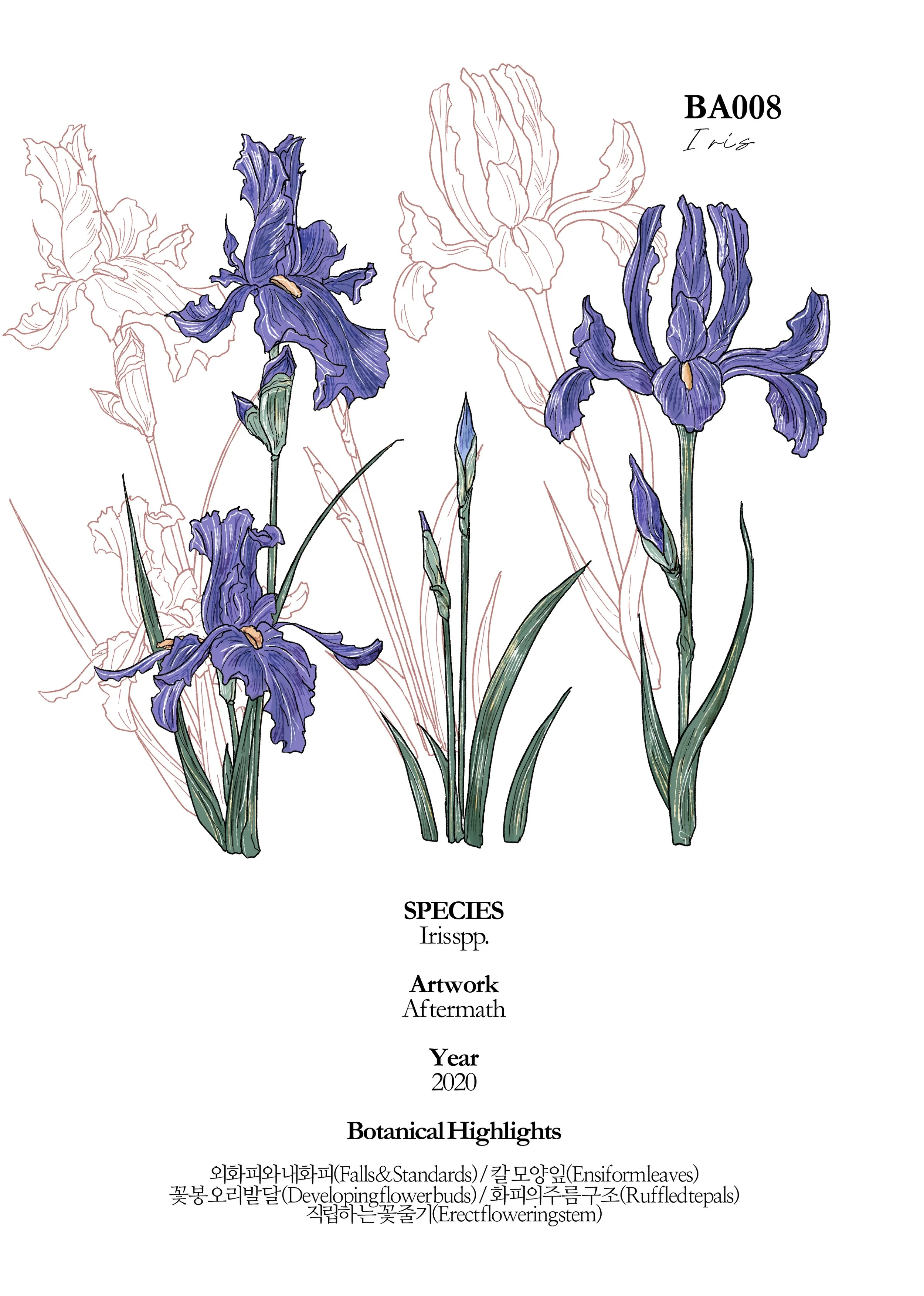
Iris
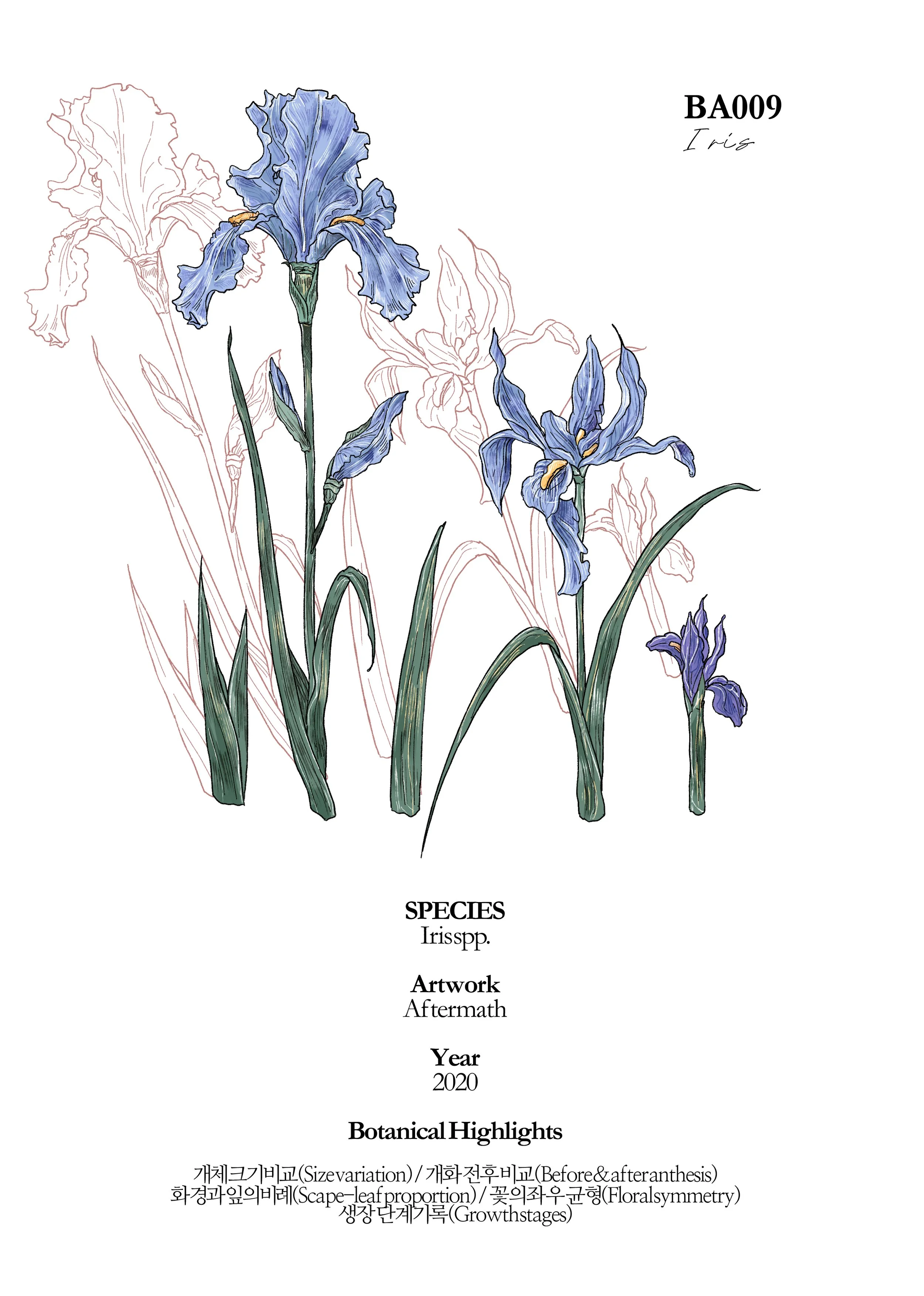
붓꽃은 여러해살이풀로, 이름은 꽃봉오리가 먹을 머금은 붓과 같다고 해서 붓꽃이라고 합니다. 잎은 난처럼 길고, 꽃은 푸른 빛을 띄는 보라색입니다. 줄기는 방패처럼 교차로 나며 곧게 뻗고, 잎은 긴 선 모양입니다. 오뉴월에 청자색 꽃이 피는데, 꽃은 하루가 지나면 시듭니다. 특이한 점은 암술대가 세 갈래로 갈라져 꽃을 화려하게 보이게 하는데, 구조를 모르는 사람이 보기에는 꽃잎과 색이 같아 구분하기 어렵습니다. 암술대 밑에 수술을 덮고 있어 청자색 '윗꽃잎'처럼 보이는 것을 들추면 노란 수술을 볼 수 있습니다.
조금 더 자세히 설명하면, 동양에서는 통칭 꽃잎과 암수술로 나누지만, 서양에서는 아래로 늘어지는 세 장의 '꽃잎'을 '꽃받침조각 sepal'로 표기하고, 'falls'라고 따로 이름을 붙입니다. 세 장의 위로 서는 '꽃잎'은 '꽃잎 petal'로 따로 표기하는 편입니다. 그 꽃잎들 사이로 암술대가 갈라져 있고, 아래에 수술이 숨어 있습니다. 서양과 표기 차이가 나서 공부할 때 헷갈리는 부분이기도 했답니다. 붓꽃류는 또한 기후에 따라 뿌리줄기(근경, rhizome)이나 구근(bulb)에서 나오는데, 보통 원예용으로 보는 '아이리스'는 구근에서 나옵니다.
원래는 곤충과의 관계를 생각하여 꽃의 구조가 이렇게 생겼습니다. 한 번 수술밥을 한 꽃에서 묻히고 나오면 꽃을 나올 때 같은 꽃의 암술에 닿지 않아 자가수분하는 일을 방지합니다. 동물이나 사람이나 자가수분 또는 근친은 유전자의 다양성을 해쳐 살아남기에 불리하기 때문에, 식물들도 이런 일을 방지하기 위한 다양한 방책을 마련하고 있습니다.
동양에서는 좀 더 매끈한 난초같은 붓꽃을 선호하고, 서양 특히 영국쪽에서는 화려하게 물결치는 꽃잎, 꽃받침을 가진 붓꽃을 원예용으로 선호합니다. 단아함과 화려함을 아우르는 다양성은 몇 가지 붓꽃 종을 개량해서 하이브리드로 만들어서 나오기도 하지요. 영미권에는 몇몇 꽃에 대한 소사이어티가 있기도 한데, 붓꽃도 그 중 하나랍니다. 붓꽃을 다양하게 보여주는 붓꽃 전용 식물원도 있고, 붓꽃 애호가들과 학자들이 모이는 소사이어티가 있지요.
이번 BA009와 이어지는 BA010에서는 붓꽃의 다양한 장식적 상을 그렸습니다. 좀 더 정확하게 구조를 볼 수 있는 버전은 BA050 이후에 추가로 그려보려 계획하고 있습니다. 동서양의 미학이 한 식물에서 완전히 정반대인 점이 굉장히 재미있습니다. 서양의 'Bearded Iris'도 찾아 보세요.
Iris is a perennial plant whose Korean name, butkkot, comes from the resemblance of its unopened flower bud to a brush dipped in ink. Its leaves are long and blade-like, similar in appearance to those of an orchid, while the flowers are typically violet with a bluish cast. The stems rise upright, with the leaves crossing one another like overlapping shields.
The flowers usually bloom from late spring to early summer, and each individual flower lasts only about a day before beginning to wither. One of the most distinctive features of the iris is its style, which divides into three broad branches and contributes greatly to the flower’s ornate appearance. Because these style branches are similar in color to the petals, they can easily be mistaken for petals by anyone unfamiliar with the structure.
Beneath each style branch lies a stamen. If you gently lift what appears to be a bluish-purple “upper petal,” the yellow anther hidden underneath becomes visible.
In a little more detail, the terminology used to describe the iris can differ between East Asian and Western botanical traditions. In Western botanical descriptions, the three downward-curving floral segments are generally identified as sepals and are often called the falls, while the three upright segments are identified as petals. Between them, the style divides into three branches, with the stamens tucked underneath.
This difference in terminology can be confusing when first studying the flower.
Irises also vary in their underground structures depending on species and climate. Some grow from rhizomes, while others emerge from bulbs. Many of the irises commonly cultivated as garden plants are bulbous types.
The structure of the flower is closely connected to its relationship with pollinating insects. When an insect enters the flower and picks up pollen from the anther, the shape and position of the floral organs help prevent that pollen from being immediately deposited on the stigma of the same flower as the insect exits. In this way, the flower reduces the likelihood of self-pollination.
Genetic diversity is important for survival, and plants have evolved many different mechanisms to reduce self-fertilization and encourage cross-pollination.
There is also an interesting aesthetic difference in the way irises have been appreciated and bred in different cultural regions. In East Asia, smoother and more restrained forms—often reminiscent of orchids—have traditionally been favored. In the West, and especially in Britain, garden irises with dramatically ruffled petals and sepals have often been preferred.
This contrast between restraint and ornament has also shaped the development of many hybrid irises, created by crossing selected species and cultivars. In English-speaking countries, certain flowers have long-standing specialist societies devoted to their cultivation and study, and the iris is one of them. There are iris gardens dedicated entirely to displaying different varieties, as well as societies that bring together enthusiasts, growers, and researchers.
In BA009 and the following BA010, I focused on several decorative interpretations of the iris rather than on a strictly structural study. A more anatomically precise version, showing the flower’s morphology in greater detail, is something I plan to revisit after BA050.
What I find especially fascinating is how differently the same plant has been appreciated in Eastern and Western aesthetics.
If you are interested, look up the Bearded Iris as well. It offers one of the clearest examples of the highly ornamental direction Western iris breeding has taken.