2021-BA010 - African Lily
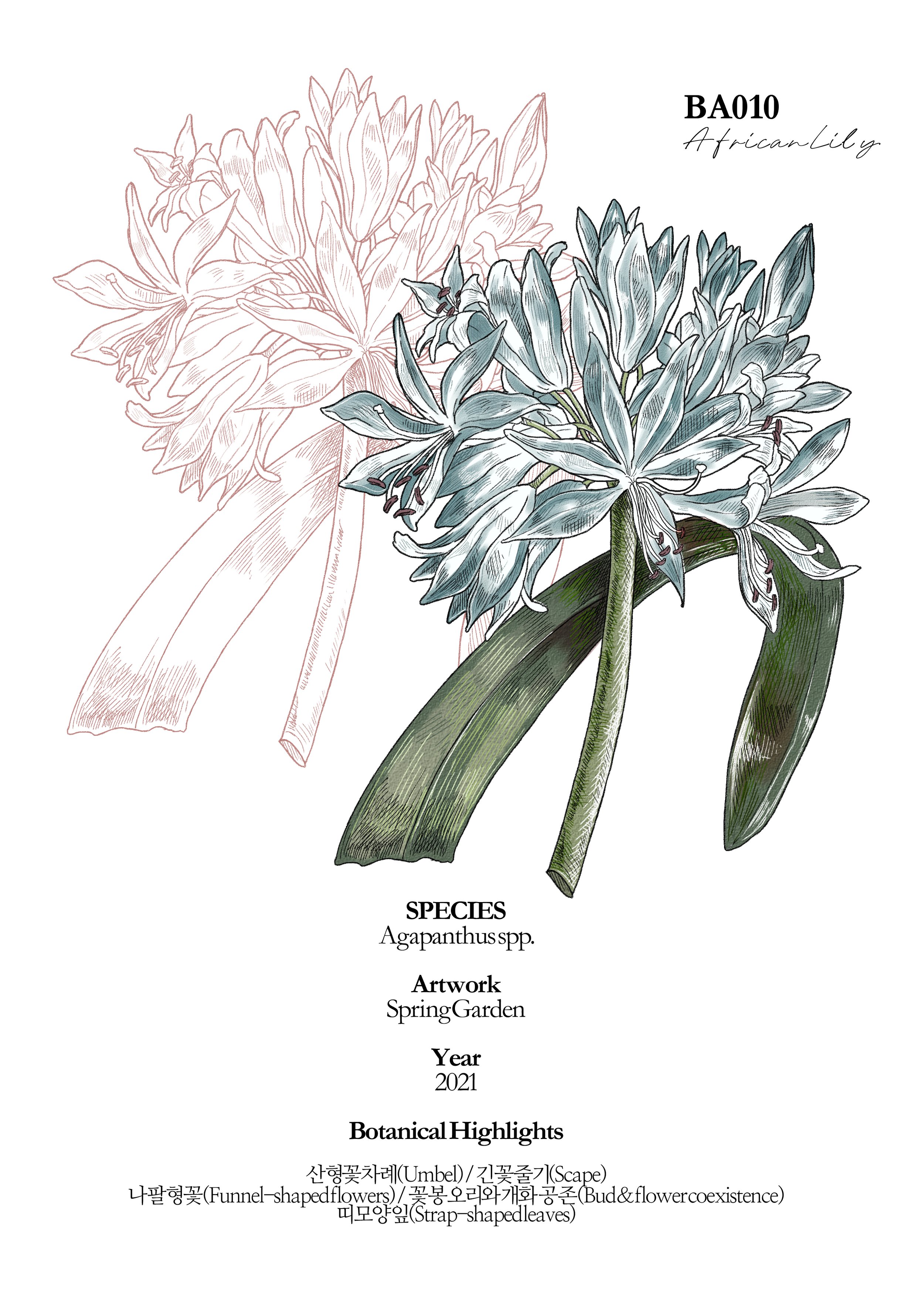
BA010 African Lily
서양 과학의 발전 속에도, 여성은 과학-이성과 대비되는 감성적 존재로 묘사되며, 남성과 똑같은 일을 해도 저평가되는 경우가 많았죠. 이 아프리칸 릴리(아가판서스)는 Google Arts의 여성 식물세밀화 작가 모음의 Henrietta Moriarty의 그림을 모사한 것입니다. 유럽에서 식물세밀화는 남성들의 경우 '전문적인, 과학적인'것으로 평가되었지만 여성들의 식물세밀화는 '취미적인, 교양의' 수준으로 평가되었었거든요. 실제로 여성의 식물세밀화가 얼마나 많은 귀중한 자료와 발견을 가져다주었는지에 비해 알고 나면, 이는 정말 모욕적인 수준입니다. 현대에서도 '보태니컬 일러스트'는 특히 한국에서는 은퇴한 어머니들의 취미 아니야?로 평가되는 경향이 있는데, 실제로 그들의 그림을 보면 깜짝 놀랄 겁니다. 여성의 작업에 대한 편견을 버려야 우리는 사회적인 지식의 발전을 이륙할 수 있습니다.
유럽에서는 대항해 시대를 거치며 서구 제국 열강이 만들어지며, 여러 식민지에서 동식물을 채집하고 표본화하면서 식물원 문화가 발달하게 되었습니다. 식물원과 온실은 식민지의 자원을 체계적으로 분류하고, 동시대의 식물학과 약학, 정원학 지식을 높이는 데 쓰였는데요. 근대 식물원의 출현은 이런 제국주의적 시각이 들어갔다 해도, 식물원 자체는 현대에까지 이어 귀중한 지식의 보고가 되었습니다. 항해를 통해 동승했던 남성 식물학자들은 식물 표본을 만들고 이를 기록했습니다. 반면 여성의 경우 집안에서 앉아 교양으로 정물화를 그리는 것이 사회적인, 명예로운 취미로 자리잡았고, 많은 여성이 식물을 그렸습니다. 여성의 경우 식물의 암수술을 그리는 것은 성기를 그리는 것으로 간주되어 성적으로 여겨져, 많은 여성이 이를 생략했는데요. 이럼에도 꿋꿋히 암수술을 포함해 식물세밀화를 그리던 여성들이 있었고, 이들의 예술은 후에 귀중한 자료가 되었습니다.
Google Arts & Culture 에는 이러한 Women Botanical Artist들을 두 편의 글로 큐레이션했습니다. 크게 네 가지 축으로 나뉘는데요, 식물만 그리지 않고 곤충, 생명의 주기, 환경을 같이 보고 그린 (1) 생태, 서사형 여성작가 Merian과 Herolt가 있었습니다. 또한 아름답고 회화적인 화면을 중시하는 (2) 회화적 작가 Dietzch, Cloquet, Moriarty가 두 번째 축입니다. 해부학적 특징, 잎맥, 꽃잎, 뿌리, 생육상태를 보여주며 (3) 과학, 식별적 그림을 그린 Blackwell, Hamilton, Howard가 있었고, 자연 상태, 장소, 시간, 개인 기억, 재배와 여행 맥락까지 포함한 (4) 현장, 기록형 작가 Hussey, Parry, Smith, Wharton sisters, Brassey 등이 있었습니다. 이 중 아프리칸 릴리는 회화적 특징이 강하게 드러나 색, 배경, 구성, 입체감을 뛰어나게 보여주는 Henrietta Moriarty의 그림을 모사했습니다. 일종의 여성 식물세밀화 작가에 대한 제 나름의 존경과 찬사랄까요?
여러 여성의 영역이 지금까지 폄하당하고 있곤 합니다. 여성의 노동과 작업의 결과가 남성들과 같거나 더 뛰어나도 폄하당하곤 하죠. 하지만 지식이라는 건 이성과 감성 모두가 필요합니다. 이성적인 것만으로 사회를 구성할 수 없는 것처럼. 아니, 애초에 이성과 감성이 성별에 따라 나뉘지도 않고요. 다양성은 생물학에서 가장 중요한 키워드입니다. 다양성이라는 것이 곧 사회의 변수를 만들어내고, 변수들이 쌓여야 발전이 이뤄지기 때문이지요. 잠시 시간을 들여 여성과 남성의 영역에서 다르게 받아들여지는 것이 무엇인지, 과연 그것이 사실인지 점검해 볼까요? 그리고 그것을 사회 전체의 다양성으로 받아들이고, 차이를 유의미하게 변환하는 건 어떨까요.
Even as Western science developed, women were often portrayed as emotional beings in opposition to science and reason. Their work was frequently undervalued even when they were doing exactly the same work as men.
This African lily, or Agapanthus, was drawn as a study after a botanical illustration by Henrietta Moriarty, whose work appears in Google Arts & Culture’s collection on women botanical artists.
In Europe, botanical illustration produced by men was often regarded as “professional” and “scientific,” while botanical work produced by women was more readily dismissed as a genteel pastime or an accomplishment cultivated for refinement. Considering how much valuable knowledge, documentation, and even discovery women botanical artists contributed, such distinctions can feel almost insulting in retrospect.
Even today, botanical illustration can sometimes be treated in Korea as little more than a hobby for retired women. Yet anyone who actually looks closely at the work produced within this field may be surprised by its extraordinary precision, patience, and depth of observation. If we continue to dismiss work simply because it has historically been associated with women, we also limit the development of our collective knowledge.
Botanical illustration, empire, and the garden
During the European Age of Exploration, expanding imperial powers collected, transported, classified, and cultivated plants and animals from territories around the world. Botanical gardens and greenhouses developed alongside these activities.
They became places where resources gathered from colonies could be systematically classified and studied, contributing to contemporary knowledge in botany, medicine, horticulture, and agriculture. The emergence of the modern botanical garden therefore cannot be separated entirely from imperial history. At the same time, botanical gardens themselves have survived into the present as invaluable repositories of living knowledge.
Male botanists who travelled on expeditions were able to collect specimens, prepare herbarium sheets, and record plants in the field.
Women, by contrast, were more often expected to remain within the domestic sphere. Drawing flowers and still lifes became one of the socially acceptable and respectable accomplishments available to them, and consequently many women developed remarkable skills in depicting plants.
There was another peculiar restriction. Depicting the stamens and pistils of flowers could be interpreted as depicting sexual organs and was therefore sometimes considered inappropriate for women. As a result, reproductive structures were omitted from some botanical illustrations made by women.
And yet there were women who continued to draw them.
They observed, recorded, and represented plants with reproductive structures intact, despite the conventions imposed upon them. Their illustrations later became valuable visual and scientific records.
Women botanical artists: four different approaches
Google Arts & Culture has curated two features introducing these women botanical artists. Looking across their practices, I found that their work could be broadly understood through four approaches.
The first is an ecological and narrative approach.
Artists such as Maria Sibylla Merian and Johanna Helena Herolt did not isolate plants from the rest of the living world. They depicted insects, stages of metamorphosis, relationships between species, and the environments in which plants existed. Their botanical images became records not simply of form, but of life unfolding through time.
The second is a more painterly approach.
Artists such as Barbara Regina Dietzsch, Lise Cloquet, and Henrietta Moriarty placed greater emphasis on colour, composition, volume, atmosphere, and the visual beauty of plants. Their work demonstrates that botanical accuracy and pictorial beauty do not need to exist in opposition to one another.
The third is a more scientific and identificatory approach.
Artists including Elizabeth Blackwell, Dame Ann Hamilton, and Lady Frances Howard recorded anatomical details such as veins, petals, roots, reproductive structures, and different stages of growth. Their images helped viewers identify and understand the plants themselves.
The fourth is what I think of as a field and archival approach.
Artists such as Anna Maria Hussey, Sarah Matilda Parry, Dorothea Eliza Smith, the Wharton sisters, and Lady Anna Brassey incorporated not only natural form but also place, time, cultivation, travel, personal memory, and the conditions in which a specimen was encountered.
For BA010, I chose to study a work by Henrietta Moriarty, whose illustrations display particularly strong painterly qualities through their handling of colour, composition, dimensionality, and botanical form.
Perhaps this drawing is my own small tribute to those women botanical artists.
Knowledge requires more than one way of seeing
Many areas historically associated with women continue to be undervalued.
Women’s labour and creative work can still be dismissed even when the results equal—or surpass—those produced by men. But knowledge does not develop through reason alone. It also depends on sensitivity, observation, intuition, memory, and the ability to notice relationships that others may overlook.
And, of course, reason and emotion were never divided neatly according to gender in the first place.
In biology, diversity is one of the most important conditions for resilience and development. Diversity creates variation. Variation creates possibilities. And when enough possibilities accumulate, adaptation and development become possible.
Perhaps we might take a moment to examine the things we still perceive differently depending on whether they belong to the sphere of women or men.
Are those differences really inherent?
Or have we simply learned to see them that way?
What might happen if, instead of ranking those differences, we recognised them as part of the diversity of knowledge itself—and learned to transform difference into something meaningful?
2021-BA011 - Belladonna
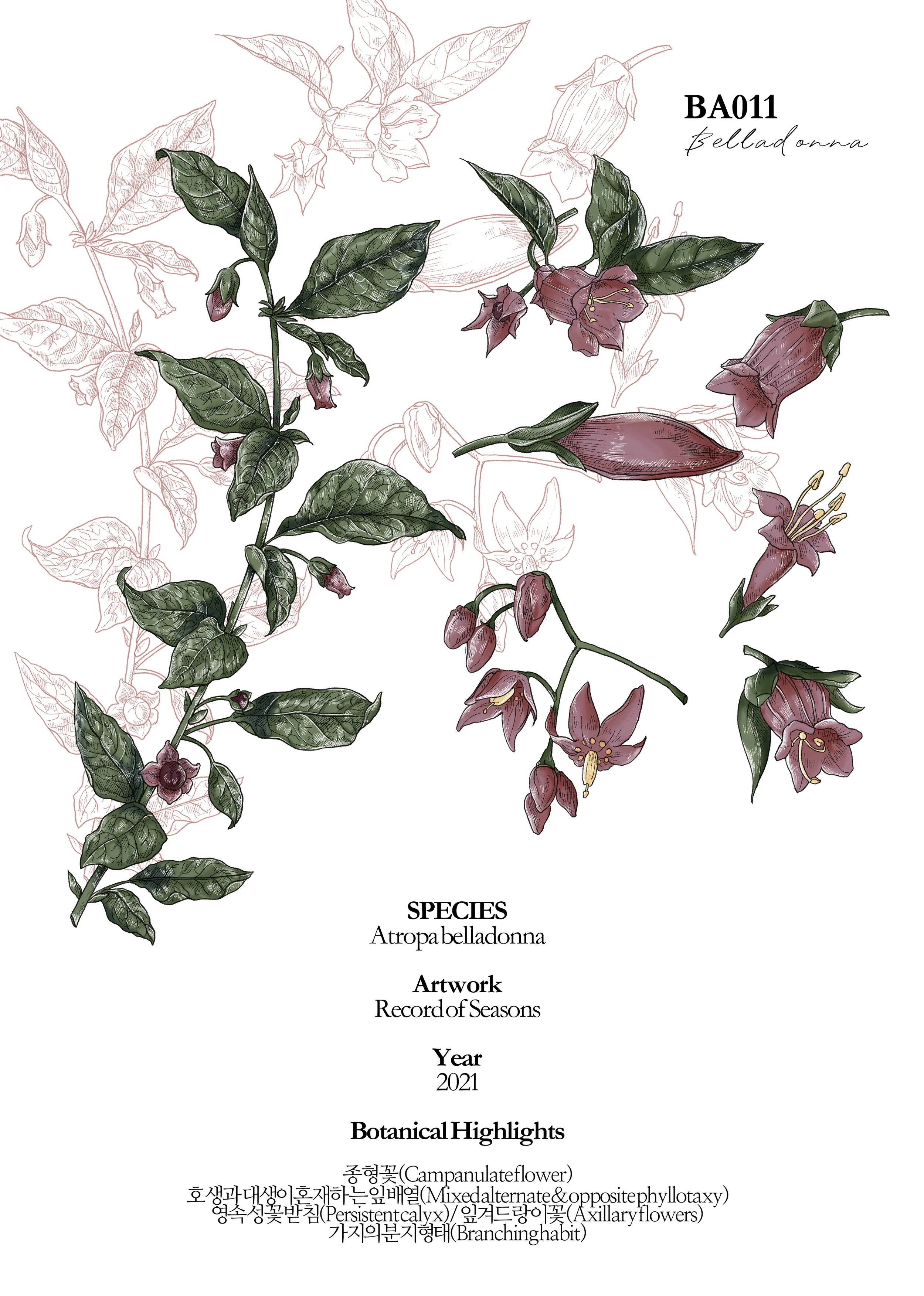
BA011 Belladonna
독과 약은 종이 한 장의 양면과 같습니다. 이번 Botanical Archive에서 다룰 식물은 그 문장을 가장 잘 보여주는 예 중 하나인 벨라도나입니다.
벨라도나는 가지과(Solanaceae)에 속하는 여러해살이 초본 식물로, 오래전부터 약용·화장·중독성 물질·독약 등 서로 상반된 용도로 사용되어 왔습니다. 이 식물의 이름부터 이미 그런 이중성을 품고 있습니다. Belladonna는 이탈리아어로 ‘아름다운 여인’이라는 뜻이지만, 영어권에서는 동시에 Deadly Nightshade라는 이름으로도 잘 알려져 있습니다.
잎과 열매에는 아트로핀(atropine), 스코폴라민(scopolamine)과 같은 트로판 알칼로이드가 포함되어 있습니다. 이 성분들은 과량 섭취할 경우 섬망, 환각, 심박수 증가, 심각한 중독을 일으킬 수 있습니다. 그러나 흥미롭게도 바로 그 성분들이, 용량과 사용법을 정확히 통제했을 때는 의약 성분으로도 사용됩니다. 결국 벨라도나는 늘 한 경계 위에 있습니다. 독약과 약, 위험과 유용성의 차이는 때로 물질 자체가 아니라 용량과 사용 방식에서 갈립니다.
학명인 Atropa belladonna 역시 이 식물의 성격을 잘 보여줍니다. 속명 Atropa는 고대 그리스 신화의 운명의 세 여신, 모이라이(Moirai) 가운데 한 명인 아트로포스(Atropos)에서 유래합니다. 아트로포스는 인간의 수명을 상징하는 실을 끊는 여신입니다. 즉, 학명 자체에 이미 죽음과 치명성의 이미지가 담겨 있는 셈입니다.
벨라도나는 가지과 식물입니다. 가지과에는 우리가 매우 익숙하게 사용하는 식물들이 많습니다. 감자, 토마토, 가지, 고추, 담배 등이 모두 같은 과에 속합니다. 가지과 식물들은 꽃과 열매의 구조에서 닮은 점이 많습니다. 많은 종류가 다섯 갈래로 갈라진 합생화관을 가지며, 둥글거나 타원형의 열매를 맺습니다. 이 때문에 같은 과의 식물들은 외형적으로 서로 비슷하게 보이기도 하고, 경험이 적은 경우 식용 가능한 종과 독성이 있는 종을 혼동할 위험도 있습니다. 우리나라에서 흔히 볼 수 있는 까마중이나, 텃밭에서 자주 마주치는 고추와도 어떤 형태적 유사성이 있습니다.
유럽에서 가지과 식물들이 오랫동안 낯설고 위험한 식물군으로 인식되었던 배경에는, 벨라도나처럼 강한 독성을 가진 식물의 존재도 어느 정도 영향을 주었을 가능성이 있습니다. 오늘날 너무나 익숙한 토마토와 감자조차 유럽에 처음 소개되었을 때는 오랫동안 경계의 대상이었습니다.
르네상스 시기에는 벨라도나가 미용 목적으로도 사용되었습니다. 당시 일부 여성들은 벨라도나 성분이 들어간 액체를 안약처럼 사용해 동공을 크게 만들었다고 전해집니다. 동공이 커지면 눈이 더 크고 깊어 보였고, 그것이 당시의 미적 기준에서 매력적으로 여겨졌기 때문입니다. ‘아름다운 여인’이라는 의미의 belladonna라는 이름도 이 이야기와 자주 연결됩니다. 하지만 이런 사용은 결코 안전하지 않았습니다. 동공을 확장시키는 작용은 시야를 흐리게 만들고, 심한 경우 시력 손상이나 전신 중독으로 이어질 수 있었습니다.
벨라도나라는 식물에는 그래서 늘 하나의 모순이 따라다닙니다. 아름다움을 위해 사용되었지만 몸을 해칠 수 있고, 강한 독성을 가졌지만 동시에 약이 될 수도 있습니다.
벨라도나는 종 모양의 어두운 자주색 꽃을 피웁니다. 꽃부리는 대개 다섯 갈래로 나뉘며, 이후에는 광택이 나는 짙은 자주색 또는 검은색 열매를 맺습니다. 겉모습 자체는 아주 화려한 편은 아닙니다. 오히려 차분하고 그늘진 인상을 주며, 열매 역시 장식적인 느낌을 줄 수 있습니다. 아마 그래서 더 위험하게 느껴지는지도 모릅니다. 외형만으로는 그 안에 무엇이 들어 있는지 쉽게 알 수 없기 때문입니다.
이런 특성 때문에 벨라도나는 서양 문학과 시각문화에서 오랫동안 죽음, 유혹, 위험, 금지된 지식을 암시하는 식물로 자주 등장해왔습니다. 그 이미지가 동아시아로 전해진 뒤에는 한국과 일본의 서양풍 순정만화, 고딕풍 일러스트레이션 등에서도 ‘치명적인 아름다움’을 상징하는 식물로 반복해서 등장합니다.
예쁜 꽃이라고 안전한 것은 아니고, 독성을 가진 물질이라고 언제나 해로운 것만도 아닙니다. 하나의 성분은 사람을 해칠 수도 있고, 정확하게 다뤄질 때는 치료에 쓰일 수도 있습니다. 벨라도나는 그런 모순을 한 식물 안에 동시에 품고 있습니다.
아름다움과 위험. 독과 약. 매혹과 죽음.
Atropa belladonna는 우리에게
‘유익한 것’과 ‘해로운 것’의 경계가 때로 얼마나 얇은지를 보여주는 식물입니다.
Poison and medicine can be two sides of the same coin. Few plants illustrate this more clearly than Atropa belladonna.
Belladonna is a perennial herbaceous plant in the nightshade family, Solanaceae. For centuries, it has occupied an unstable boundary between medicine, cosmetics, intoxicants, and poison. Its common name, belladonna, comes from the Italian for “beautiful woman.” Yet the same plant is also known as deadly nightshade—a contrast that already suggests the double nature of its history.
In antiquity, extracts of belladonna were reportedly used as poisons, including on weapons and in political or domestic poisoning. Its leaves and berries contain tropane alkaloids such as atropine and scopolamine, substances that can cause delirium, hallucinations, rapid heartbeat, and severe poisoning.
And yet these same chemical compounds also became medically useful. Derived and controlled in precise doses, belladonna alkaloids have been used for their anticholinergic effects. A substance capable of poisoning the body can, under carefully controlled conditions, also become medicine.
Belladonna therefore exists at a fascinating threshold: poison, drug, and remedy are separated not always by the substance itself, but by dose, preparation, and context.
Even its scientific name carries a sense of danger. The genus name Atropa refers to Atropos, one of the three Moirai—the Fates of ancient Greek mythology. Atropos was the one who cut the thread of life. The reference makes the plant’s lethal reputation visible even within its botanical name.
Belladonna belongs to the Solanaceae, the nightshade family. This family contains many plants deeply embedded in human life: potatoes, tomatoes, eggplants, peppers, tobacco, and many others. Members of the Solanaceae often share recognizable floral structures. Many have flowers with a fused, five-lobed corolla and berries that can appear remarkably similar across related species. This resemblance can be dangerous. Edible and toxic nightshades may sometimes look deceptively alike to an inexperienced observer, particularly when fruiting. Familiar plants such as black nightshade and cultivated peppers can share aspects of form with their more toxic relatives.
The long history of European suspicion toward members of the nightshade family may also have been reinforced by notorious poisonous species such as belladonna. Tomatoes and potatoes, now ordinary foods, were once regarded with considerable uncertainty after their introduction to Europe.
During the Renaissance, belladonna acquired another famous—and dangerous—use. Women are said to have used preparations containing belladonna as eye drops to dilate their pupils, making the eyes appear larger and, according to the beauty ideals of the time, more attractive. This practice is often connected to the name bella donna, “beautiful woman.” But the effect came at a cost. The same pharmacological action that enlarged the pupils could impair vision and cause serious systemic poisoning. What was used to create beauty could also damage the body.
This contradiction follows belladonna wherever it appears. It is beautiful, medicinal, intoxicating, and lethal at once. Accidental poisoning has also contributed to its dark reputation. Its glossy black berries can look attractive, especially to children, despite containing potentially dangerous levels of toxic alkaloids.
Botanically, belladonna produces bell-shaped, dusky purple flowers, usually divided into five lobes. These later give way to glossy berries that mature to a deep purple-black. Its appearance is not flamboyant. The flowers are muted, almost shadowed, and the dark fruits seem quietly ornamental. Perhaps this visual restraint makes the plant even more unsettling: nothing in its appearance fully announces the severity of what it contains.
For this reason, belladonna has appeared repeatedly in Western literature and visual culture as a symbol or foreshadowing of death, danger, seduction, and forbidden knowledge. Its imagery also travelled into East Asian popular culture. In Korea and Japan, belladonna often appears in Western-inspired romantic illustration, comics, and gothic visual language as a flower associated with fatal beauty.
It is a plant that makes contradiction visible. A beautiful flower that carries poison. A poison that becomes medicine. A substance once used to alter beauty that could also destroy sight.
Atropa belladonna reminds us that categories such as “harmful” and “beneficial” are sometimes less stable than they appear. In nature, the boundary between poison and medicine can be extraordinarily thin.
2021-BA012 - Campsis
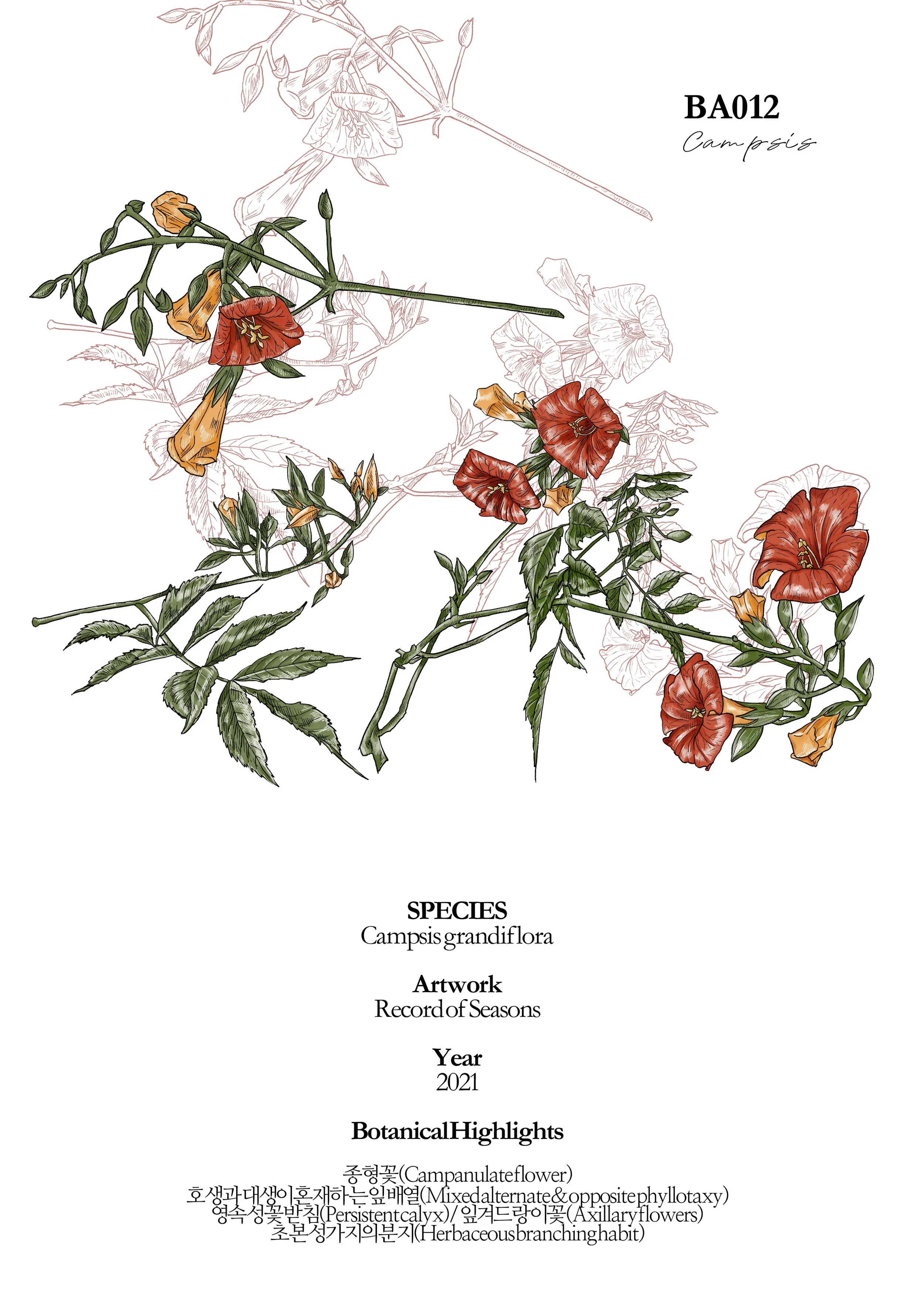
BA012 Campsis
능소화는 독특한 한자이름을 갖고 있는 식물입니다. '업신여길 능', '하늘 소'를 쓰는 꽃, 즉 하늘을 업신여기는 꽃이라는 뜻을 갖고 있는데요. 덩굴성 식물인 능소화가 나무에 달라붙어 하늘을 향해 높게 오르기에, 이름이 유래되었습니다.
또다른 해석으로는 - 능소화는 7월~9월에 피는 꽃으로, 만개 시기는 한여름인 8월입니다. 8월은 장마와 태풍, 푹푹 찌는 더위가 도사리고 있는 달 - 자라나는 식물에게 저주와도 같은 시기이죠. 하지만 능소화는 장마와 태풍을 견뎌내고, 궂은 날씨를 퍼붓는 하늘을 업신여기듯 피어납니다. 아무리 고난을 주어도, 피어나고 만다는 능소화의 이름이 퍽 도드라집니다.
능소화는 2020년대에 들어 한국에서는 여름의 대표 꽃으로 자리잡았습니다. 2010년대라면 수국이 위치하고 있을 포지션인데요. 대중가요 '능소화'도 인기에 한 몫 했을 것이고, 능소화의 매력을 느낀 다양한 사진작가, 에세이 작가들의 사랑도 한몫했을 것으로 추정합니다. 오래된 주택이나 아파트 담장을 올라가는 능소화가 여름이 되면 자주 SNS에 올라옵니다.
이 그림에서 저는 조금의 변주를 주었는데요. 보통 한국에서 능소화를 그리면 만개한 모습, 둥글둥글한 꽃잎을 그리기 마련입니다. 하지만 저는 능소화가 지기 직전에 접히는 꽃잎을 그려, 날카롭고 직선적인 느낌을 강조했습니다. 능소화를 관념적으로만 접한 작가들은 둥글둥글한 능소화만 그립니다. 하지만 능소화가 피고 지는 모습까지 끝까지 보는 입장에서, 능소화는 둥글둥글한 때보다 아닐 때가 더 많습니다.
꽃의 만개를 보는 사람은 많습니다. 하지만 꽃이 스러지는 모습까지 기억하는 사람은 드뭅니다. 마지막을 함께 해 주는 사람이 당신을 더 다양하게 기억할 수 있습니다. 꽃도 마찬가지입니다.
Campsis has a distinctive Korean name written with the Chinese characters 凌霄花.
The characters can be read as “to defy” and “the sky,” giving the flower the poetic meaning of a flower that defies the heavens.
The name is thought to come from the way this climbing plant clings to walls and trees, rising steadily upward toward the sky.
There is another interpretation I find especially compelling.
Campsis flowers from July through September, with its peak bloom in August. In Korea, August is a month of monsoon rain, typhoons, heavy humidity, and relentless heat — conditions that can feel almost hostile to growing plants. And yet Campsis continues to climb and bloom through them.
No matter how harsh the weather becomes, it flowers anyway.
Perhaps that is why the name feels so striking: a flower that seems almost to look up at the stormy sky and refuse to submit.
In Korea, Campsis has gradually become one of the flowers most strongly associated with summer in the 2020s. A decade earlier, hydrangeas may have occupied that position more clearly. Popular songs, photography, essays, and the familiar sight of Campsis climbing the walls of old houses and apartment complexes have all contributed to its growing cultural presence. Every summer, images of its orange flowers appear repeatedly across social media.
In this drawing, however, I wanted to shift away from the usual image of Campsis.
When Campsis is illustrated in Korea, it is often shown in full bloom, with soft and rounded petals. Instead, I focused on the moment just before the flower falls, when the petals begin to fold inward and the shape becomes sharper and more linear.
Artists who encounter Campsis only as an idea often paint only its rounded, fully opened form.
But when you watch the flower from blooming to fading, you realize that it does not remain soft and round for very long.
Many people remember a flower at its fullest bloom.
Far fewer remember the way it disappears.
The person who stays until the end can remember you in more than one form.
Flowers are the same.
2021-BA013 - Commelina
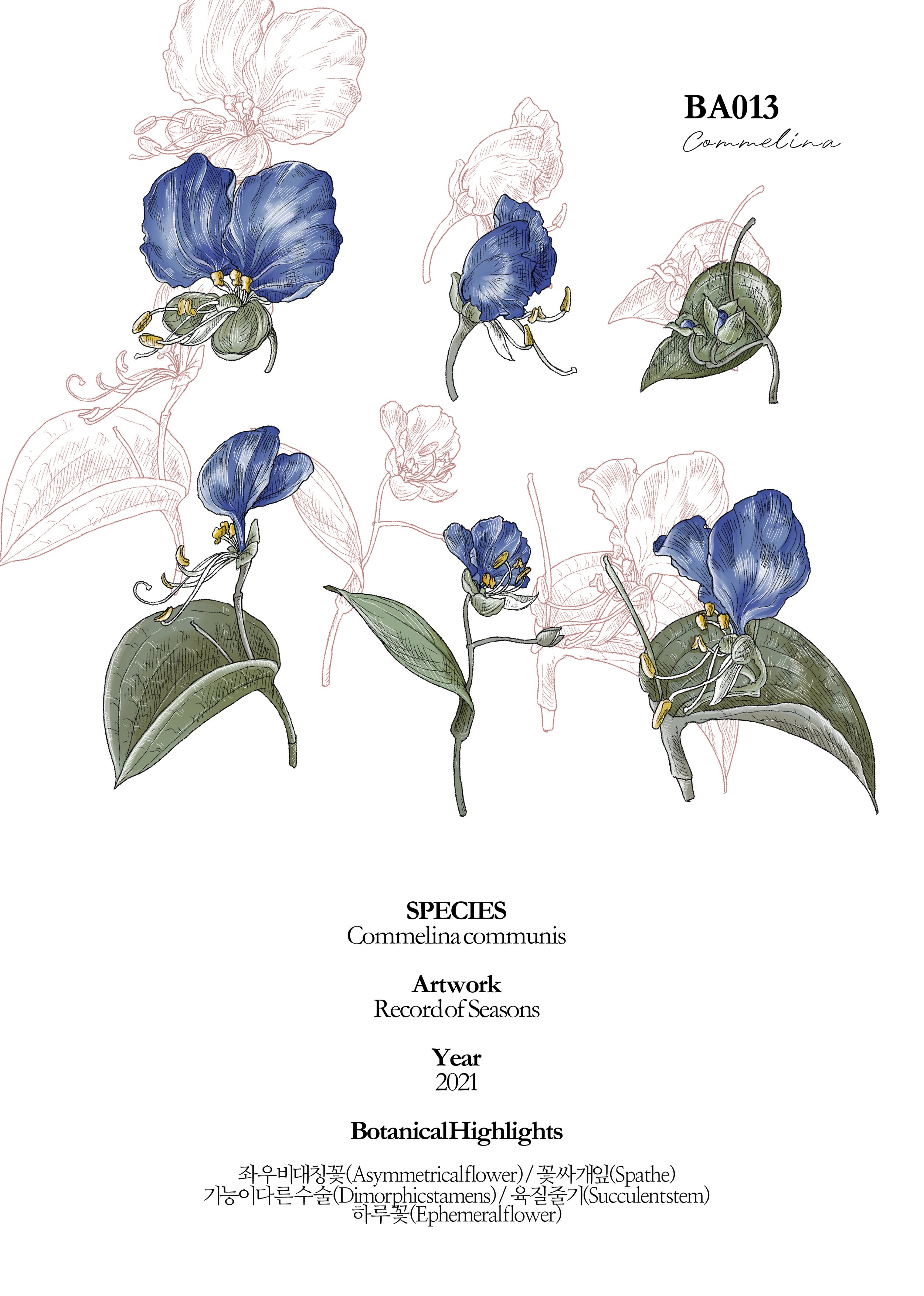
BA013 Commelina
닭의장풀은 닭의장풀과의 한해살이풀로, 달개비라고도 많이 부릅니다. 닭의장풀과의 모식종(type species)으로, 과를 대표합니다. 아시아권(중국, 한국, 일본, 대만, 동남아와 극동 러시아권...)에서는 약재로도 쓰이고, 염료를 얻기 위해 가공하기도 했습니다. 줄기는 가로로 뻗으며 많은 가지로 뻗어 있어, 아파트의 벽과 난간, 계단을 자주 가로질러 오르기도 합니다. 6월에서 9월경에 다소 반원형으로 접힌 포엽 속에서 1개씩의 청색 꽃이 피어나는데, 이 꽃들은 하루가 지나면 금세 시들어버립니다.
한편, 꽃잎 중에서 2개는 크고 청색인데 다른 하나는 작고 흰색입니다. 완전한 수술은 2개이고 길며, 다른 4개(가운데 1, 청색 꽃잎쪽에 붙은 3개)는 헛수술입니다. 매우 독특한 구조를 갖고 있어, 그리게 되었습니다. 곤충들에게 눈에 띄기 위해 이런 독특한 구조를 가지게 되었는데 - 헛수술, 헛꽃잎, 헛꽃받침처럼 기능을 하지 않으나 눈에 띄기 위한 기관들을 가지는 식물들도 많답니다. 닭의장풀의 헛수술도 생존 기작 중의 하나지요.
일본에서는 우키요에 미술품의 청색 염료를 채취하기 위해 쓰이기도 했습니다. 하지만 근대에 와서는 프러시안 블루 염료로 대체된 경우가 많아, 달개비는 점차 '잡초'로 불리게 되었습니다.
달개비를 그리게 된 계기는 '잡초'를 그려보자는 생각에서 시작되었어요. 지인 중 '잡초'만을 연구하는 지인이 있는데, 환영받지 못하는 식물들을 연구하더라고요. 쓰임이 있고 없고는 식물의 몫보다는 사람들이 어디까지 식물의 진실을 발견하느냐에 달렸다고 생각하는데, 달개비에 대해 과거에는 쓰임이 있었으나 현대에는 대체되거나 큰 쓰임이 없어 잡초로 분류되는 것에 애달픔을 느끼기도 했습니다. 분명 곤충을 유인하기 위한 기작 - 독특한 수술의 형성과 배치에서도 많은 식물학자들이 놀라워했던 과거를 두고, 특히 아시아권에는 - 한국에서는 특히, 아파트 안의 흔한 동네 꽃으로 여겨집니다. 하지만 달개비를 들여다본 적이 있으신가요? 이처럼 흔한 꽃인데도, 달개비를 확대해 보여주면 처음 본다는 사람이 많습니다. 때로는 가장 흔한 것이 경이를 일으킨다는 점, 잊지 말고 주위의 '잡초들'도 살펴보시길 바랍니다.
Commelina is an annual herb in the family Commelinaceae, and in Korea it is also commonly known as dalgaebi. As the type species of the genus Commelina, it stands as one of the representative plants of the family.
Across many parts of Asia — including China, Korea, Japan, Taiwan, Southeast Asia, and the Russian Far East — Commelina has long been used medicinally and has also been processed as a source of blue dye. Its stems spread horizontally and branch freely, often creeping across apartment walls, railings, stairways, and other edges of the built environment.
From around June to September, a single blue flower emerges from a somewhat folded, semicircular bract. Each flower is remarkably short-lived, usually withering within a day.
Its floral structure is especially distinctive. Two of the petals are large and blue, while the third is much smaller and white. There are two long, fully fertile stamens, while the remaining four — one at the center and three positioned near the blue petals — are staminodes, or sterile stamens.
This unusual structure was one of the reasons I wanted to draw the plant.
The flower appears to have developed these conspicuous structures in part to attract the attention of pollinators. Many plants possess organs that no longer perform the function their name might suggest, yet remain visually prominent — structures such as staminodes, petaloid organs, or modified sepals. The staminodes of Commelina are one such example: organs that contribute not directly through fertility, but through visibility, and therefore through survival.
In Japan, Commelina was also used historically as a source of blue pigment for ukiyo-e printing. In later periods, however, it was increasingly replaced by synthetic pigments such as Prussian blue. As its practical value diminished, the plant itself gradually came to be regarded more often simply as a “weed.”
My decision to draw Commelina began with a simple thought: I wanted to draw a weed.
I know someone who studies only plants that are generally classified as weeds — plants that are rarely welcomed, cultivated, or admired. Watching that work made me think about the fact that whether a plant is considered useful or useless may depend less on the plant itself than on how much of its reality people have chosen to notice.
Commelina was once used as medicine and as a dye plant. In the present day, many of those uses have either disappeared or been replaced, and the plant is now often dismissed as something ordinary, expendable, or unwanted.
There is something quietly sad about that shift.
Its strange floral structure — especially the formation and arrangement of its fertile stamens and staminodes — once drew the attention of botanists precisely because of how unusual and sophisticated it was. Yet today, particularly in Korea, Commelina is often treated as nothing more than a familiar neighborhood flower growing between apartment buildings and along walls.
But have you ever really looked at one?
It is such a common flower, and yet when I show people an enlarged image of Commelina, many say they feel as though they are seeing it for the first time.
Sometimes, the most ordinary things are the ones most capable of producing wonder.
So I hope you will not forget to look closely at the “weeds” around you as well.