
Records of Flora No. 001
Hello,
This is SALEIGN'S LAIR, where botanical observations, philosophy, and illustration come together through the changing seasons.
While redesigning my website, I decided to bring over The Flower Journal, a series originally published on my Korean Naver blog.
I have always enjoyed observing plants and writing about them. Although I majored in Philosophy, I also studied Life Sciences with a focus on Plant Taxonomy. Several readers once suggested that, since flowers appear throughout my illustrations, I should share not only the artworks and products they inspired, but also the botanical stories behind them.
Flowers appear everywhere in my work. Rather than wild species hidden deep in the mountains, I am often drawn to cultivated plants that quietly accompany everyday life in the city—those growing beside pavements, traffic lights, apartment gardens, and public flower beds.
Because these plants belong to the rhythm of the seasons, I imagined this archive as a record that would bloom alongside them.
This first entry, Brisk Magnolia, was originally written for Arbor Day in Korea and shares its name with the principal design of my Early Spring memo pad series.
The original essay was published on 2 April 2022, just as magnolia buds were beginning to open. The photographs, however, were taken three years earlier, on 23 March 2019, after I found a freshly pruned magnolia branch near my home and brought it back to study.
The Arrival of Spring
How do you remember spring?
Or perhaps, a better question is: how do you reconstruct it?
Do you count the days on a calendar? Do you know spring has arrived when new stationery appears in shop windows, or when the weather finally rises above freezing?
For me, spring begins with flowers.
Climate change has gradually altered flowering seasons, and the traditional order of blooming has become less predictable. Yet before flowers appear, the world still feels like winter. The first blossoms quietly announce that another season has begun.
Although the earliest flowers around me are technically those of the boxwood, I rarely noticed them. Instead, the flowers that have always signalled spring in my own memory are winter jasmine, forsythia, plum blossom, magnolia, cherry blossom, Korean azalea, pear blossom, and bridal wreath spirea.
Today these flowers often bloom together, their seasons overlapping more than they once did.
People occasionally ask why I call this illustration Brisk Magnolia.
My answer is simple.
The wind is still cold when magnolias bloom.
Their petals appear soft, almost creamy in texture, yet I have always associated them with the sharp air of early spring, when coats are still necessary.
An Ancient Flowering Lineage
Magnolias belong to one of the oldest surviving lineages of flowering plants.
Unlike gymnosperms such as pines, magnolias are angiosperms—flowering plants whose seeds develop inside an ovary. Yet within the evolutionary history of flowering plants, magnolias remain remarkably ancient, preserving characteristics that appeared near the beginning of angiosperm evolution.
If you observe a magnolia carefully, many of these ancestral traits become visible.
Its leaves are arranged alternately rather than in opposite pairs. Their margins are smooth, lacking the serrated edges seen in roses. During winter, the flower buds remain wrapped in soft stipules that protect the developing bloom.
Many people believe magnolia flowers have nine petals.
Botanically speaking, however, they consist of three sepals and six petals. Because both look almost identical, distinguishing between them at first glance is surprisingly difficult.
Inside a Magnolia Flower
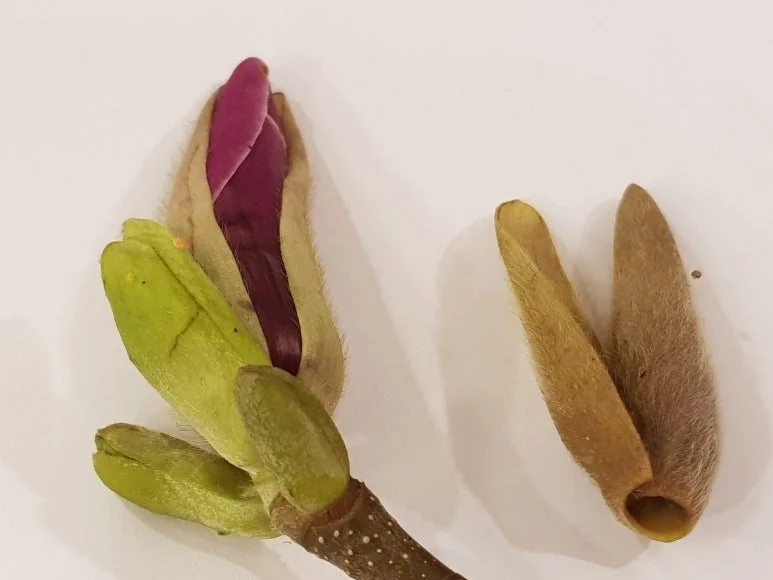
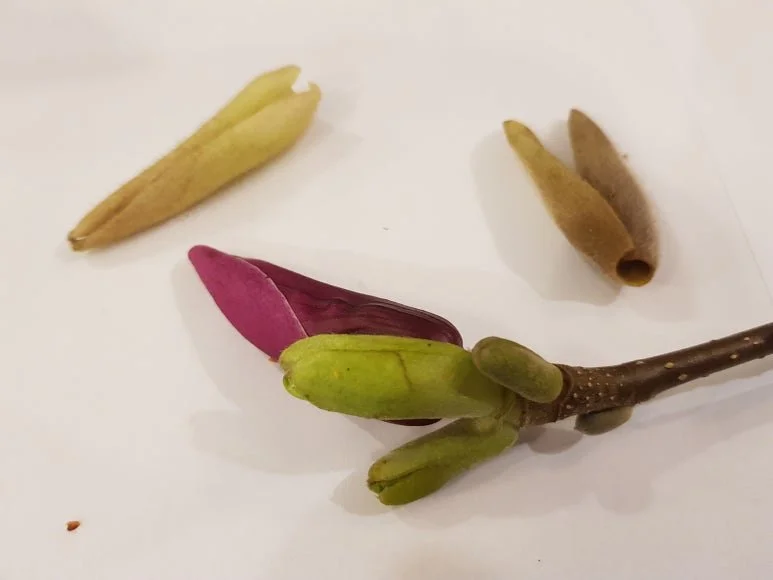
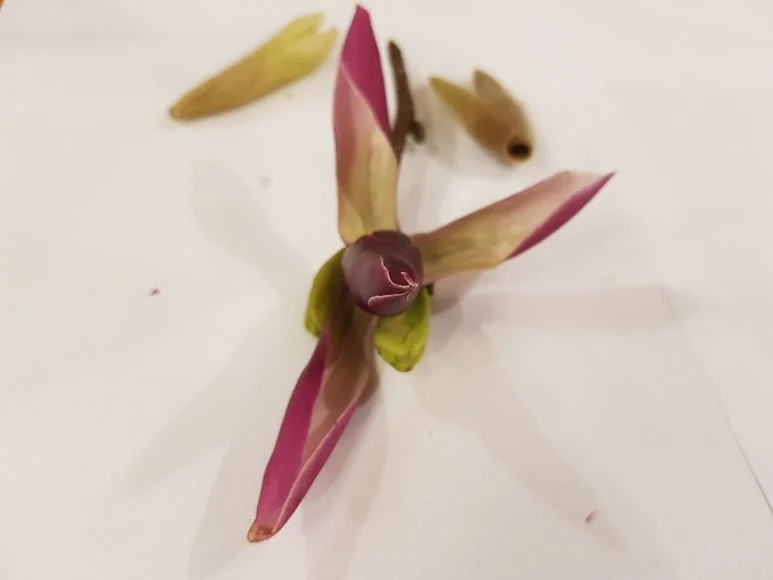
Removing the three outer sepals reveals six petals of almost identical appearance.
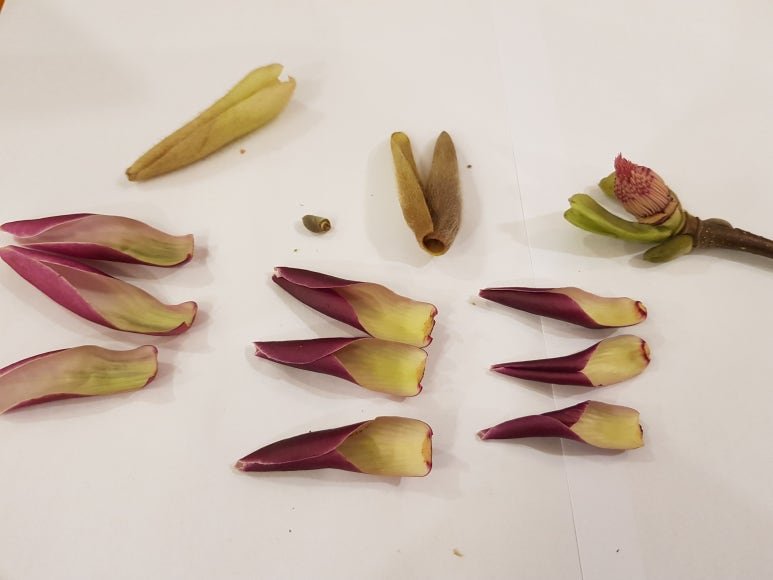
Beneath them lie the reproductive organs.
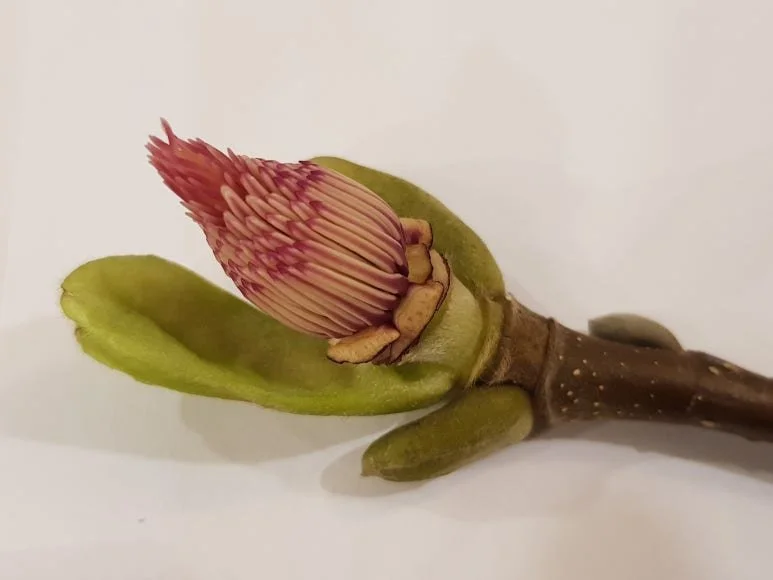
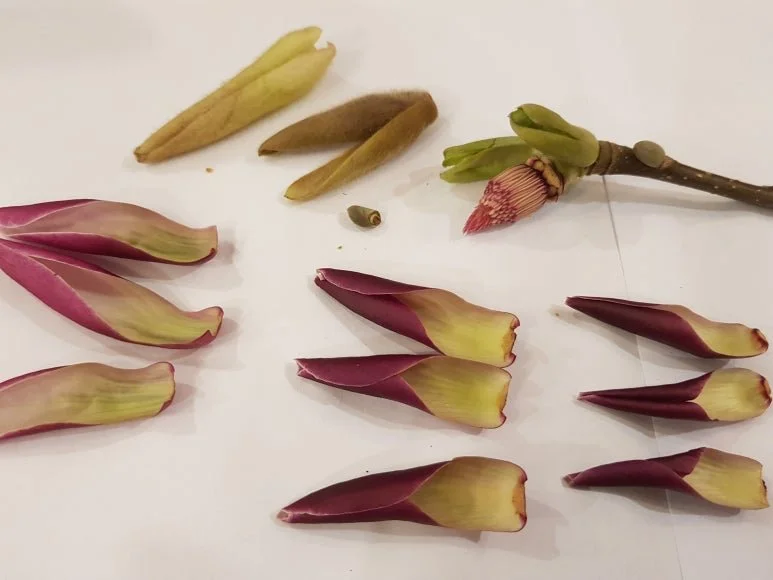
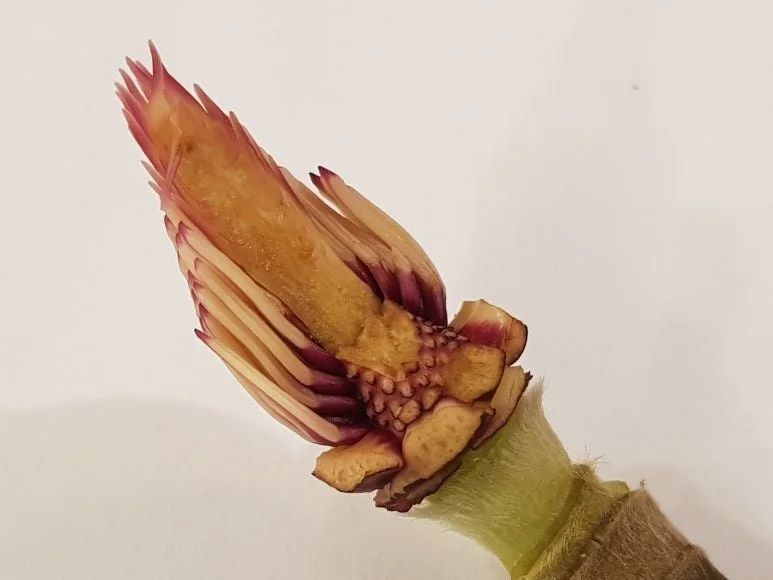
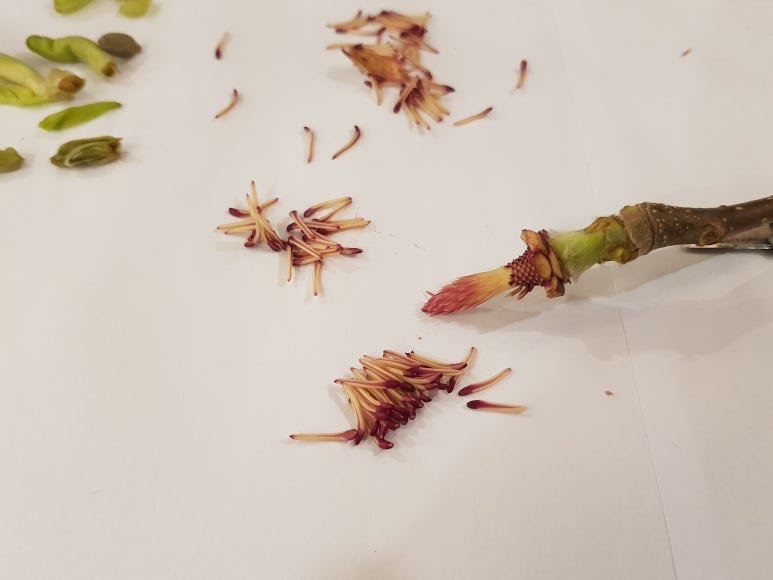
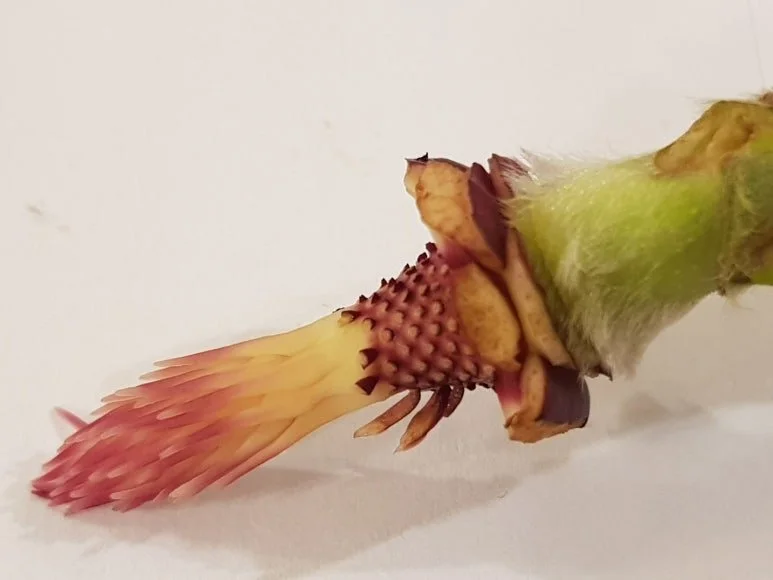
The stamens and pistils spiral around an elongated floral axis rather than forming clearly separated rings, reflecting an ancient floral structure that has survived for millions of years.
Together with its solitary blossoms, smooth leaves, and the subtle distinction between petals and sepals, these features reveal why magnolias are often regarded as living representatives of one of the earliest flowering plant lineages.
The Last Chill of Early Spring
In Korea, spring is often represented by cherry blossoms.
Their overwhelming beauty has become the visual symbol of the season.
Magnolias bloom earlier.
There is another reason I associate them with coldness.
Almost every year, only a few days after cherry blossoms reach their peak, rain begins to fall. Soon afterwards, the final chill of early spring disappears, and the warmth we instinctively recognise as "spring" finally arrives.
Magnolias bloom before that moment.
If I were to describe them with a single adjective, I would choose brisk.
To me, they preserve the last breath of winter hidden inside spring itself.
Heralds of Early Spring
Since 2019, the subtitle beneath my Early Spring memo pad series has read:
Heralds of Early Spring
The magnolia, cornelian cherry, and cherry blossom illustrations in the series all bloom just before spring fully unfolds.
Years ago, someone visiting my booth asked,
"Why is it called Brisk Magnolia?"
At the time, I answered only that one visitor.
This journal has finally given me the opportunity to tell the whole story.
Each year, from mid-March to early April, I decorate my planner with the Early Spring memo pads and include them in the letters and parcels I send.
If this is your first encounter with my stationery, I hope this series becomes your own herald of spring as well.
Brisk Magnolia
Herald of Early Spring
