
Hello,
this is SALEIGN’S LAIR, sending you images of quiet elegance and ornament.
While deciding what to write for the second entry of Flower Journal, I found myself returning to the idea of rules.
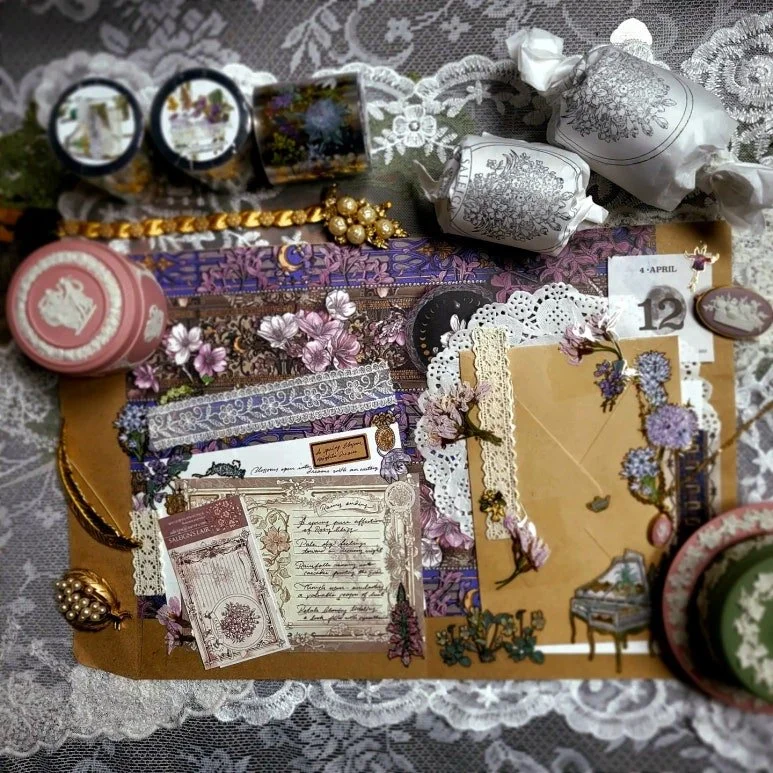
I had recently decorated a journal page using the Rules design from the Singing Frame memo pad series, following an earlier spread made with my typewriter memo pad. Thinking about the word rules led me to decorate another envelope, this time with Spring Blossom from the Classic Tones wrapping paper series.
I had originally intended to tell a lighter story. But seeing the spectacular procession of spring flowers this year, I felt that I had to write about this instead.
Throughout winter, flowers sleep inside seeds and winter buds before emerging again in spring. And because spring flowers are the first act in the return of flowers, each of them has its own set of rules.
If we look at plants as a broader category, a species can be understood as a group of organisms that follow a similar set of characteristics in nature, which humans identify, name, and classify according to various criteria for the sake of understanding and convenience.
Rather than there being a perfectly fixed blueprint for every species, we might say that humans gradually discover and infer the rules of a plant by observing the characteristics shared by its members.
Spring flowers, too, have their own seasonal order.
Their rule is to bloom one after another.
Depending on changes in temperature, humidity, sunlight, and other environmental conditions, spring flowers usually appear in sequence. Camellias announce the end of winter. Then plum blossoms open, followed by magnolias. Around the time magnolias begin to fall, yellow forsythias bloom. As the forsythias fade, azaleas—whose flowers emerge before their leaves—reach their peak. Cherry blossoms follow, and after the spring rains come shepherd’s purse and lilacs, each taking its turn.
But this spring was almost frighteningly beautiful.
Did you notice?
The plum blossoms, magnolias, forsythias, azaleas, and cherry blossoms all opened with almost no meaningful interval between them.
As the order of spring flowers—the rules of their timing—collapsed, we were met instead with a dazzling and almost overwhelming festival of blossoms.
It was also a visible sign of the climate crisis.
Reading Flowers through an Identification Key
The “rules” of spring flowers can also be written as an identification key.
An identification key is, in simple terms, rather like a game of Twenty Questions. It is often easier to understand by looking at one than by explaining it. In botany and the life sciences, identification keys are used to work backwards through observable characteristics in order to determine the name or identity of an unknown plant.
The following is a key I wrote after observing plants around my home on approximately April 15, 2016.
1. Ovules are not enclosed within a carpel; they are exposed.
2. Leaves are alternate ........................ Bald cypress
3. Leaves are opposite ........................ Dawn redwood
2. Ovules are enclosed within a carpel.
3. Flowers are sympetalous.
4. Flowers are four-merous ................ Lilac
5. Flowers are five-merous ................ Korean azalea
4. Flowers have separate petals.
5. Flowers have a spur .................... Pansy
6. Flowers do not have a spur.
6. Plant does not produce fruit ........ Double-flowered kerria
7. Plant produces fruit.
8. Pistil consists of one carpel .... Magnolia
9. Pistil consists of two carpels ... Shepherd’s purse
If we place the spring flowers mentioned earlier into a similar identification key, we might distinguish them as follows.
Subjects: plum blossom, magnolia, forsythia, azalea, cherry blossom, shepherd’s purse
1. Not a eudicot ................................ Magnolia
1. A eudicot.
2. Flowers are four-merous .................... 3
3. Leaves on the stem are opposite ......... Forsythia
3. Leaves on the stem are alternate ........ Shepherd’s purse
2. Flowers are not four-merous ................ 5
5. Pistil has a single carpel .............. 6
6. Pedicel is shorter than 1 cm ......... Plum blossom
6. Pedicel is longer than 1 cm .......... Cherry blossom
5. Pistil consists of multiple carpels ..... Azalea
It may look difficult, but the same kind of key can be written in everyday language.
For example, if we wanted to distinguish plum blossoms, cherry blossoms, and apricot blossoms, we could write:
1. The sepals bend backwards when the flower opens
............................................... Apricot blossom
1. The sepals do not bend backwards when the flower opens
............................................... 2
2. The flower stalk is so short that the flower appears
attached directly to the branch ............ Plum blossom
2. The flower hangs away from the branch on a longer stalk
............................................. Cherry blossom
It is much like Twenty Questions: you keep asking about the flower’s characteristics—its traits—until its identity gradually becomes clear.
If someone were to ask me in writing, “What plant is this?”, I could ask questions in this way and narrow down its identity step by step.
When the Calendar of Flowers Stops Working
In the past, flowers bloomed one after another over distinct periods of time, which meant that even season and flowering time could be used as part of an identification key.
That has become increasingly difficult.
As the seasonal order breaks down, flowers begin to bloom together. The landscape becomes extraordinarily beautiful, but if everything flowers and fades at once, I cannot help worrying about the insects and birds that depend on nectar and flowers for food.
The signs of the climate crisis are becoming increasingly visible, yet it is impossible not to find comfort in the beauty of the landscape before us.
So before the rain comes, perhaps we should enjoy the spring flowers while they are here—and at the same time, do what we can so that the order of flowers might have a better chance of returning.
We need to respond to the climate crisis from wherever we stand.
The attitude of saying, “The climate is already broken, everything is ruined, so we may as well do nothing,” does not help. If anything, it accelerates the crisis.
If we want to keep seeing these beautiful landscapes—and to see them unfold in their proper seasons—we have to make whatever efforts are available to us.
Ironically, stopping production altogether might be the most effective answer. But a modern economy cannot function without production, and this is something I struggle with as well.
Art, after all, is based on creation. Even when it involves recycling or regeneration, it still produces something new. So artists also have to ask what they can do within the process of making things: reducing plastic, avoiding meaningless production, choosing environmentally responsible materials, and thinking more carefully about what really needs to be made.
In everyday life, we can participate in smaller ways too: using environmentally friendly detergents, shampoo bars or dishwashing bars instead of plastic bottles, replacing synthetic sponges with more sustainable alternatives, recycling properly, supporting responsible companies, and simply using what we already own for longer.
This entry began with the rules of flowers.
But when the order of flowers collapses, the ecological systems connected to them can unravel remarkably quickly. Seeing such visible signs of abnormal climate patterns, I felt that I could not write about spring flowers without also writing about this.
Perhaps each of us can choose just two or three things that we are able to do in our own lives, and try to help the rules of ecology function a little more normally.
Today’s Flower Journal has become a beautiful but rather heavy one.
Still, I hope it might offer a moment to think—not from despair, but from the desire to consider what we can do so that we may continue living alongside beauty for a long time.
SALEIGN’S LAIR
Flower Journal #2
