
꽃의 일지 — Reprise 3 - <꽃꽂이 수업 - 철학적 사고> 다시보기
Chapter 3. 꽃꽂이 수업
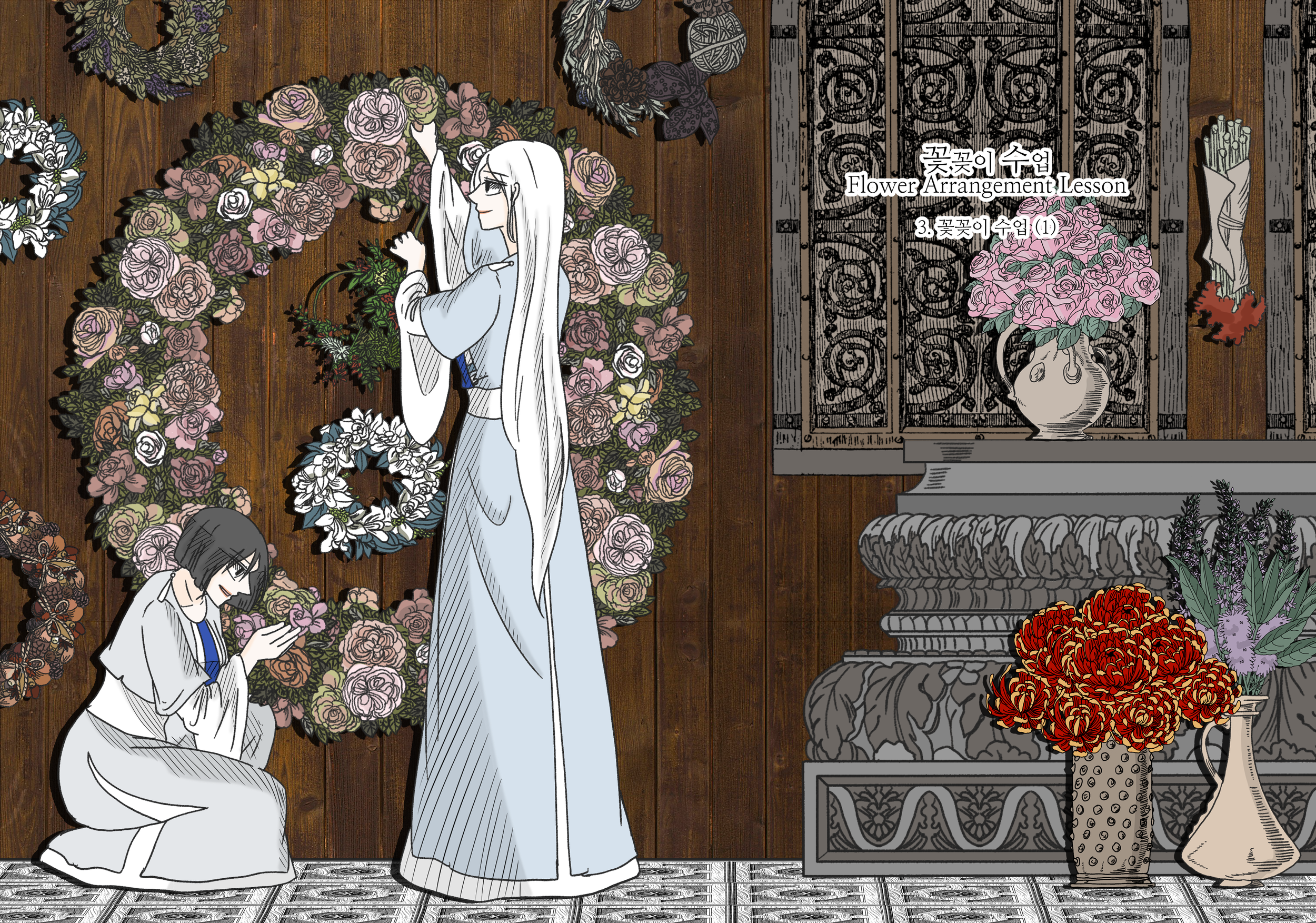
2018년에 그린 《꽃꽂이 수업 — 철학적 사고》를 다시 꺼내 읽고 있습니다. 앞선 이야기에서 식물을 바라보고, 기르고, 인간이 식물을 자신의 생활에 맞추는 방식에 대해 생각했다면, 마지막 이야기는 조금 더 까다로운 질문으로 향합니다. 우리는 식물을 어디까지 생명으로 대해야 할까, 그리고 윤리는 어디에서 시작될까?
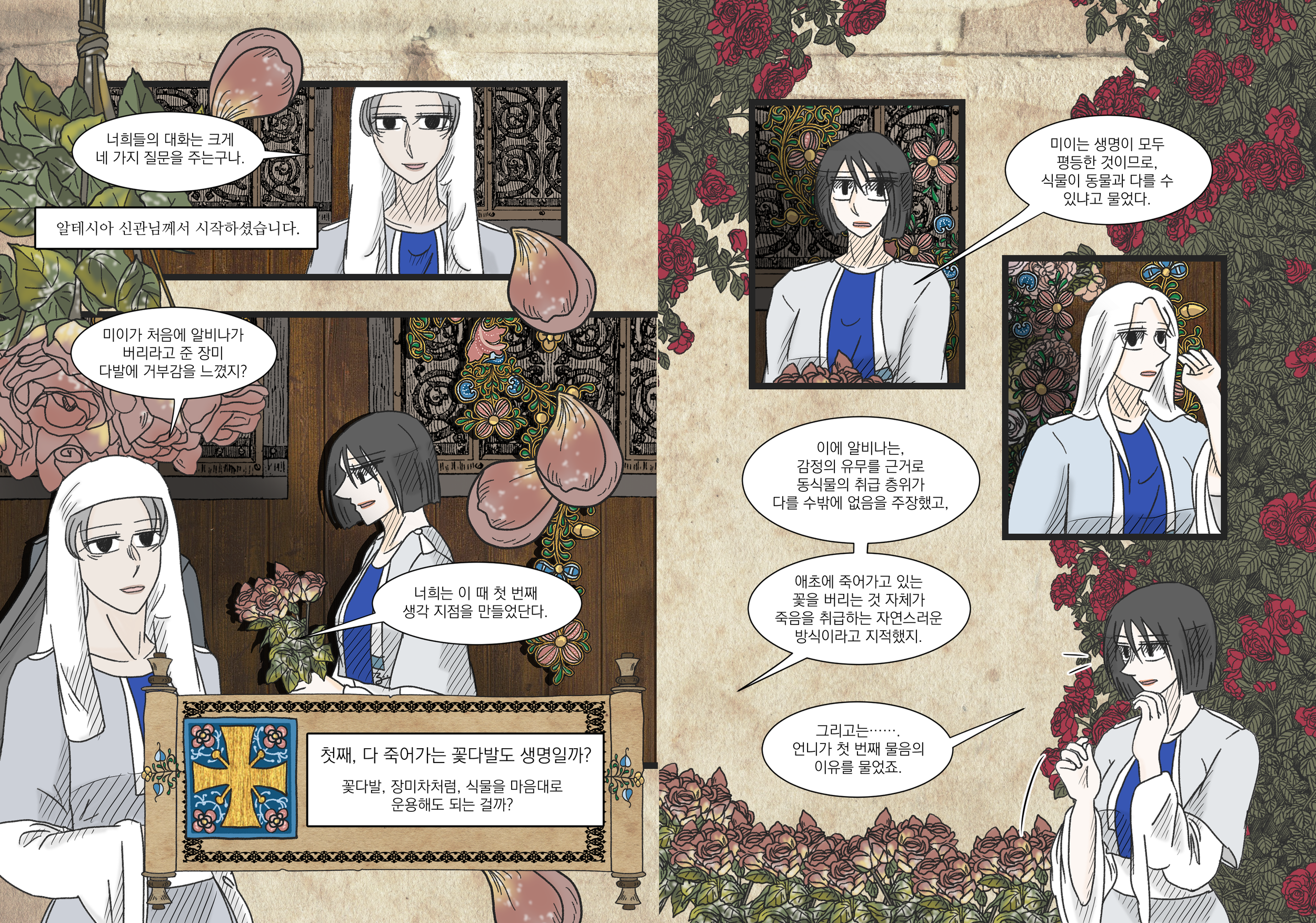
수업을 기다리던 미이는 벽에 걸린 오래된 장미 다발을 발견합니다. 꽃잎은 이미 색이 바래고, 줄기에는 검은 반점과 흰 곰팡이가 생기기 시작했습니다. 알비나는 그 장미를 버려 달라고 말합니다. 하지만 미이는 이상하게도 그 말을 쉽게 따르지 못합니다.
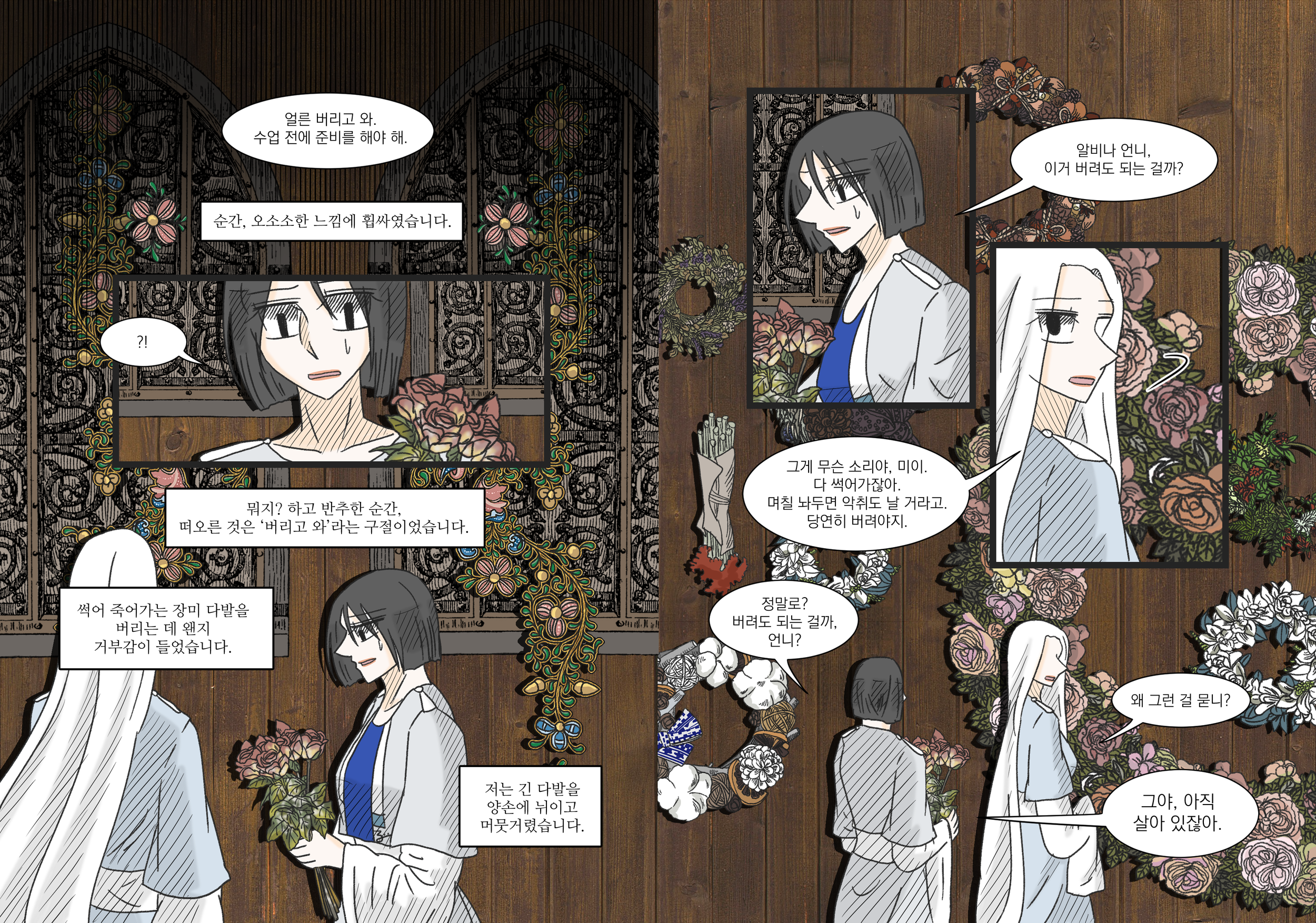
아직 완전히 죽은 것 같지 않았기 때문이기도 하고, 무엇보다 그 장미가 자신에게는 특별한 의미를 가진 꽃이었기 때문입니다. 그러면서 이야기는 하나의 질문으로 시작합니다. (1) “죽어가는 꽃을 버리는 것은 생명을 함부로 대하는 일일까?”
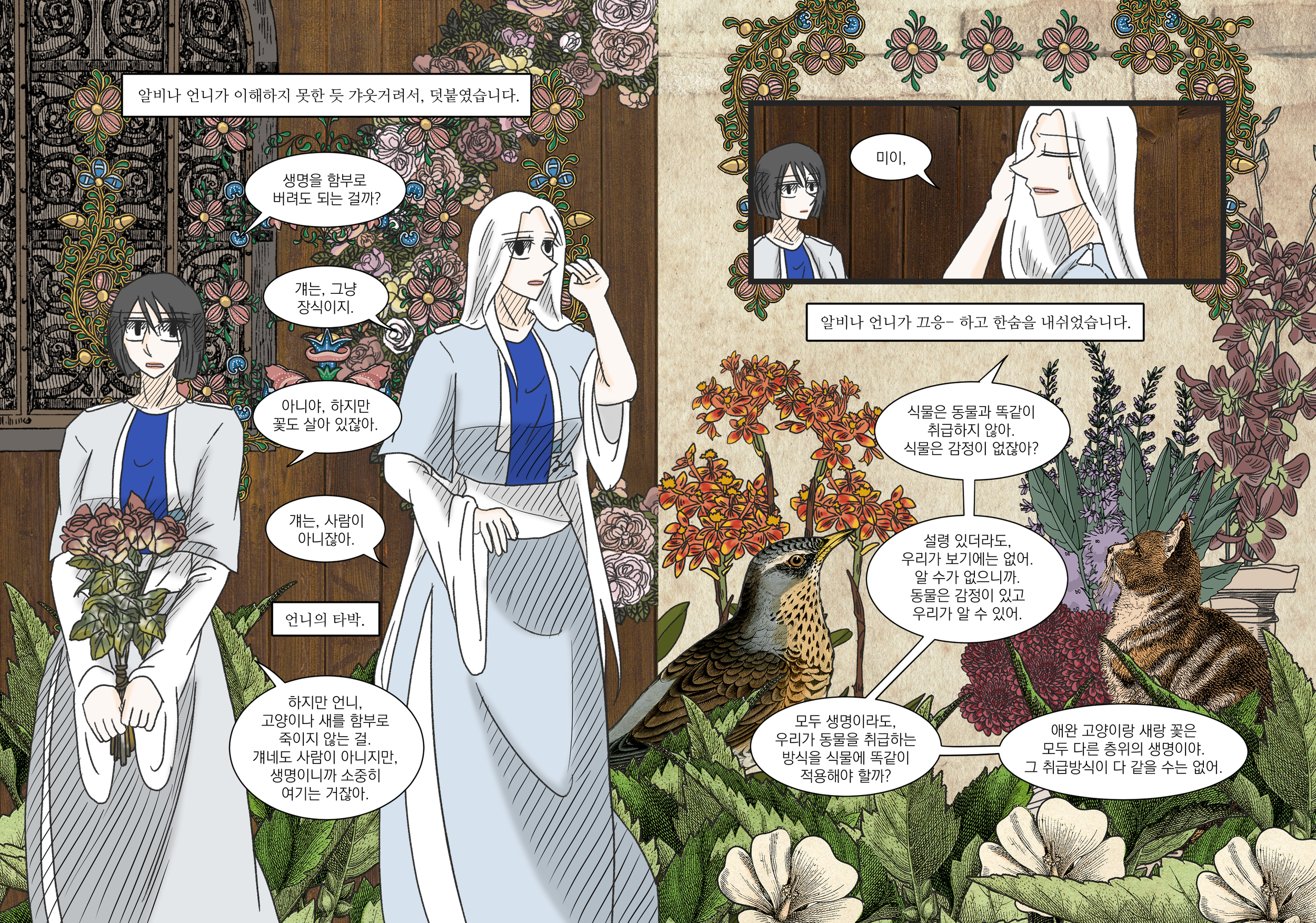
알비나는 고양이나 새와 꽃이 모두 생명이지만, 모든 생명을 동일한 방식으로 대할 수 있는지는 생각해 볼 문제라고 말합니다. 우리는 꽃을 잘라 꽃꽂이를 하고, 채소를 먹으며 살아갑니다. 식물을 전혀 해치지 않는 삶은 사실상 불가능합니다. 그렇다면 식물을 자르는 행위 자체가 곧 잘못이라고 말할 수도 없습니다.
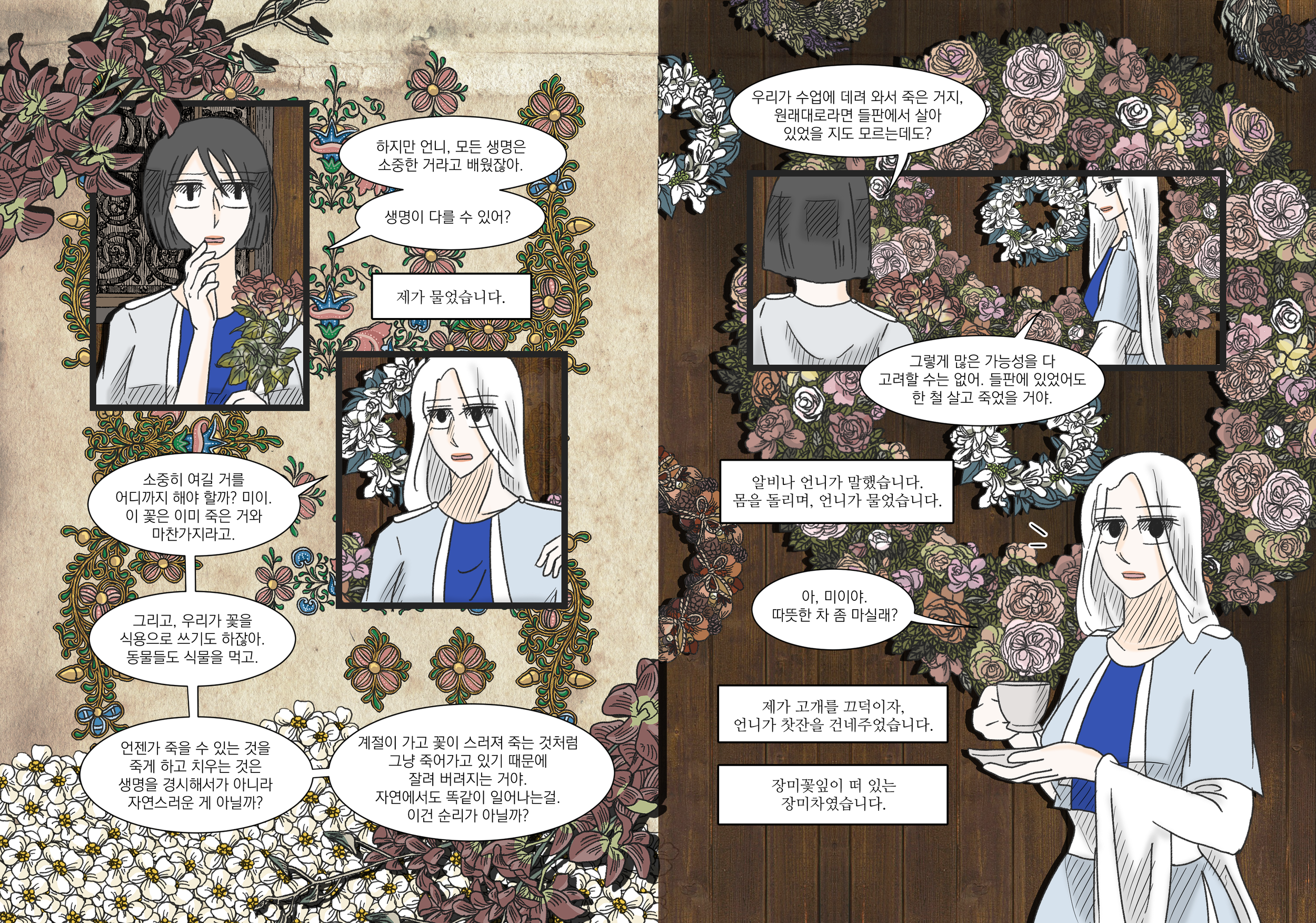
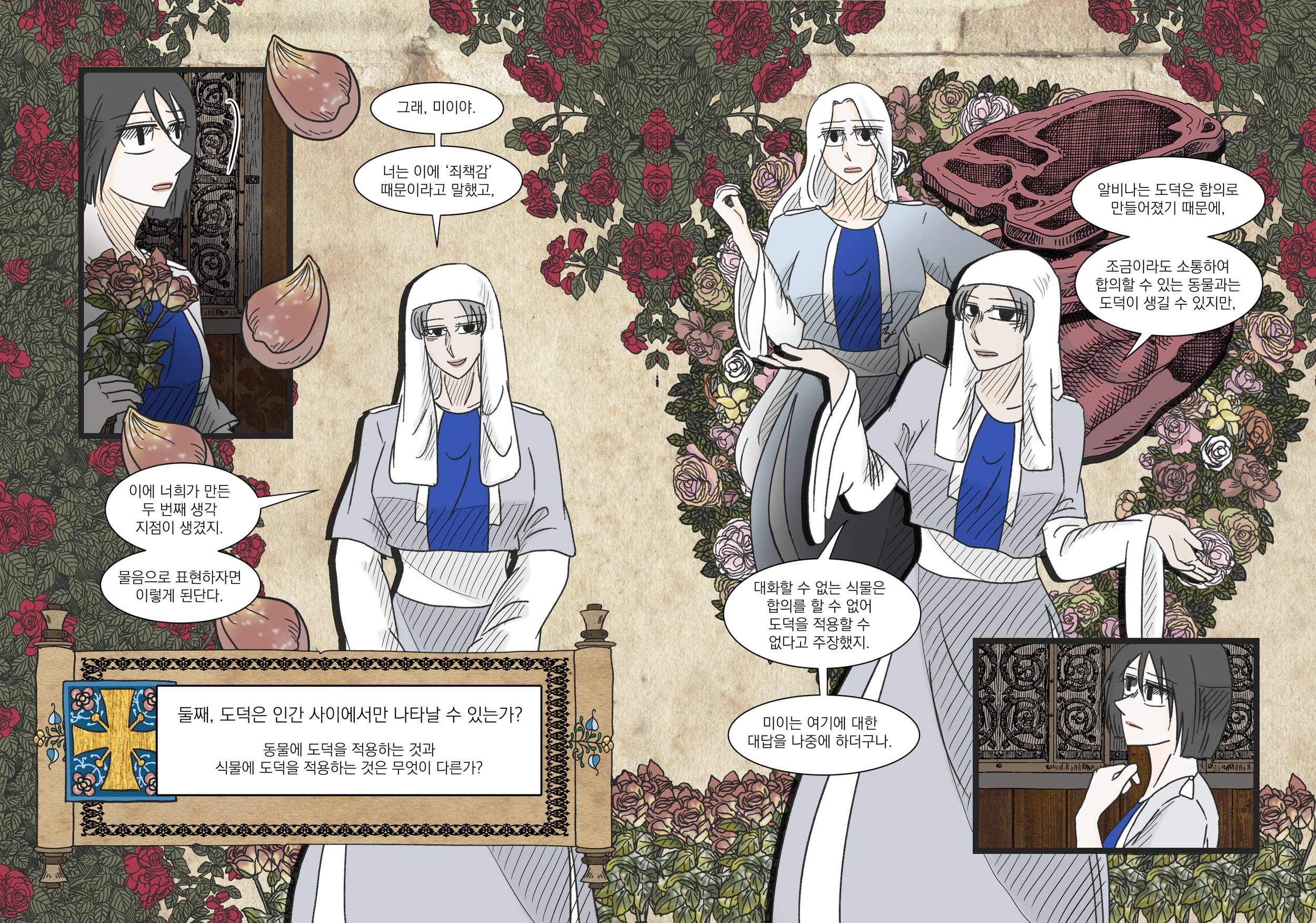
이 대화는 자연스럽게 두 번째 질문으로 이어집니다. (2) 도덕은 인간 사이에서만 존재하는가? 동물에게 적용하는 윤리와 식물에게 적용하는 윤리는 무엇이 다른가?
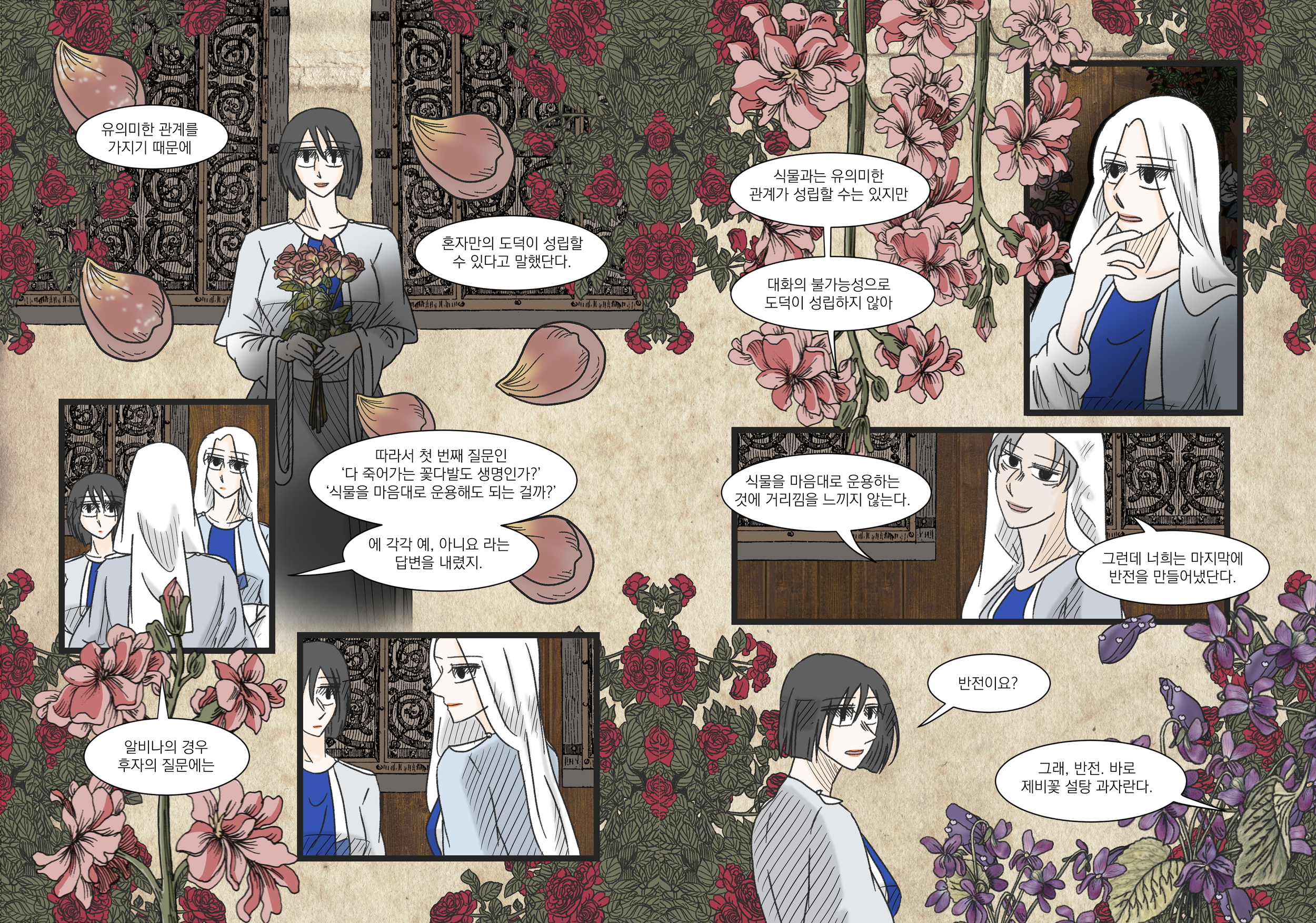
사람과 사람 사이에서는 서로 이야기하고 합의할 수 있습니다. 동물과는 언어로 대화하기 어렵지만, 행동과 반응을 통해 어느 정도 의사를 짐작할 수 있습니다. 하지만 식물은 우리와 대화할 수 없습니다. 그렇다고 해서 식물과 우리의 관계가 아무 의미도 없는 것은 아닙니다. 미이는 자신에게 특별한 추억이 있는 장미 다발을 바라보며, 자신이 왜 그 꽃을 버리는 일에 그렇게 마음이 쓰였는지 생각합니다.
그리고 한 가지 답에 가까워집니다. “나에게 의미가 있기 때문에 더 소중한 거야.” 이 지점이 지금 다시 읽어도 흥미로워요.
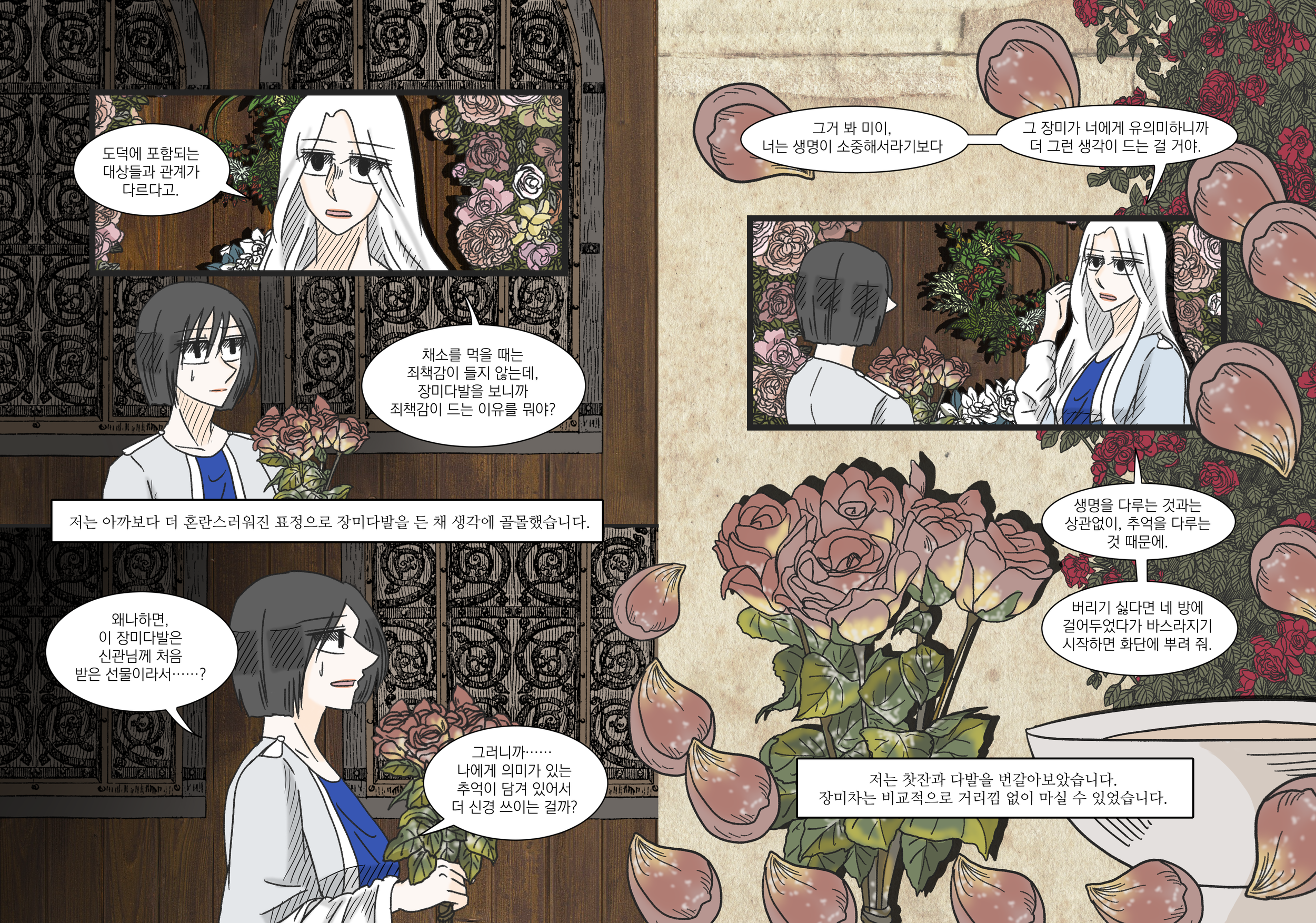
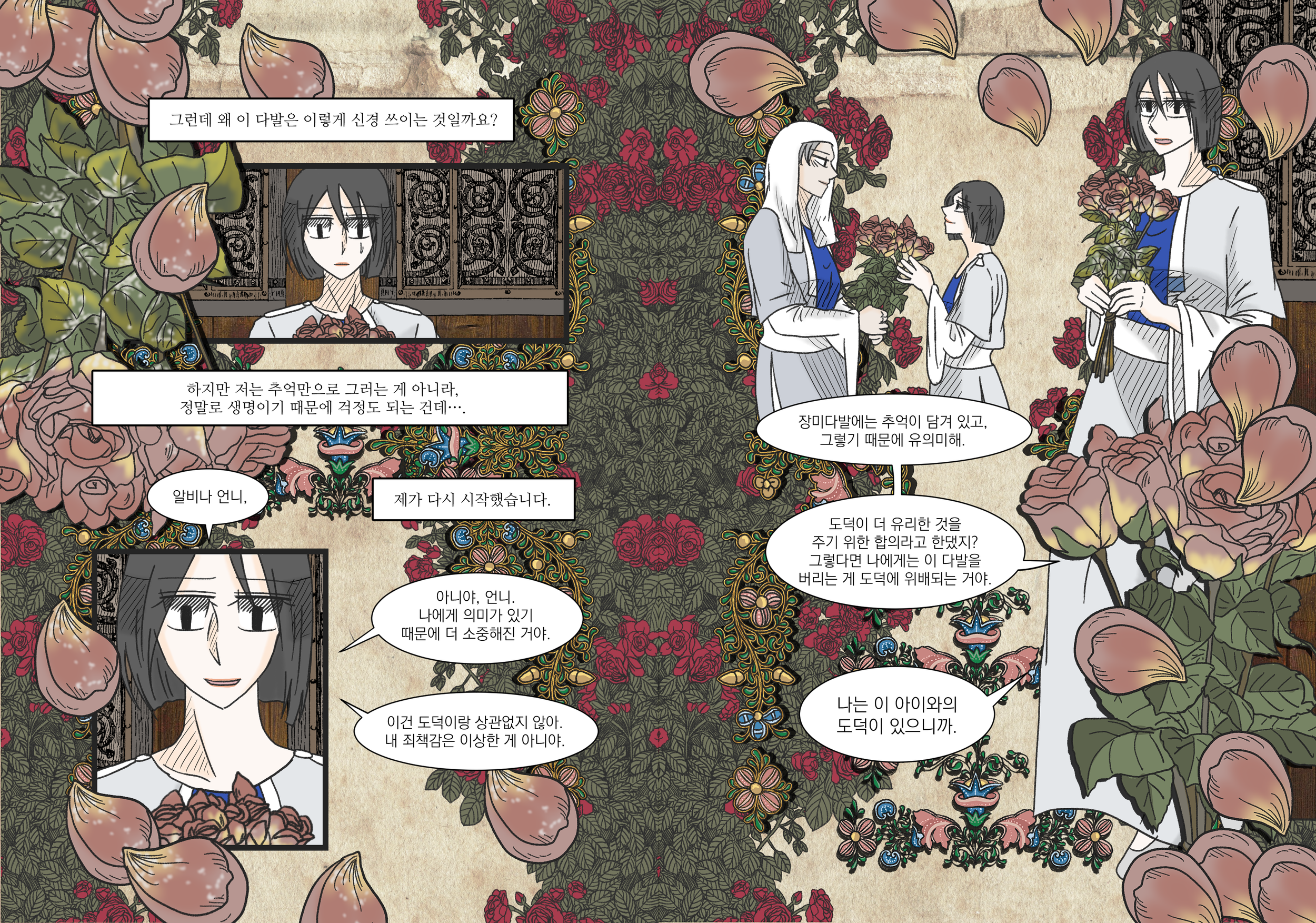
당시 저는 식물을 무조건 인간과 동일하게 대해야 한다고 말하려 했던 것은 아닙니다. 오히려 우리가 무엇을 소중하게 느끼고, 무엇에 죄책감을 느끼는지가 언제나 논리적으로 일관되지는 않는다는 사실에 관심이 있었습니다. 장미를 버리는 것은 불편하면서도, 제비꽃으로 만든 설탕 과자를 먹는 데에는 아무런 거리낌이 없을 수도 있습니다.
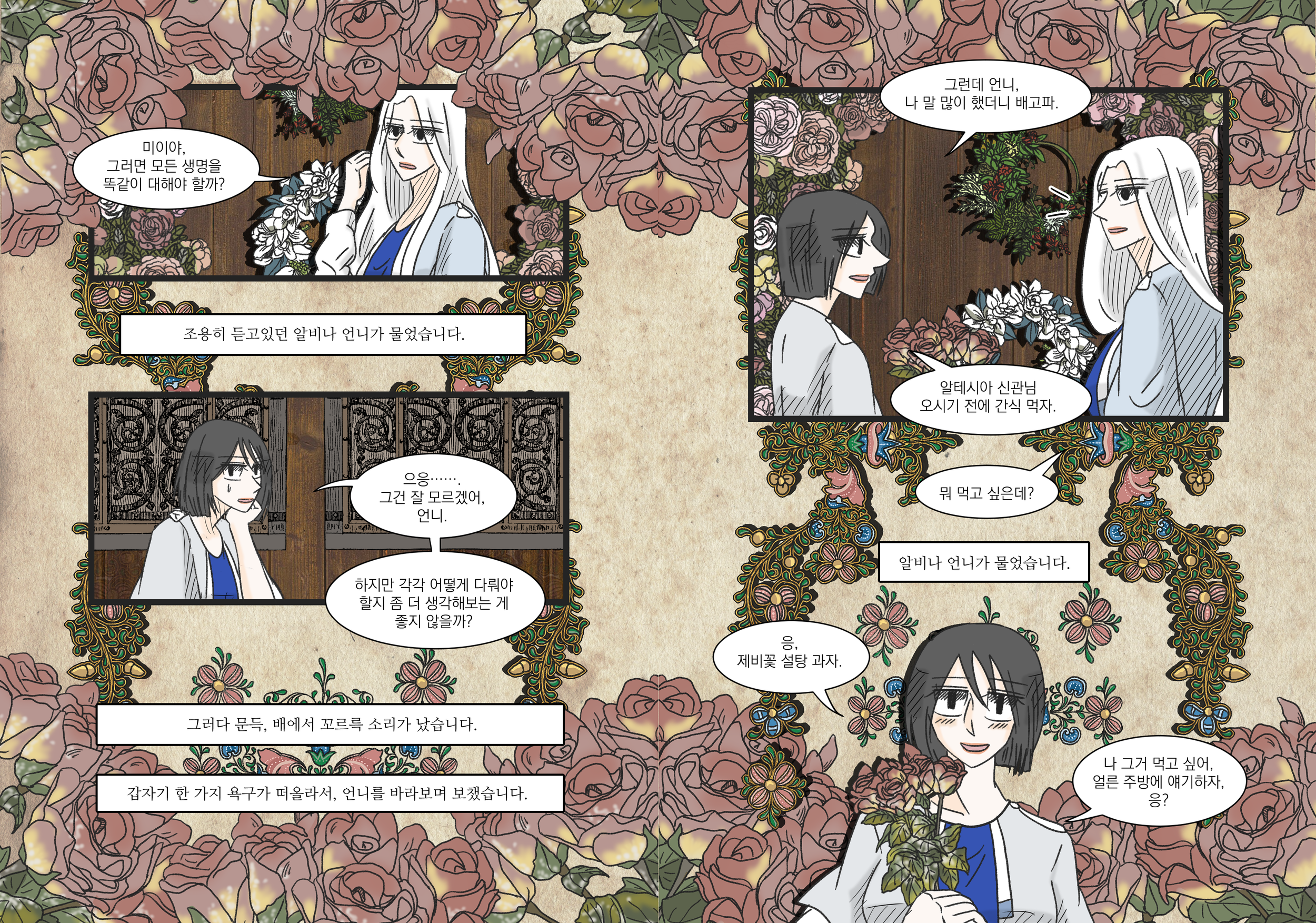
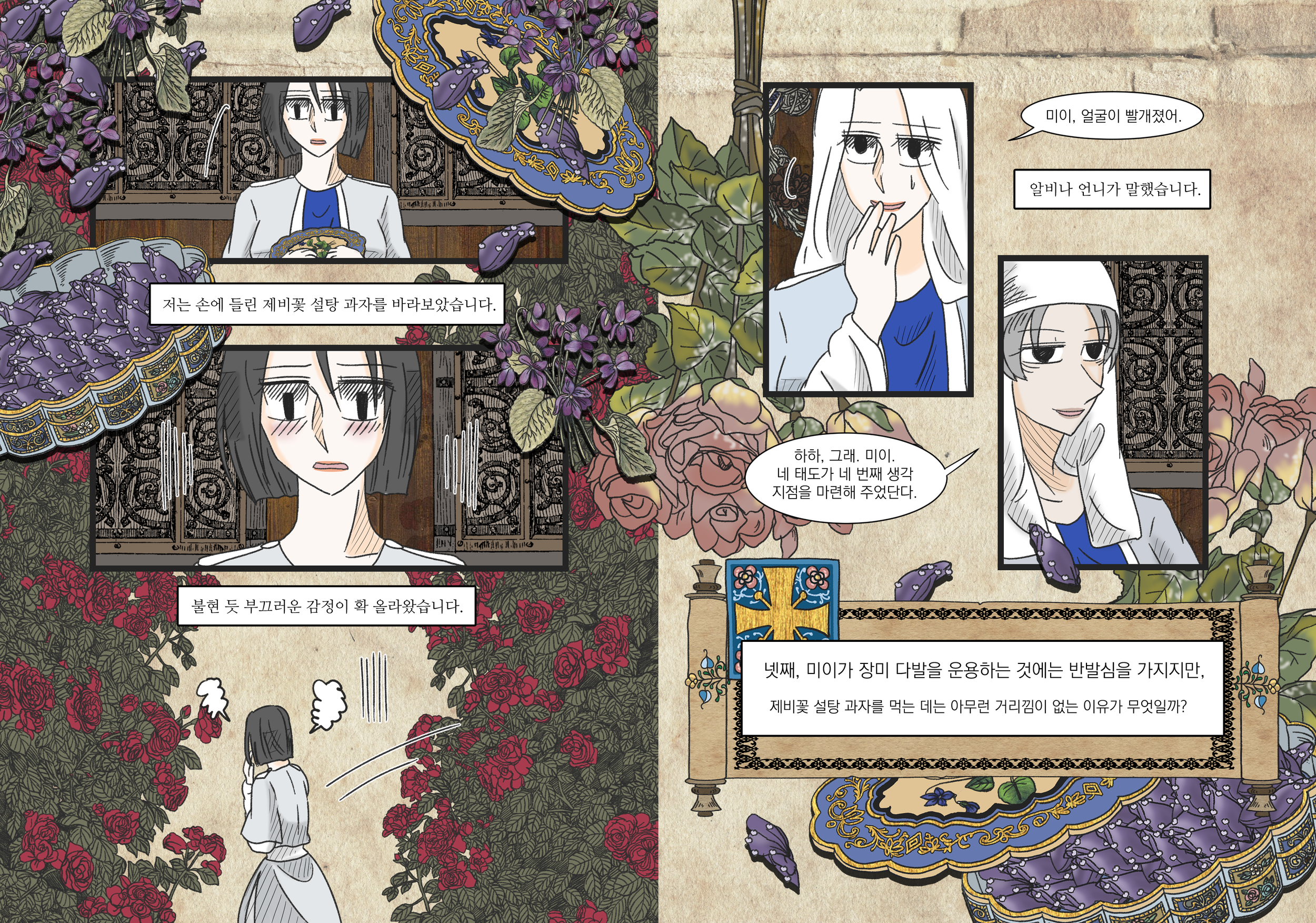
미이 역시 그 모순을 발견합니다. 그리고 마지막으로 이런 질문을 받습니다. (3) 왜 장미 다발을 버리는 일에는 반발심을 느끼면서, 제비꽃 설탕 과자를 먹는 일에는 아무렇지 않았을까? 인간의 감정과 도덕적 판단은 언제나 일관될 수 있을까?
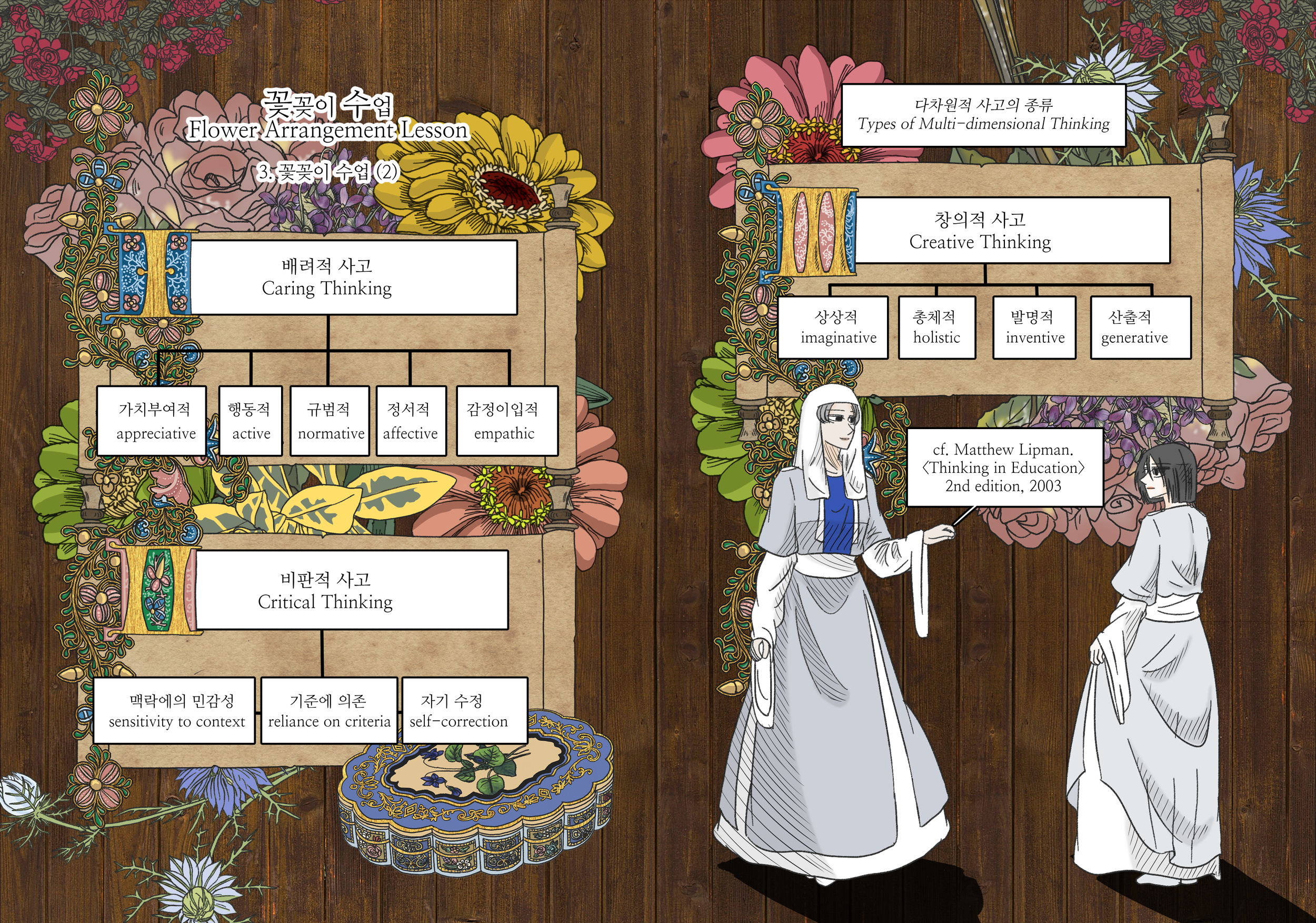
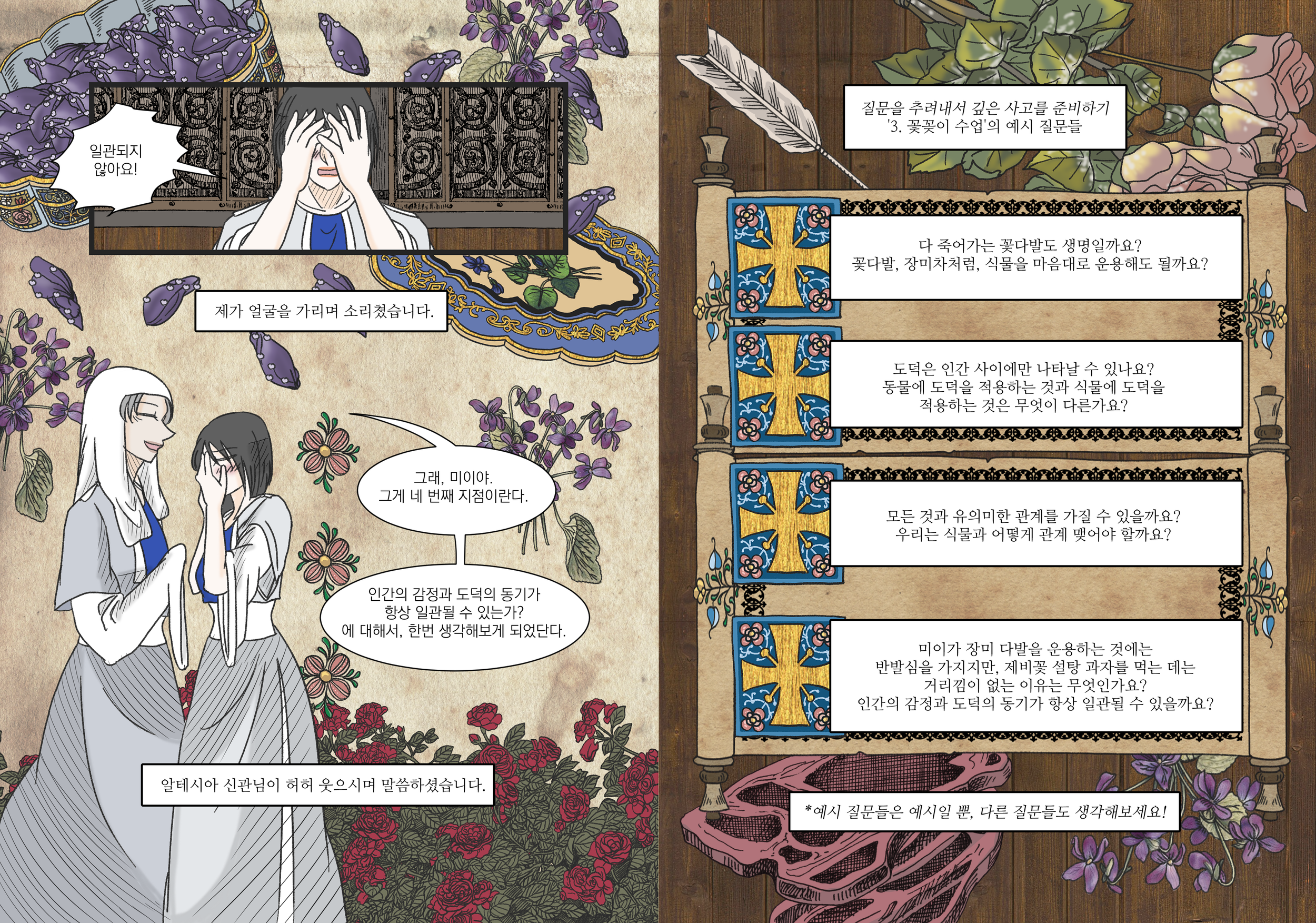
2018년의 저는 이 질문들에 하나의 정답을 제시하기보다, 서로 다른 생각의 지점을 만들어 두고 싶었던 것 같습니다. 비판적 사고, 배려적 사고, 창의적 사고처럼 하나의 문제를 여러 방향에서 바라보고, 다시 질문을 만들어 보는 방식이 이 만화의 마지막 수업이었습니다. 그리고 지금 다시 보면 이것은 제가 이후 Botanical Archive와 Records of Flora에서 계속하고 있는 방식과도 꽤 닮아 있습니다.
식물 하나를 오래 바라보고, 그것이 가진 생물학적 구조를 이해하고, 사람과 식물 사이에 쌓여 온 문화와 이야기를 살펴보고, 그 관계에서 다시 질문을 만들어 보는 것. 관심의 대상은 조금씩 확장되었지만, 생각의 출발점은 생각보다 오래전부터 비슷했던 것 같습니다.
《꽃꽂이 수업 — 철학적 사고》의 이야기는 여기에서 겨울을 맞습니다. 식물들이 잠시 쉬어 가고, 봄이 오면 다시 새로운 이야기가 시작됩니다. 2018년에 남겨 둔 이 질문들은 지금의 저에게도 아직 완전히 끝난 질문은 아닙니다.
* * *
원작에 대하여
이 글은 2018년 제작한 만화책 <꽃꽂이 수업 — 철학적 사고>의 5화와 6화, <꽃꽂이 수업>을 2026년의 시선으로 다시 읽은 기록입니다.
원작에서는 미이, 알비나, 알테시아의 대화와 사건을 통해 이 질문이 보다 긴 이야기로 이어집니다.
Records of Flora — Reprise 3
Revisiting Flower Arrangement Class — Philosophical Thinking
Chapter 3. Flower Arrangement Class
I have been rereading Flower Arrangement Class — Philosophical Thinking, a comic I created in 2018.
If the earlier chapters asked us to think about how we observe plants, cultivate them, and adapt them to suit human life, the final story turns toward a more difficult question:
To what extent should we treat plants as living beings, and where does ethics begin?
While waiting for class to begin, Mii notices an old bouquet of roses hanging on the wall. The petals have already faded, and black spots and white mold have begun to appear on the stems. Albina tells her to throw the bouquet away.
For some reason, however, Mii cannot bring herself to do it easily.
Partly because the flowers do not yet seem completely dead, and more importantly because those roses carry a particular meaning for her.
The story therefore begins with its first question:
(1) Is throwing away a dying flower a careless way of treating life?
Albina points out that cats, birds, and flowers are all living things, but asks whether that necessarily means we should treat every form of life in exactly the same way.
We cut flowers for arrangements. We eat vegetables in order to live. A life in which we never harm plants at all is virtually impossible. If that is the case, we cannot simply say that cutting a plant is inherently wrong.
The conversation naturally leads to a second question:
(2) Does morality exist only between human beings? How is the ethics we apply to animals different from the ethics we apply to plants?
Between people, we can speak to one another and reach agreements. With animals, verbal communication may be difficult, but we can still infer something about their intentions through behavior and response.
Plants, however, cannot speak with us.
That does not mean that our relationships with plants are meaningless.
Looking at the bouquet of roses associated with a special memory, Mii begins to wonder why the idea of throwing those flowers away troubles her so deeply.
Eventually, she arrives at something close to an answer:
“It matters more because it means something to me.”
This is the point I still find interesting when I reread the work today.
At the time, I was not trying to argue that plants should simply be treated in the same way as human beings. Rather, I was interested in the fact that what we value, and what makes us feel guilty, is not always logically consistent.
We may feel uncomfortable throwing away a bouquet of roses, while feeling no hesitation at all about eating candied violets.
Mii notices this contradiction as well.
And finally, she is asked one last question:
(3) Why did throwing away the bouquet of roses provoke resistance, while eating candied violets did not? Can human emotion and moral judgment ever be completely consistent?
I think the version of myself who wrote this in 2018 was less interested in presenting a single correct answer than in creating several different points from which to think.
The final lesson of the comic was about approaching one problem from multiple directions and then generating new questions again: through critical thinking, caring thinking, and creative thinking.
Looking back now, that method feels surprisingly similar to what I later continued to develop through the Botanical Archive and Records of Flora.
To look at a single plant for a long time.
To understand its biological structure.
To examine the cultures and stories that have accumulated between plants and people.
And then, from those relationships, to ask another question.
The subjects of my attention have gradually expanded, but the starting point of my thinking seems to have remained remarkably similar for much longer than I realized.
The story of Flower Arrangement Class — Philosophical Thinking reaches winter here.
The plants pause for a while, and when spring comes, another story will begin.
The questions I left behind in 2018 are still not entirely finished questions for me today.
About the Original Work
This essay is a record of rereading Episodes 5 and 6, Flower Arrangement Lesson, from the 2018 comic Flower Arrangement Lesson — Philosophical Thinking through the perspective of 2026.
In the original work, these questions unfold through a longer series of conversations and events involving Mii, Albina, and Artesia.
