
<꽃꽂이 수업 - 철학적 사고> 다시보기
Chapter 1. 맨드라미의 죽음
살아 있다는 것은 죽을 수 있다는 것
2018년, 저는 <꽃꽂이 수업 — 철학적 사고>라는 한 권의 만화를 만들었습니다. 철학과 생명과학을 공부하던 시기에 식물과 인간의 관계에 대해 생각하며 그린 이야기였습니다. 등장인물들은 꽃을 꽂고, 기르고, 관찰하고, 때로는 죽음을 마주하면서 식물과 함께 살아간다는 것이 무엇인지 질문합니다. <꽃의 일기 Reprise>에서는 2018년의 이 만화를 2026년의 시점에서 다시 공유해 보려 합니다.
첫 번째 이야기는 붉은 맨드라미 한 송이에서 시작합니다.
주인공 미이의 언니 알비나는 꽃꽂이 수업에서 붉은 맨드라미를 보고 싶다고 말합니다. 절화는 오래 살지 못한다는 것을 알면서도, 동생 미이가 잘 돌본다면 조금 더 오래 살릴 수 있을 것이라 생각합니다. 하지만 알비나에게 받은 맨드라미는 나흘을 넘기지 못하고, 닷새째 아침 죽어버립니다. 그 작은 사건은 미이에게 첫 번째 생각 수업이 됩니다.
1. 생명은 통제할 수 없다
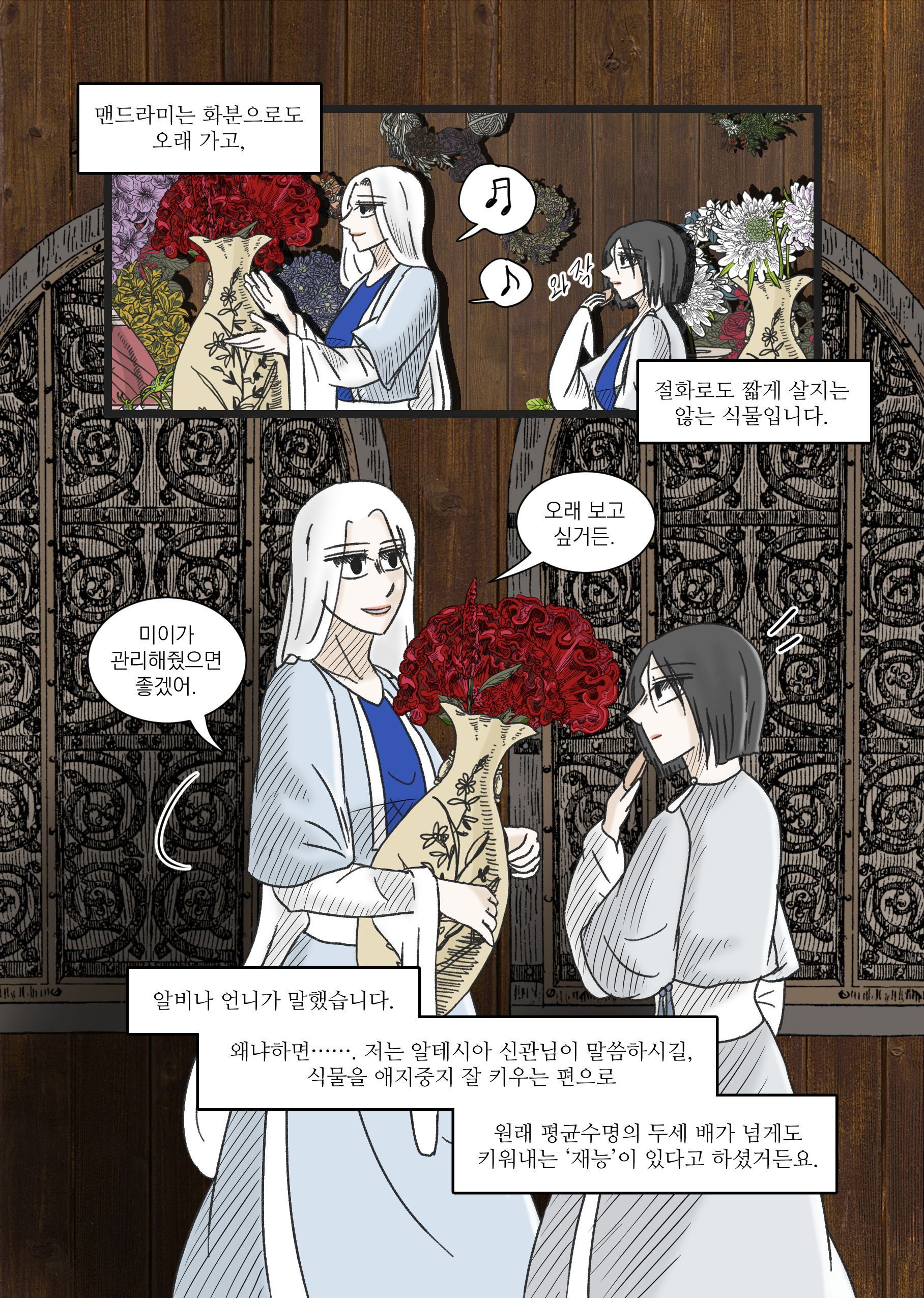
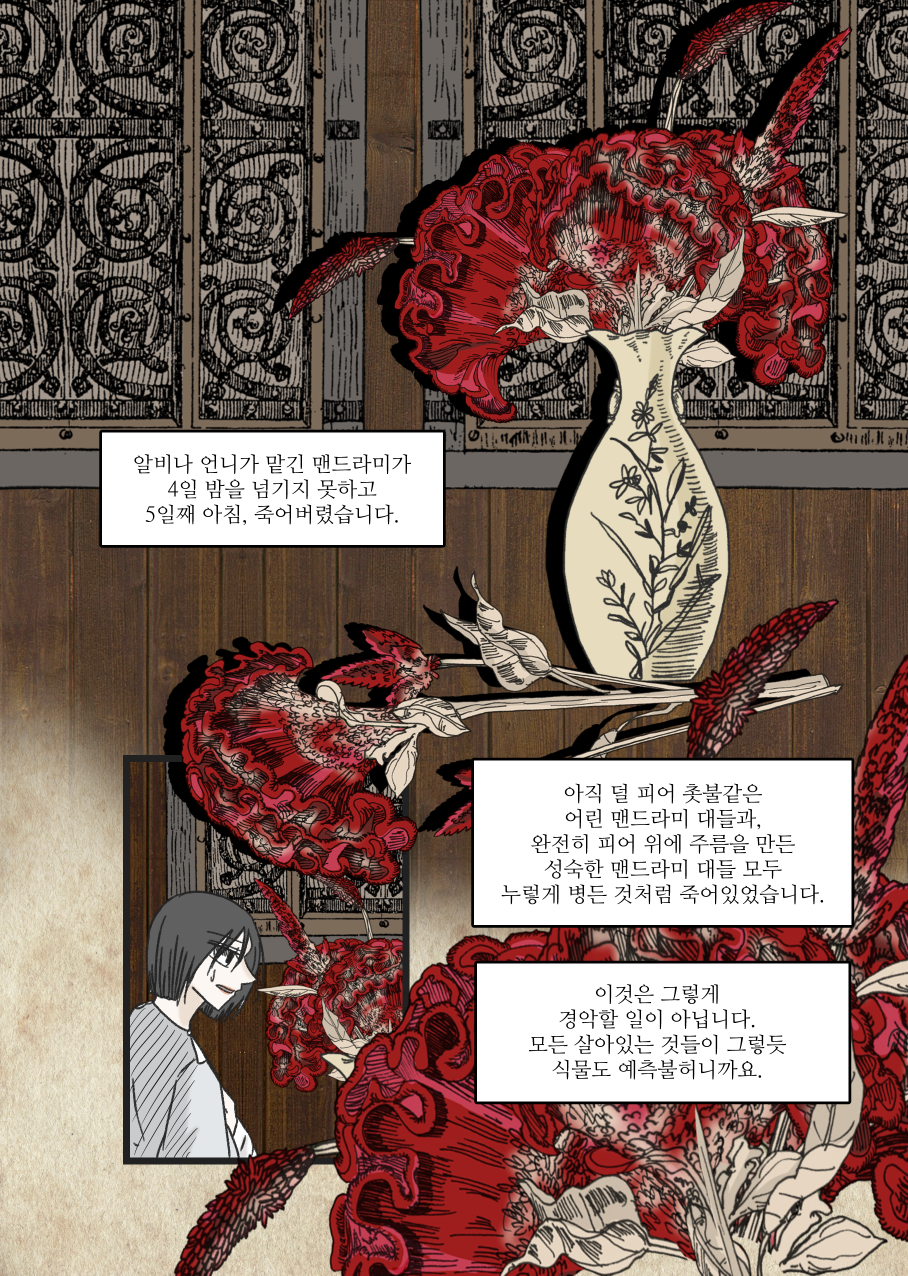
미이는 맨드라미를 오래 보고 싶어 했습니다. 물을 잘 갈아주고, 적당한 환경을 만들어주면 평균 수명보다 오래 살릴 수도 있다고 생각했습니다. 식물을 잘 돌보는 일에는 어느 정도 인간의 기술과 경험이 개입합니다.
그러나 맨드라미는 예상보다 일찍 죽었습니다.
미이는 이유를 찾습니다. 물이 맞지 않았을 수도 있고, 밤의 기온이 좋지 않았을 수도 있으며, 자신이 무엇인가 잘못했을 수도 있습니다. 하지만 모든 조건을 설명한다고 해서 생명의 결과까지 완전히 예측할 수 있는 것은 아닙니다.
당시 제가 이 장면에서 생각했던 것은 생명을 돌보는 일과 생명을 통제하는 일은 다르다는 것이었습니다. 생명은 우리가 잘해준 만큼 정확히 돌려주는 시스템이 아닙니다. 돌봄은 결과를 보장하기보다는, 살아 있는 존재와 관계를 맺는 하나의 방식에 가깝습니다.
2. 죽음은 생명성의 반대가 아니다
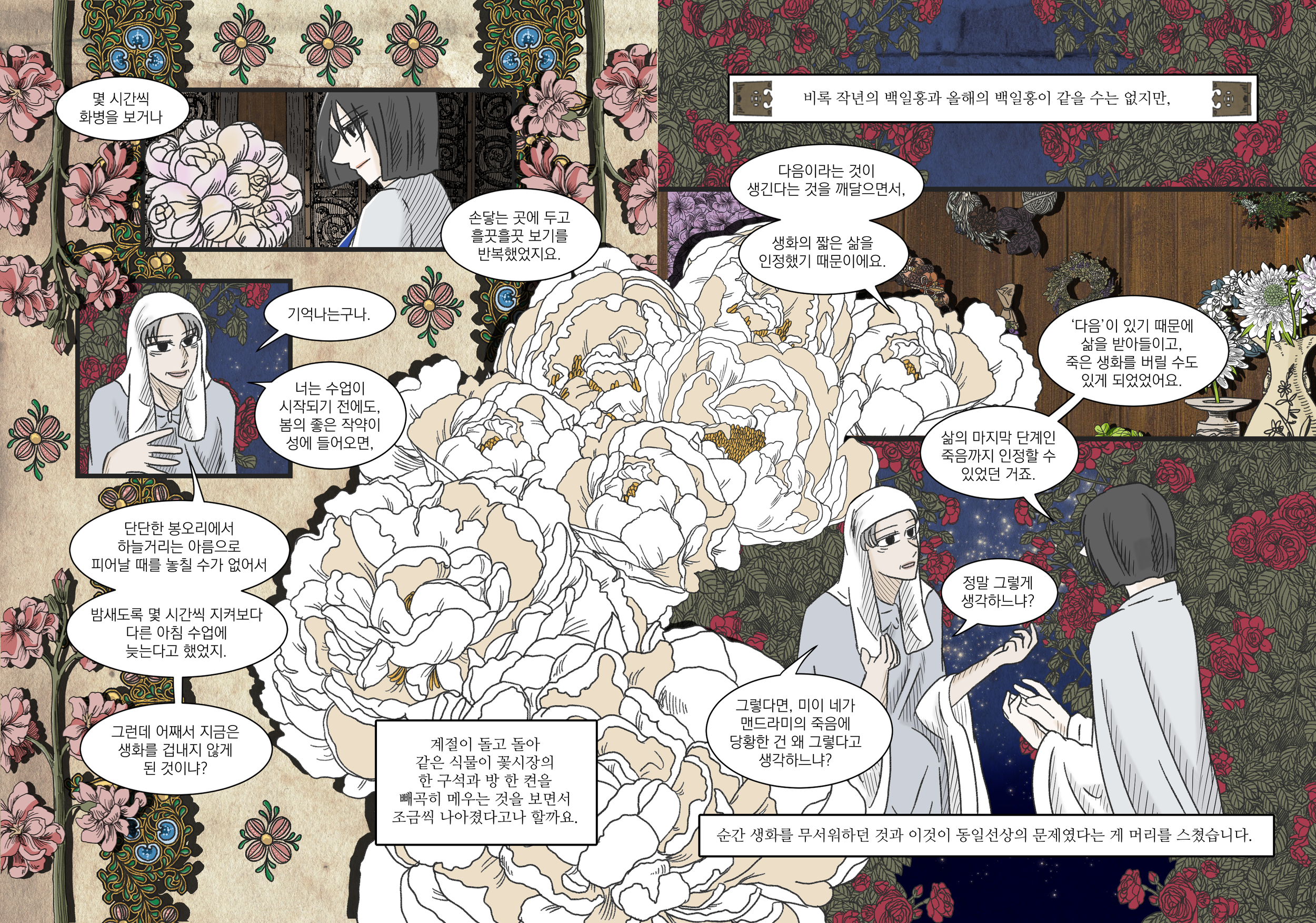
미이는 이후 여러 꽃을 돌보면서 ‘다음’이라는 것을 알게 됩니다. 지난해 피었던 꽃과 올해 피는 꽃이 같은 개체일 수는 없고, 한 송이의 생화는 결국 시들고 사라집니다. 그러나 계절이 돌아오면 또 다른 꽃을 만날 수 있습니다. 그때 미이는 꽃이 죽는다는 사실을 조금씩 삶의 일부로 받아들이게 됩니다. 살아 있다는 것은 번성하고 성장한다는 뜻만을 갖지 않습니다. 죽을 수 있다는 것 역시 살아 있다는 조건 안에 포함됩니다.
생명성을 삶의 활력과 성장에만 한정한다면, 쇠락과 죽음은 실패처럼 보입니다. 하지만 죽음까지 하나의 생의 과정으로 본다면 이야기는 달라집니다. 이 생각은 지금 제가 식물을 관찰하는 방식과도 연결됩니다.
꽃은 언제나 만개한 모습으로 존재하지 않습니다. 봉오리에서 시작해 피어나고, 접히고, 색이 바래고, 형태를 잃어갑니다. 그 모든 시간이 한 식물의 모습입니다.
3. 감정은 제거해야 할 것이 아니다
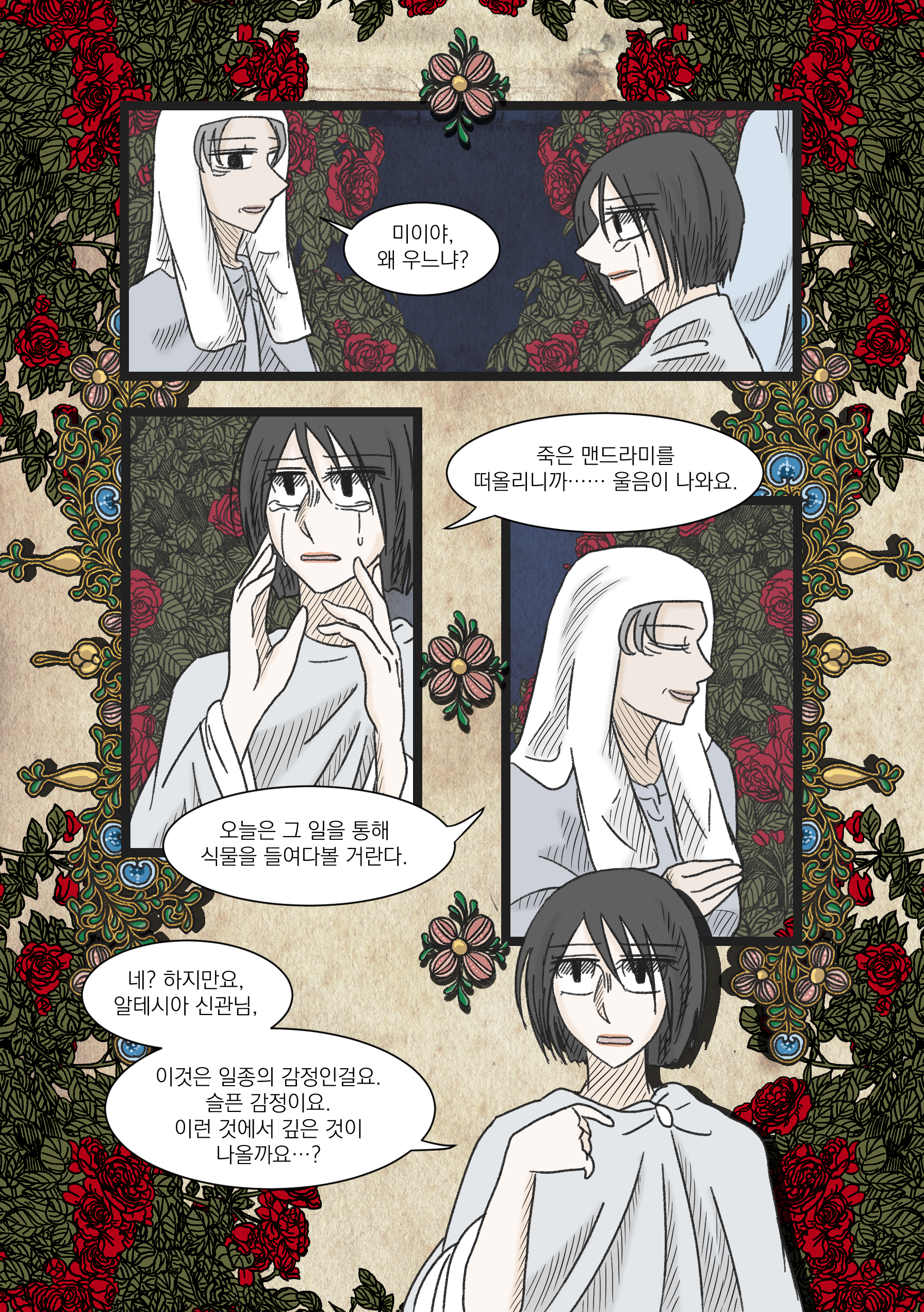
맨드라미의 죽음을 떠올리던 미이는 눈물을 흘립니다. 그리고 묻습니다. 슬픈 감정에서 정말 깊은 것이 나올 수 있을까. 이 장면을 지금 다시 보면서 흥미로운 것은, 이야기 속 수업이 미이의 슬픔을 없애려고 하지 않는다는 점입니다. 왜 슬픈지, 왜 그 짧은 죽음이 그렇게 크게 다가왔는지를 들여다보게 합니다.
당시에는 감정과 사유가 서로 반대편에 있는 것이 아니라는 생각을 하고 있었던 것 같습니다. 우리는 어떤 대상을 충분히 바라보고 관계를 맺었기 때문에 기뻐하기도 하고 슬퍼하기도 합니다. 그렇다면 감정은 사유를 방해하는 것만이 아니라, 무엇이 나에게 중요했는지를 알려주는 흔적이 될 수도 있습니다. 식물이 남긴 감정을 들여다보는 것 역시 식물을 이해하는 한 가지 방법일지 모릅니다.
4. 식물을 대상으로만 바라보지 않는다는 것
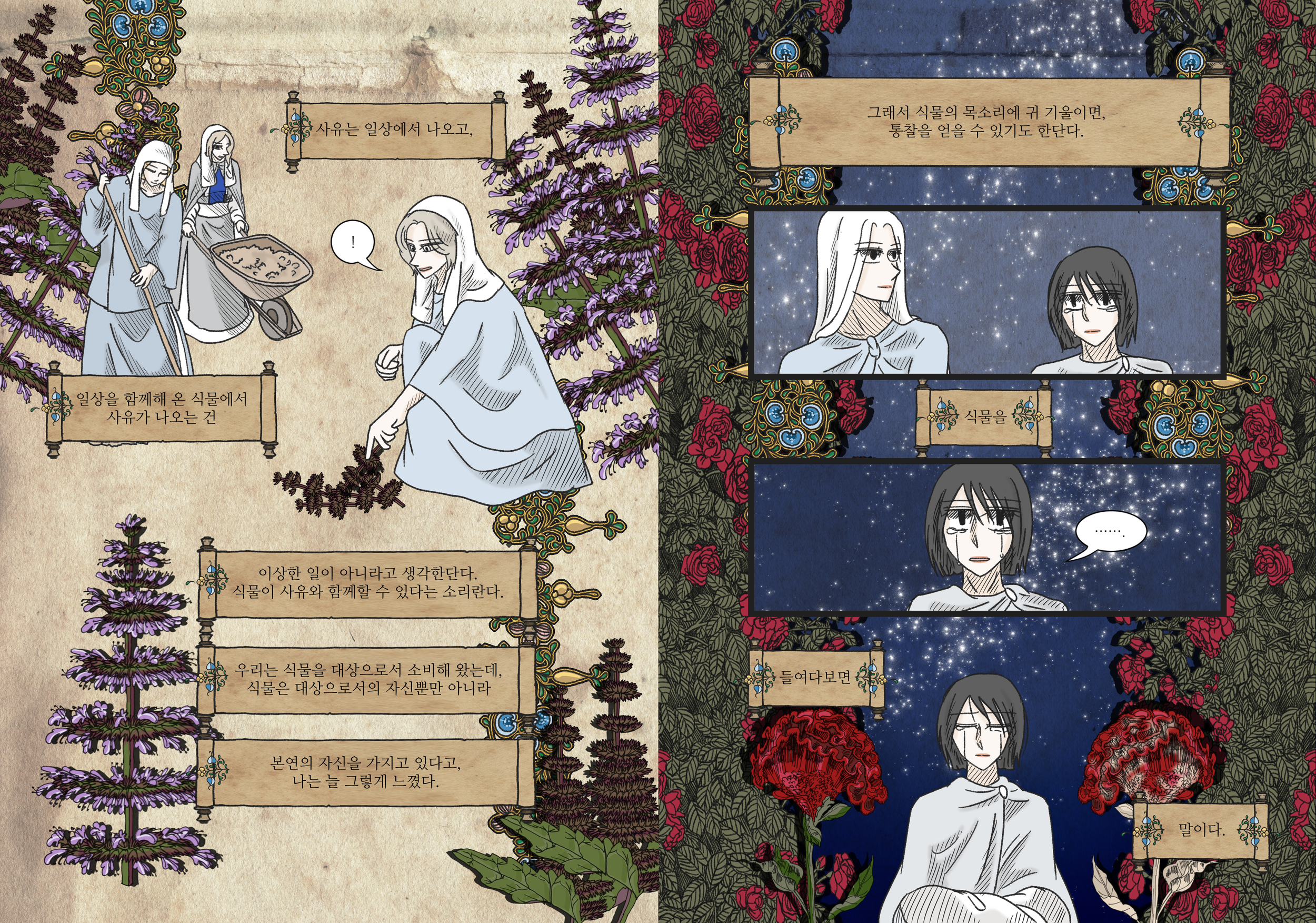
인간은 오랫동안 식물을 다양한 방식으로 이용해 왔습니다. 식물은 아름다움과 영감의 대상이었고, 음식이었으며, 놀이와 장식의 재료였고, 때로는 약과 독이었습니다. 우리는 식물과 역사를 함께해 왔지만, 어쩌면 대부분의 경우 식물을 인간을 위한 대상으로 바라봐 왔는지도 모릅니다.
<꽃꽂이 수업 — 철학적 사고>에서 제가 시도했던 질문은 여기서 한 걸음 더 나아갑니다. 식물에게도 인간의 필요와는 별개인 삶의 시간이 있다는 것을 인정한다면, 우리는 식물을 조금 다르게 바라볼 수 있을까. 식물을 인간과 같은 방식으로 의인화할 필요는 없습니다. 다만 인간이 정한 목적과 효용만으로 식물의 존재 전체를 설명할 수 없다는 사실을 기억할 수는 있습니다.
관찰은 어쩌면 그 지점에서 시작됩니다. 이미 알고 있다고 생각했던 대상을 잠시 멈춰 보고, 그 대상이 실제로 어떤 모습으로 존재하는지 다시 바라보는 일...
2018년의 질문을 2026년에 다시 읽으며
2018년의 저는 한 송이 맨드라미의 죽음에서 출발해 생명, 우연, 죽음과 감정에 대해 생각했습니다. 그때는 솔직히 이 질문들이 오늘의 작업으로 이어질 것이라고 생각하지 못했습니다. 하지만 2026년 지금, Botanical Archive를 만들며 제가 반복하고 있는 일 역시 크게 다르지 않습니다.
관찰 → 이해 → 재해석 → 기록
저는 이제 꽃이 가장 아름답게 만개한 순간만을 기록하지 않습니다. 피기 전의 모습과 만개한 순간, 꽃잎이 접히고, 시들고, 형태가 무너지는 과정까지 바라보려고 합니다. 최근 그린 BA012 능소화에서도(웹사이트/인스타그램 참고) 만개한 둥근 꽃잎보다, 꽃이 지기 직전 안으로 접히며 날카로운 형태를 띠는 순간을 선택했습니다. 많은 사람이 꽃의 만개를 기억합니다. 그러나 꽃이 스러지는 모습까지 기억하는 사람은 많지 않습니다.
돌아보면 <맨드라미의 죽음>은 지금의 저에게 꽤 오래된 질문 하나를 남긴 이야기였습니다. 살아 있는 것을 바라본다는 것은 어디까지 바라보는 일일까.
원작에 대하여
이 글은 2018년 제작한 만화책 <꽃꽂이 수업 — 철학적 사고>의 1화와 2화, <맨드라미의 죽음>을 2026년의 시선으로 다시 읽은 기록입니다.
원작에서는 미이, 알비나, 알테시아의 대화와 사건을 통해 이 질문이 보다 긴 이야기로 이어집니다.
원작은 한국에서 구매하실 수 있습니다. (아래 링크)
Revisiting Flower Arrangement Lesson — Philosophical Thinking
Chapter 1. The Death of the Celosia (Cockscomb)
To be alive is to be capable of dying.
In 2018, I created a one-volume comic titled Flower Arrangement Lesson — Philosophical Thinking.
I made this story while studying philosophy and life sciences, thinking about the relationship between plants and humans. Its characters arrange flowers, grow and observe plants, and sometimes encounter their deaths, asking what it means to live alongside them.
In Records of Flora — Reprise, I revisit this comic from 2018 through the perspective of 2026.
The first story begins with a single red cockscomb.
Albina, the older sister of the protagonist Mii, says during a flower-arrangement lesson that she would like to see a red cockscomb. Although she knows that cut flowers do not live for very long, she believes that with Mii’s careful attention, perhaps it might live a little longer.
But the cockscomb Albina entrusts to her does not survive beyond four nights. On the morning of the fifth day, it dies.
That small event becomes Mii’s first lesson in thinking.
1. Life Cannot Be Controlled
Mii wanted to keep the cockscomb for as long as possible.
She thought that by changing its water carefully and providing the right environment, she might be able to keep it alive beyond its average lifespan. Caring for plants does, after all, involve a certain degree of human knowledge and experience.
But the cockscomb died earlier than she expected.
Mii begins searching for a reason. Perhaps the water was unsuitable. Perhaps the temperature during the night was wrong. Perhaps she herself had made a mistake.
Yet even if we could explain every condition surrounding a living thing, it would not mean that we could completely predict its fate.
What I was thinking about through this scene was the difference between caring for a life and controlling a life.
Life is not a system that returns exactly as much as we put into it. Care does not guarantee an outcome. It is, rather, one way of entering into a relationship with another living being.
2. Death Is Not the Opposite of Being Alive
As time passes, Mii cares for many different flowers and gradually discovers the idea of “the next.”
The flowers blooming this year cannot be the very same flowers that bloomed the year before. A cut flower will eventually wither and disappear.
And yet, when the seasons turn, another flower can be encountered.
Through this repetition, Mii gradually begins to accept the short life of a flower.
To be alive does not mean only to flourish and grow.
The possibility of death is also contained within being alive.
If we understand vitality only through growth, abundance, and flourishing, decline and death can easily appear to be failures.
But if death is also understood as part of the course of a life, the story begins to look different.
This idea still connects closely to the way I observe plants today.
A flower never exists only at the moment of full bloom. It begins as a bud, opens, folds inward, loses its color, and eventually loses its form.
All of those moments belong to the same plant.
3. Emotions Do Not Have to Be Removed
Thinking about the dead cockscomb, Mii begins to cry.
She asks whether anything profound can truly emerge from sadness.
Looking back at this scene now, what interests me is that the lesson does not try to make Mii’s sadness disappear.
Instead, she is encouraged to examine why she is sad, and why the short death of a single flower affected her so deeply.
I think I was already considering the possibility that emotion and thought do not necessarily stand on opposite sides.
We feel joy or grief because we have looked at something closely enough, and because some kind of relationship has formed.
If so, emotion may not simply interfere with thought.
It can also become a trace that tells us what mattered to us.
Listening to the emotions a plant leaves behind may itself be one way of understanding it.
4. Looking at Plants as More Than Objects
Humans have lived alongside plants for a very long time.
Plants have been sources of inspiration and beauty. They have been food, decoration, entertainment, medicine, and poison.
We often say that humans and plants have shared a long history.
But perhaps, throughout much of that history, we have primarily understood plants as objects for human use.
In Flower Arrangement Lesson — Philosophical Thinking, I tried to move the question one step further.
If we acknowledge that a plant possesses a life and a time of its own, independent of human needs, could we begin to see it differently?
We do not have to anthropomorphize plants or imagine them as miniature humans.
But we can remember that their existence cannot be explained entirely through the purposes and values humans assign to them.
Perhaps observation begins there.
By stopping for a moment in front of something we believe we already know, and looking again at how it actually exists.
Revisiting a Question from 2018 in 2026
In 2018, I began with the death of a single cockscomb and found myself thinking about life, chance, death, and emotion.
At the time, I did not know that these questions would continue into the work I make today.
But in 2026, as I work on Botanical Archive, I find myself repeating a process that is not so different:
Observation → Understanding → Reinterpretation → Archive
I no longer record flowers only at the moment when they appear most beautiful.
I try to observe what comes before blooming, the moment of full bloom, the folding of petals, the fading of color, and the gradual collapse of form.
In my recent BA012 Campsis, for example, I chose not to depict the familiar rounded form of the flower at its peak. Instead, I focused on the moment just before it falls, when the petals begin to fold inward and become sharper.
Many people remember a flower at its fullest bloom.
Far fewer remember the way it disappears.
Looking back, The Death of the Cockscomb seems to have left me with a question that has stayed with me for a very long time:
When we say we are looking at a living thing, how far are we willing to look?
About the Original Work
This text revisits Chapters 1 and 2, The Death of the Cockscomb, from my 2018 comic Flower Arrangement Lesson — Philosophical Thinking, through my perspective in 2026.
In the original comic, these questions unfold through a longer narrative and through conversations between Mii, Albina, and Altesia.
Records of Flora : saleign 2026i
