
꽃의 일지
#6 리프라이즈 Reprise
관찰하는 일은 언제부터 시작되었을까
안녕하세요. 살랭(SALEIGN) 작가입니다. 꽃의 일지 독자 여러분, 잘 지내셨나요?
최근 오래된 작업 자료들을 정리하다가, 2018년 소나무언덕잠실본동작은도서관에서 진행했던 4회 강의의 교본을 다시 펼쳐볼 일이 있었습니다. 강의 제목은 〈가을 꽃 산책〉. 4주 동안 진행되는 작은 강의였는데, 학업과 병행하던 기억이 납니다. 철학 전공과 부전공인 생명과학 강의를 들으며 학교와 들, 산, 바다를 거닐고, 자연 속을 정신없이 돌아다니던 때였습니다. 이때만 해도 저는 일러스트레이터이자 만화가로 활동하고 있었더군요.
여하튼 강의 자료를 발견하고, 오래된 자료라 가볍게 훑어보려고 했는데 몇 페이지를 넘기지 못하고 한참을 들여다보게 되었습니다. 지금 웹사이트와 SNS에서 연재하고 있는 Botanical Archive 프로젝트의 원형이, 생각보다 훨씬 오래전부터 선명한 형태로 이 안에 들어 있었기 때문입니다. 코로나19가 시간을 한 번 크게 갈라놓긴 했나 봅니다. 그 이전의 일이 아주 오래전이라고 생각하고 있었어요. 그런데 이렇게 연속되는 지점을 발견하니, 끊겨 있던 시간이 다시 하나로 이어지는 듯한 느낌이 들었습니다.
〈가을 꽃 산책〉은 원래부터 "식물과 인간의 관계에 대해 생각해보는 강의”라고 명시되어 있었습니다. 첫 시간에는 식물형태학을 통해 식물의 구조를 관찰하는 법을 익히고, 두 번째와 세 번째 시간에는 실제 식물을 꽃시장에서 가져와 나눠주며 글과 그림으로 함께 기록하고, 마지막 시간에는 식물과 인간의 관계 자체를 이야기하려 했던 흔적이 선연하게 남아 있었습니다. 그래서 몇 가지 부분을 다시 호출해 읽어보았습니다.
일종의 리프라이즈(reprise)라고 할까요?
식물세밀화와 보태니컬 일러스트레이션의 구분
저는 식물세밀화를 정확히 사사받은 사람은 아닙니다. 식물학과 형태학의 지식을 바탕으로, 세밀화를 나름의 방식으로 시도해오고 있습니다. 돌이켜보면 생명과학과 식물분류학 수업을 들으면서 가장 먼저 인식하게 되었던 것 중 하나가 식물세밀화와 보태니컬 일러스트레이션의 차이였습니다
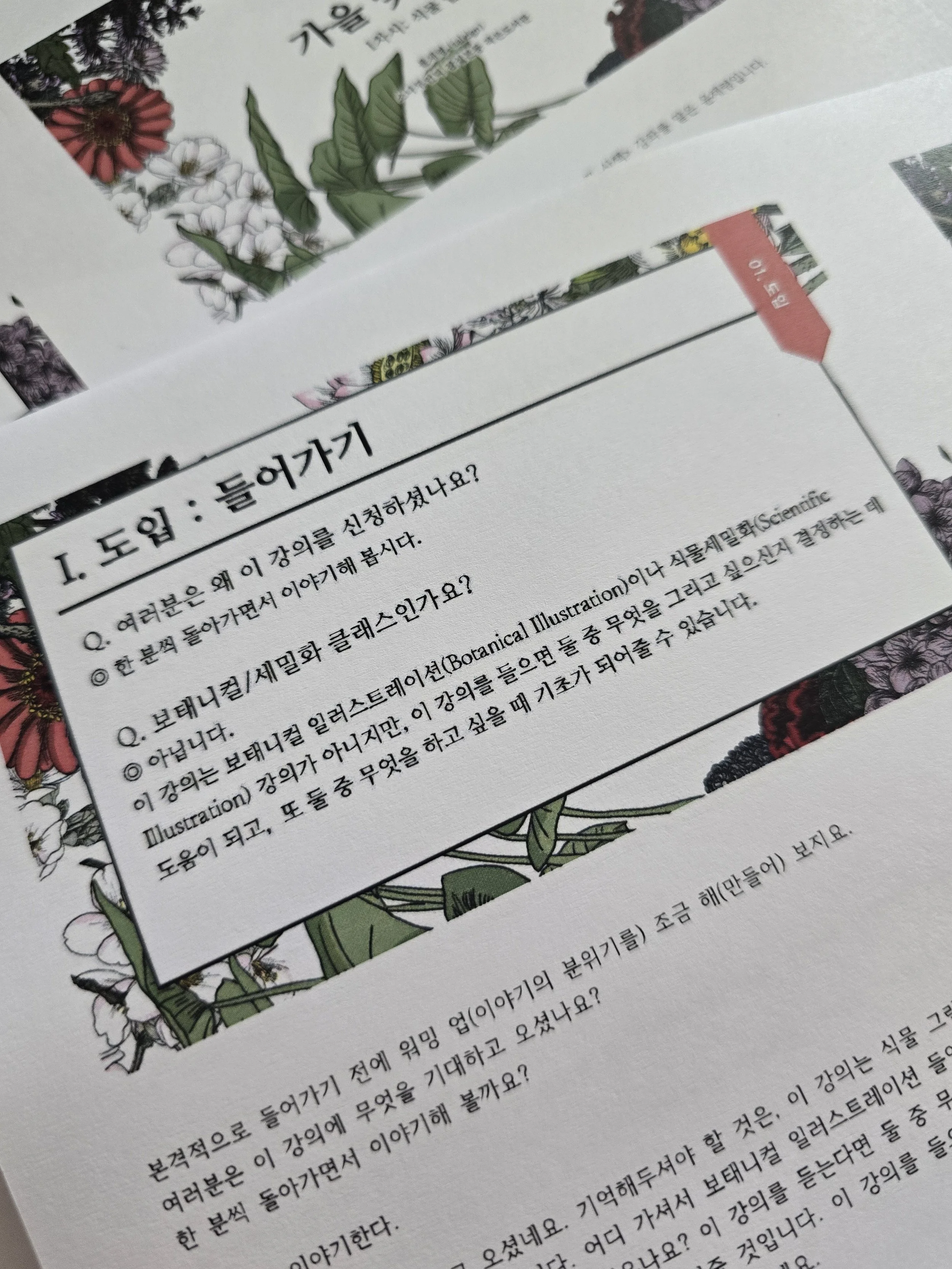
처음에는 그저 그림을 더 잘 그리고 싶다는 욕구에서 둘을 명확히 구분하지 못한 채 관련 수업을 신청했던 기억도 납니다. 그러다 이 차이를 알게 되고 매료된 뒤로는, 그림을 잘 그리는 것 자체보다 식물을 어떻게 알고, 어떻게 바라보고, 어떤 관계를 맺을 수 있을지 생각하는 일이 더 중요해졌습니다.
이때 만들었던 자료를 보면 아주 고집스러운 모습이 강하게 남아 있어요. 지금의 이 고집이 없는 데서 갑자기 생긴 건 아니구나. 잠시 웃었습니다. 지금은 업계 경력이 쌓이며 훨씬 부드러워졌고, 사교성도 많이 늘었는데요. 이때는 정말 무쇠 같았구나, 싶어요. 또 당시 언어철학과 철학교육을 수강하며 몇몇 부분에 강하게 공명했던 모양입니다. 강의 자료 곳곳에도 그 흔적이 남아 있었습니다.
관찰과 명명
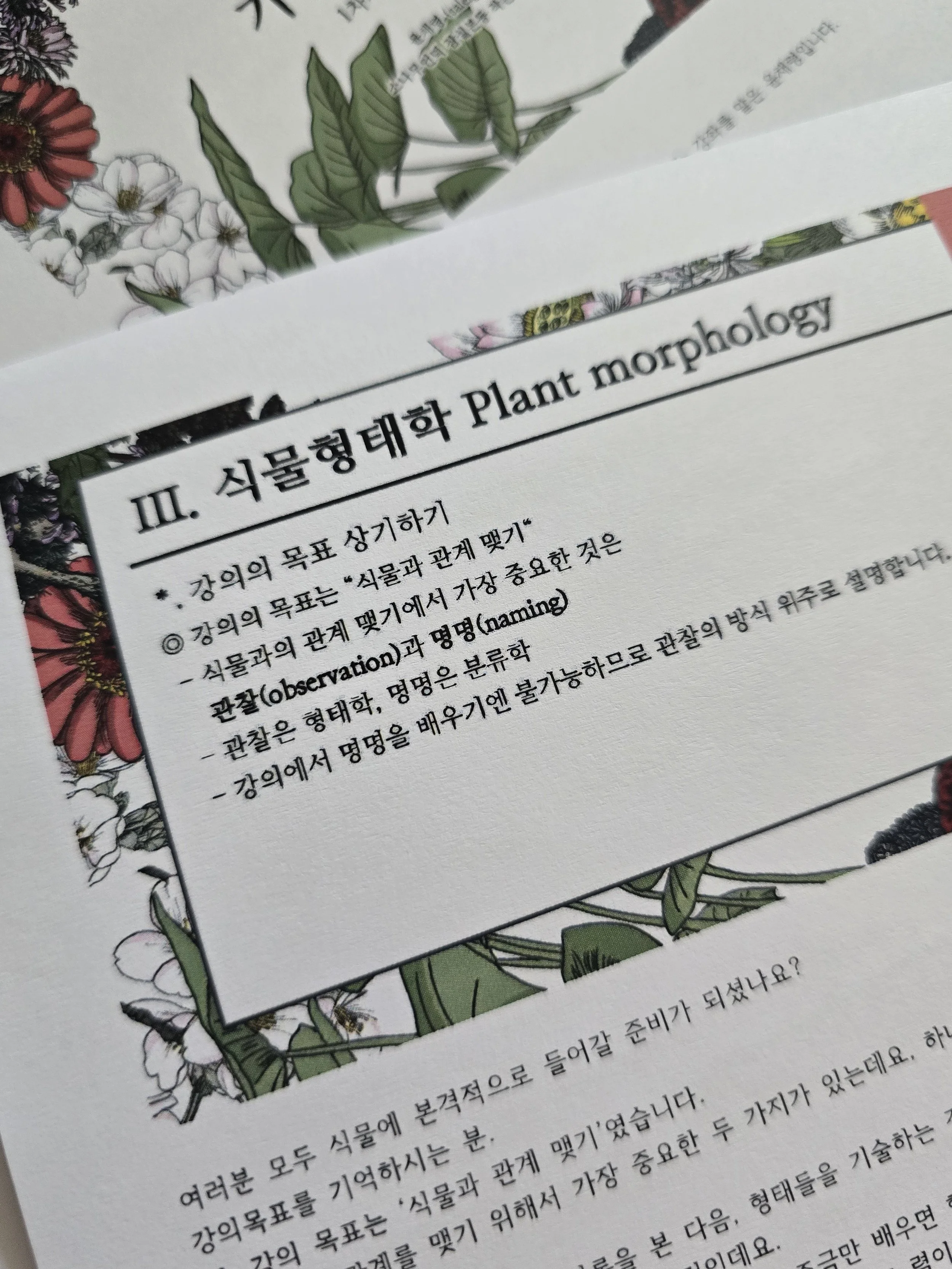
당시 첫 강의에서 식물을 알아가는 데 중요한 두 가지로 꼽았던 것이 관찰과 명명입니다. 관찰은 식물의 구조와 형태를 보고 기술하는 일이고, 명명은 분류의 기준에 따라 그 식물이 무엇인지 알아가는 일입니다. 짧은 시민 강의에서 전문적인 분류학까지 다룰 수는 없었지만, 자료를 다시 보니 적어도 어떻게 관찰할 수 있는가를 알려주기 위해 꽤 집중했던 제가 남아 있었습니다.
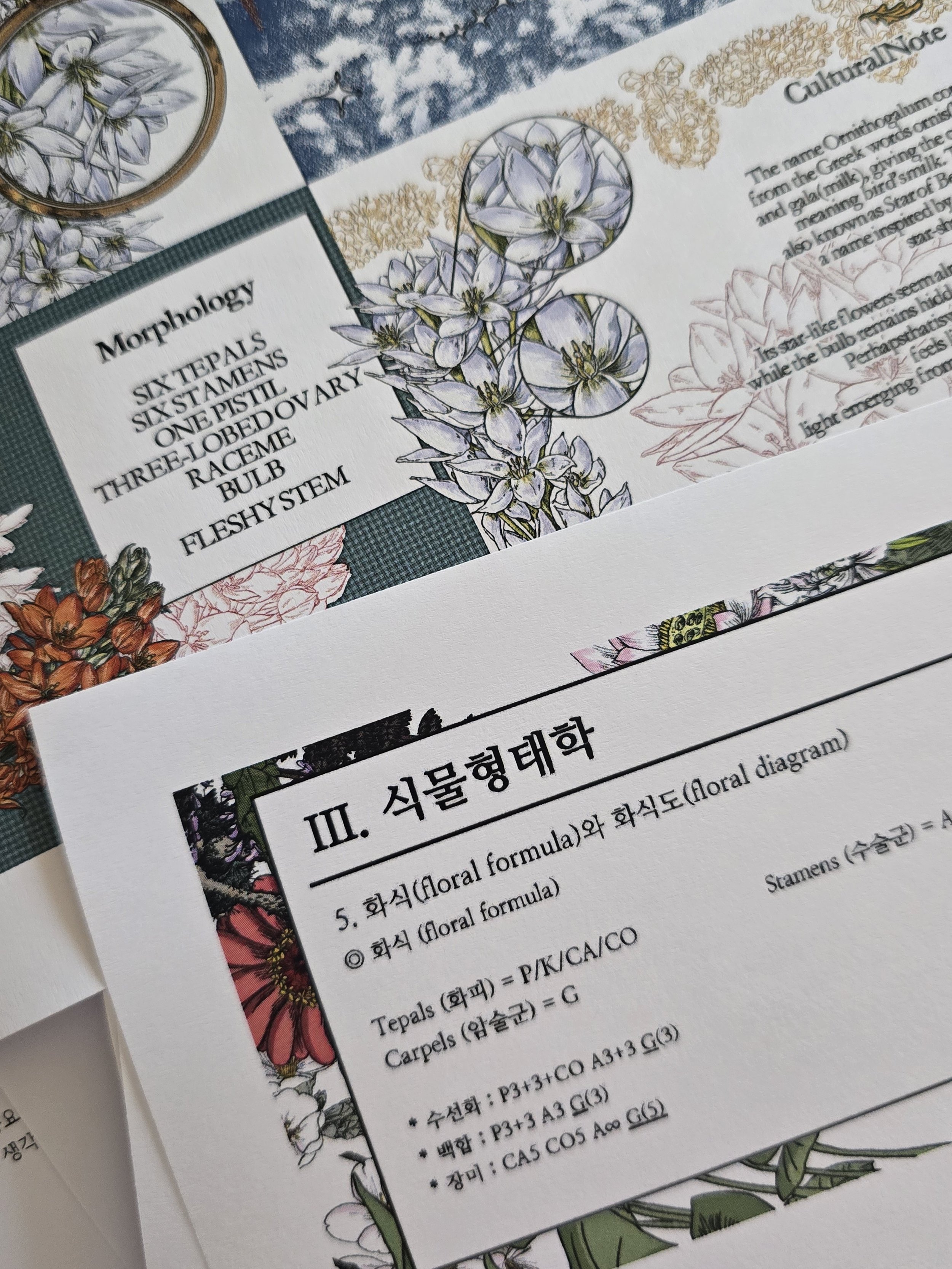
2주차에는 실제 꽃을 놓고 잎의 배열, 꽃잎과 꽃받침, 암술과 수술, 서로 연결된 조직 등을 도해로 그리며 강의했습니다. 한국의 일반적인 식물 수업에서는 자세히 접하기 어려웠던 화식(floral formula)과 화식도(floral diagram)도 소개했었네요. 꽃의 구조를 기호와 그림으로 압축해 표현하는 방법을 설명하면서, 대중 강연임에도 깊이를 포기하지 않으려 했던 흔적이 남아 있습니다.
마침 이번 추석에는 Zine을 만들고 있었습니다. 세 가지 Zine을 만들었는데요. 하나는 Botanical Archive, 두 번째는 앵무새들을 주제로 한 Parrot Notes, 세 번째는 대표작 Cabinet of Curiosities를 주제로 한 Zine입니다. Botanical Archive Zine에는 BA003 Ornithogalum, 오니소갈룸을 골랐습니다.
2018년과 2026년. 두 작업에서 동일하게 형태학의 언어를 사용해 식물을 묘사하고 있는 모습이 보여서, 나란히 보여드립니다.
당시에는 그림과 공부 사이에 조금 더 간극이 있었습니다. 하지만 지금 Botanical Archive를 만들고 수행하는 일이 갑자기 생겨난 것은 아니고, 아마 그때부터 가지고 있던 성향이 이어져온 것 같습니다. 오래된 강의를 다시 읽어보니, 식물을 오래 바라보고, 구조를 이해하고, 그것을 표현할 언어를 찾고, 다시 인간의 경험과 관계 속에서 생각하는 것. 지금 제가 이야기하는 Observation → Understanding → Reinterpretation → Archive라는 방법론적 도식의 원형이 보입니다. 관찰하고, 이해하고, 재해석하고, 그래서 기록으로 남기는 것.
당시에는 이것을 하나의 작업 방법론이라고 생각하지 않았던 것 같습니다. 이름을 붙이지 않았을 뿐, 그 골격은 이미 이때부터 만들어져 있었던 셈이지요.
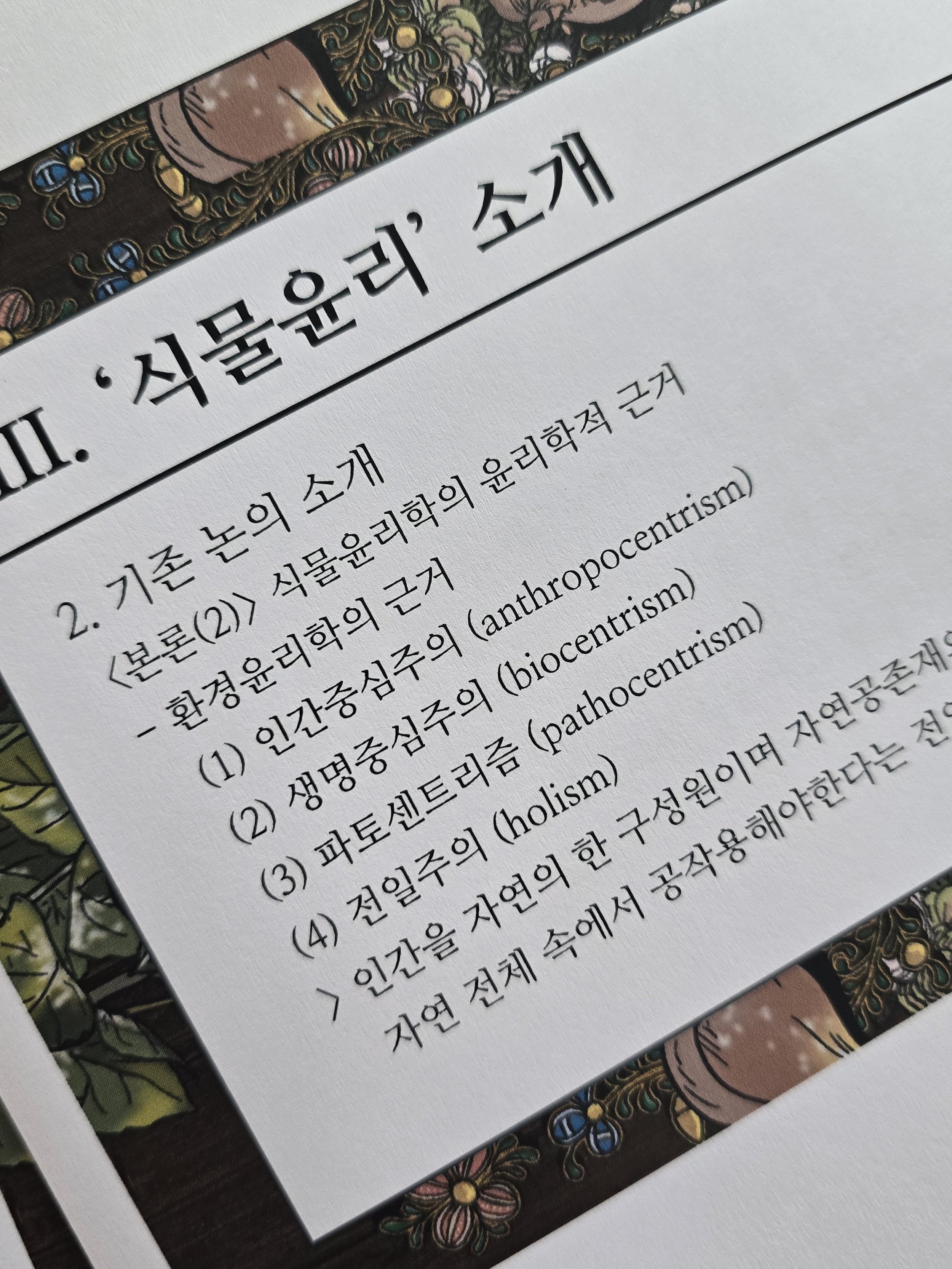
하나의 관찰로 끝나는 것이 아니라 관계를 맺는 일은 〈가을 꽃 산책〉의 마지막 차시, 식물윤리에 관한 부분에도 드러납니다. 이때 사실 시간이 굉장히 촉박했어요. 4주짜리 강의인데 넣고 싶은 내용이 너무 많았습니다. 그런데 지금 돌아보니, 그래도 잘 해냈다는 생각이 듭니다. 이것저것 많이 넣었고, 정해진 기간 안에서 열심히 설명했고, 시민분들과 유의미한 토론도 나누었던 기억이 납니다.
당시 저는 식물윤리를 “식물과 인간이 어떻게 관계할 수 있는가”의 문제로 놓았습니다. 아리스토텔레스에서 칸트, 환경윤리에 이르는 철학적 배경을 살펴본 뒤, 식물의 ‘번성’이나 ‘좋은 삶’처럼 당시 제가 공부하고 있던 개념들도 이야기했습니다. 그리고 조금 더 우리 생활 가까이에 있는 질문으로 옮겨갔습니다.
꽃시장에 간다면 식물을 살 것인가. 산다면 분재와 절화, 말린 꽃 중 무엇을 고를 것인가. 그리고 그 식물을 마지막에는 어떻게 할 것인가. 이것을 하나의 철학적 집단 사고실험으로 진행했습니다. 단순히 “식물을 죽여도 되나요?”와 같은 피상적인 문답을 하고 싶었던 것은 아니었던 것 같습니다. 식물을 좋아하고, 구매하고, 기르고, 자르고, 말리고, 기억하는 사람들의 행동 속에서 우리는 무엇을 보고 있는가. 그리고 그 과정에서 어떤 관계를 만들어가고 있는가. 그 답을 함께 찾아보려고 노력했던 것 같아요. 이렇게 남아 있는 자료를 보고 있으니, 당시 제가 이 주제에 얼마나 열중하고 있었는지가 조금씩 떠오릅니다.
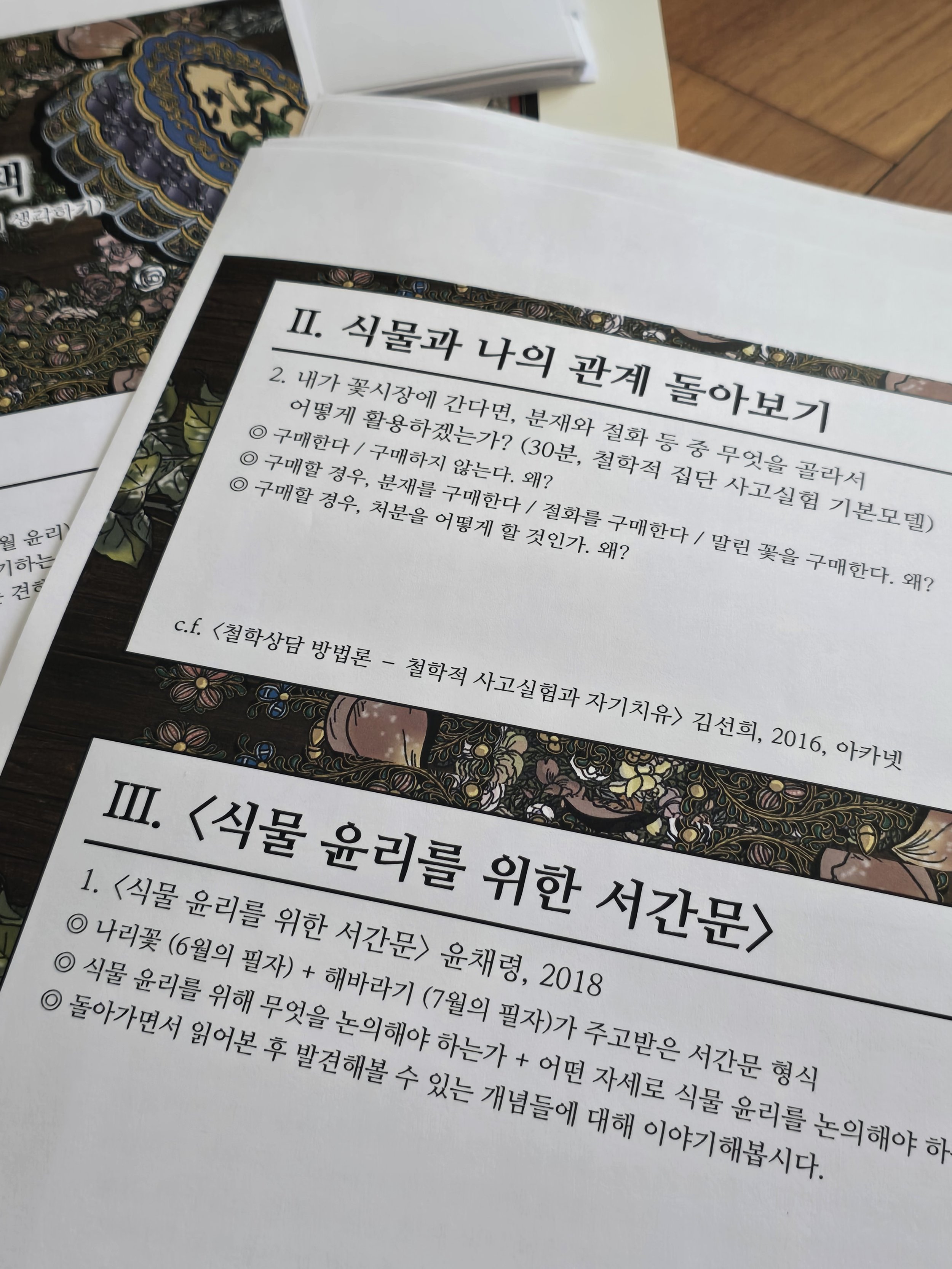
마지막 시간에는 제가 직접 작성했던 〈식물 윤리를 위한 서간문〉도 함께 낭독했습니다. 지금 생각하니 발칙하기도 하고, 조금 부끄럽기도 하네요. (어린 선생님을 따라 열심히 수업을 들어주시고 적극적으로 참여해주셨던 당시의 시민분들께 새삼 무척 감사한 마음이 듭니다.) 〈식물 윤리를 위한 서간문〉에서는 식물을 객관적으로 관찰하고 분석하는 ‘경험’과, 식물과 인간 사이에서 발생하는 감정과 사건을 포함한 ‘체험’을 구분하면서, 식물과 관계를 맺을 때 어느 하나만으로 충분할 수 있는지를 고민하고 있었습니다. 결국 사람은 식물의 목소리를 직접 들을 수 없습니다. 식물의 관점을 완전히 알 수도 없습니다. 우리가 식물을 이해할 때에는 언제나 어느 정도 인간의 해석이 개입됩니다. 그렇다면 중요한 것은 해석을 완전히 없애는 일이 아니라, 내가 어떤 방식으로 해석하고 있는지를 계속 돌아보는 일일지도 모릅니다.
2026년 지금, 서른의 저는 Botanical Archive를 작성하고 연재하면서 여전히 이 질문과 태도를 가지고 있습니다.
식물을 과학적인 정보만으로 한정해 기록하지 않고, 형태와 생태, 그 식물이 지나온 문화적 이야기와 인간의 기억까지 함께 바라보고 기록하고 있습니다.
강의 자료를 돌아보며 조금 놀랐습니다.
여러분은 ‘살랭’을 어떻게 기억하시나요? 제가 과거에는 어땠나요?
2018년, 처음 사업자를 내고 문구용품으로 그림을 판매하기 시작하던 살랭은 지금과 얼마나 달라졌을까요?
저는 지금 하고 있는 일과 프로젝트들이 최근 몇 년 사이 폭발적으로 증가하고, 그 과정에서 지금의 작업세계가 만들어졌다고 생각하고 있었던 것 같습니다. 그런데 예전 기록을 다시 보니, 2018년에도 이미 저는 식물을 관찰하고 있었고, 관찰한 것을 기록하고 있었으며, 그 기록을 인간의 관계와 윤리의 문제로 확장하고 있었습니다. 다만 당시에는 그것들이 서로 다른 활동으로 나뉘어 있었죠. (강의 - 식물 공부 - 그림) 지금은 그 세 가지를 하나의 작업 안으로 조금씩 가까이 모아가고 있는 것인지도 모르겠습니다.
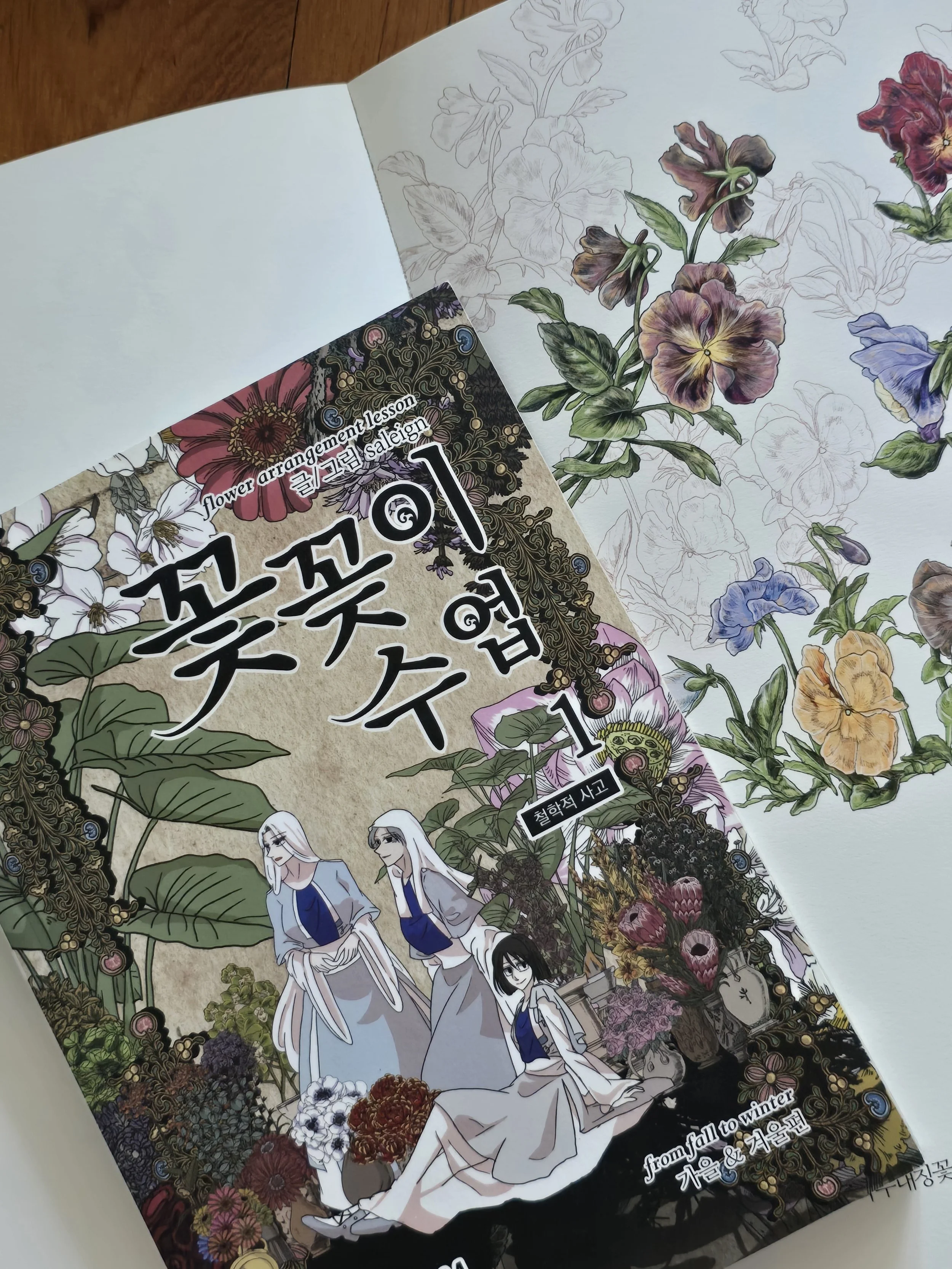
연장선상에서 지금도 판매하고 있는 만화 단행본 〈꽃꽂이 수업 — 철학적 사고〉의 파일도 다시 한번 꺼내보았습니다. 그 안에는 조금 더 날것에 가까운, 예전의 제가 식물을 바라보던 생각들이 녹아 있었습니다. 그리고 지금까지 변해온 제 가치관의 뿌리도 다시 한번 확인할 수 있었습니다.
이 자료들을 가만히 바라보다가 문득 생각했습니다. 블로그에도, 공식 웹사이트에도, SNS에도 이 오래된 기록들을 조금씩 다시 꺼내 보여드리면 어떨까. 최근 제 작업을 알게 된 분들도 많이 늘었고, 저 스스로에게도 지금의 작업이 어디에서 왔는지를 보여주는 하나의 원형이라는 생각이 들었습니다. 그래서 당분간 그림 작업을 이어가며, 매주 주말 발행하고 있는 Botanical Archive와 함께 과거에서 다시 발견하는 〈꽃의 일지〉도 조금씩 써보려 합니다.
겉으로 드러나는 이미지와 그림의 변천사만큼이나, 그 안에서 이어져온 사유의 변천 역시 꽤 컸다는 생각을 하게 되었습니다.
오래된 드라이브를 정리하러 들어갔다가 예상치 못하게 과거의 저를 한참 들여다보게 되었고, 그 이야기를 여러분과도 나누고 싶어 이렇게 글을 올리게 되었답니다.
어쩌면 오래된 기록을 다시 읽는 일은 과거의 나를 설명하는 것보다, 현재의 내가 어디에서 왔는지를 알아보는 일에 더 가까운지도 모르겠습니다. 다음 꽃의 일지에서는, 잊고 있던 만화 〈꽃꽂이 수업 — 철학적 사고〉를 조금 더 꺼내보겠습니다.
오랜만에 다시 열린 꽃의 일지에서, 천천히 만나요.
saleign's lair
26. 10. 11.
When Did the Act of Observation Begin?
Hello, this is SALEIGN. To everyone who has been reading Records of Flora, I hope you have been well.
Recently, while organizing some old working materials, I happened to unfold the handouts from a four-part lecture series I gave at Sonamu Eondeok Jamsil Bundong Small Library in 2018. The lecture was titled Autumn Flower Walk, and it was a small four-week course that I taught alongside my university studies.
I was studying philosophy and life sciences at the time, and looking back at those materials now, I was surprised by how much of what I continue to think about today was already present there.
Finding those points of continuity made the years in between feel, for a moment, as though they had been joined back together.
Autumn Flower Walk was originally introduced as “a lecture for thinking about the relationship between plants and humans.”
In the first session, we learned how to observe plant structure through plant morphology. In the second and third sessions, we brought actual flowers from the flower market, took them apart, and recorded them together through writing and drawing. In the final session, we tried to speak about the relationship between plants and humans itself.
Reading those parts again felt almost like a kind of reprise.
Distinguishing Botanical Art from Botanical Illustration
I am not someone who was formally trained as a botanical artist in the strict sense.
Based on what I learned through botany and plant morphology, I have instead continued to attempt botanical drawing in my own way.
Looking back, one of the first distinctions I became aware of while studying life sciences and plant taxonomy was the difference between botanical art and botanical illustration.
At first, I remember applying for related classes simply because I wanted to draw better, without clearly understanding the distinction between the two.
But after I began to understand that difference, the thing that fascinated me most was no longer simply the act of drawing well.
What became more important was thinking about how to know a plant, how to look at it, and what kind of relationship we can form with it.
When I look at the materials I made back then, I can still see a rather rigid and overly meticulous side of myself.
I smiled a little when I noticed it. That meticulousness did not suddenly appear out of nowhere.
Even now, as my experience has accumulated, I may be a little softer than I was then, but I can still recognize the same root.
Plant Morphology
In the second week, we placed real flowers in front of us and studied the arrangement of leaves, petals and sepals, pistils and stamens, and the tissues connecting them, drawing them as diagrams as we learned.
I also introduced floral formulae and floral diagrams, subjects that are not often covered in ordinary introductory plant classes in Korea.
They are ways of compressing the structure of a flower into symbols and diagrams.
Looking back, I realize that even in a public lecture I did not want to give up a certain level of depth.
At one point in the class, I chose BA003 Ornithogalum.
When I place the work from 2018 beside the work from 2026, I can see that both describe plants using the same language of morphology.
Seeing the two side by side makes that continuity particularly clear.
Observation, Naming, and Relationship
The materials from the lecture included a very simple goal:
to form a relationship with plants.
And one of the most important parts of forming that relationship was observation and naming.
Observation belonged to morphology.
Naming belonged to taxonomy.
Even then, I was trying to explain plants not simply as things to look at, but as beings that could be approached through structure, names and relationships.
Looking back now, I think the lectures, the study of plants and the act of drawing were separate activities at the time.
Today, however, those three things may be gradually moving closer together inside a single body of work.
Plant Ethics
The final session of Autumn Flower Walk dealt with plant ethics.
To be honest, the schedule was extremely tight.
It was only a four-week course, and there were far too many things I wanted to include.
Still, when I look back now, I think I did quite well.
I tried to explain many different ideas within a limited period of time, and I remember having meaningful discussions with the people who attended.
The final session also included a short text I had written myself, A Preamble for Plant Ethics.
Thinking about it now makes me feel both ambitious and a little embarrassed.
I am especially grateful to the participants who followed a young teacher so attentively and took part so actively.
In A Preamble for Plant Ethics, I distinguished between two ways of relating to plants.
One was experience: objectively observing and analysing a plant.
The other was lived experience: including the emotions and events that arise between plants and humans.
I wondered whether either one alone could ever be sufficient when we attempt to form a relationship with plants.
In the end, humans cannot directly hear the voice of a plant.
Nor can we ever completely know a plant’s point of view.
Whenever we try to understand plants, some degree of human interpretation inevitably becomes involved.
And if that is the case, perhaps what matters is not pretending that our interpretation does not exist, but continuing to remain aware of it.
At the time, these things belonged to separate activities:
lecture — studying plants — drawing.
Now, perhaps those three are slowly coming together within a single practice.
I also took out the files for the one-volume comic Flower Arrangement Class — Philosophical Thinking, which is still available through online bookstores.
Inside it were thoughts from an earlier version of myself—ideas about plants that were perhaps a little more raw and less settled.
And through them, I could also recognize the roots of the values that have continued to change and develop within me.
Perhaps that is why I wanted to write this post.
Before beginning the next chapter of Records of Flora, in which I plan to revisit those old drawings and thoughts, I found myself looking back for a moment at the person I once was.
And I wanted to share some of that story here as well.
Perhaps rereading an old record is less about explaining who we used to be, and more about discovering where the person we are now came from.
In the next Records of Flora, I would like to bring out the almost-forgotten comic Flower Arrangement Class — Philosophical Thinking and look at it a little more closely.
After a long absence, Records of Flora is open again.
Let us meet here slowly.
SALEIGN’S LAIR
October 11, 2026
