
Flower Journal #3
The Garden of Time
This essay was originally written in the spring of 2022.
Hello,
this is SALEIGN’S LAIR, recreating and recording the forms of flowers while living in the present.
As I continue shaping the Flower Journal series, I keep thinking about what direction it should take. As I wrote in the first entry, my original intention was to introduce the flowers of the city according to their blooming seasons, together with related knowledge and stories.
But as the lilacs are already fading now—and as I wrote in the second entry about the order of spring flowers—the blooming calendar has become increasingly disordered. Last weekend, I was genuinely surprised to hear that the tulips had already bloomed.
Three times a week, I try to think of one thing I can do in response to the climate crisis and apply it to my everyday life. This week, I have been considering changing my laundry detergent. I want to keep moving steadily toward a clear goal, yet I am often surprised by how difficult that can be when changes in international affairs affect the price and availability of raw materials.
I would also like to use environmentally friendly packaging for my brand, but I have not yet been able to make a complete transition. I already recycle what I can, and for a long time I have wanted to switch entirely to paper packaging materials and paper tape. The fact that it has not worked out as easily as I hoped makes me a little frustrated.
There is a one-person stationery brand called La Jardinière. If you have seen some of the envelopes I decorate, you may have noticed pages from their daily tear-off calendar. I mostly used their calendar and had not tried many of their other products. La Jardinière is a Korean stationery brand that explores and practices mindfulness for mood disorders and stress, creating stationery with very distinct purposes and personalities—such as therapy books, fruit journals, circle books, and aurora cards. Recently, I began seeing many people around me using their Fruit Book, and I became curious about it. Then I heard that it might not be recommended for people with obsessive tendencies. So I asked: if I am someone who lives with both anxiety and obsessive tendencies, which of their products might be more helpful to me?
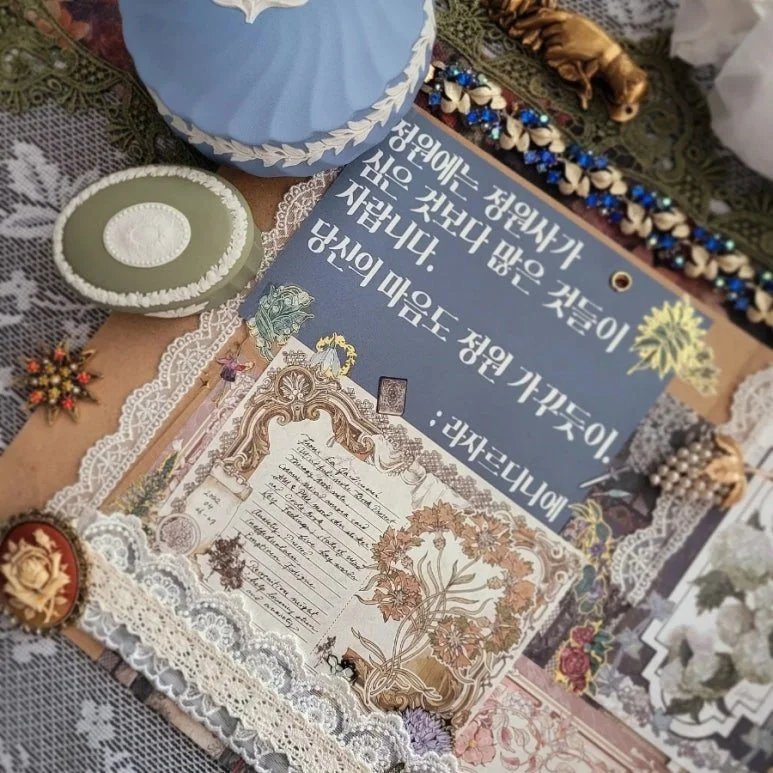
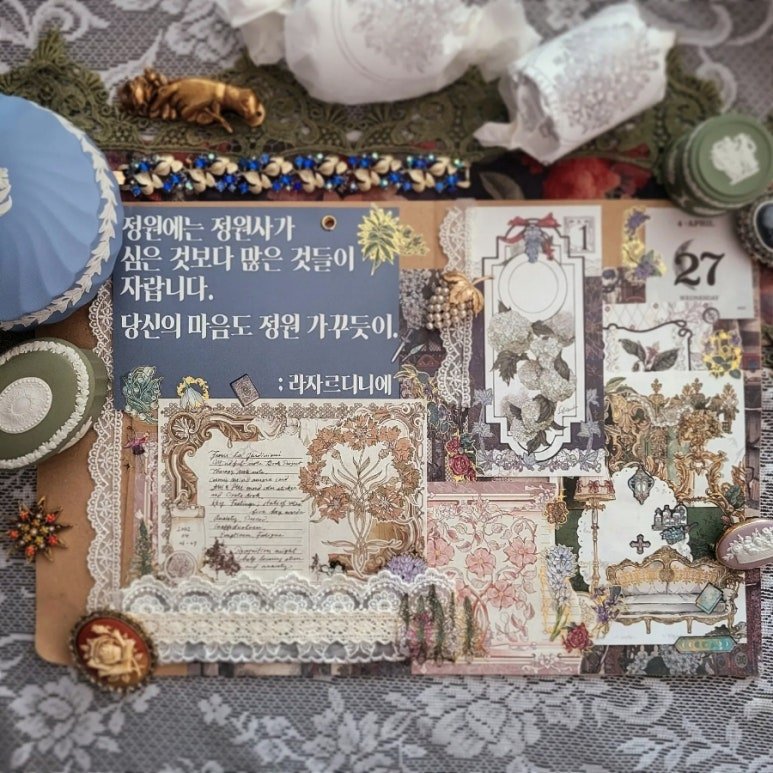
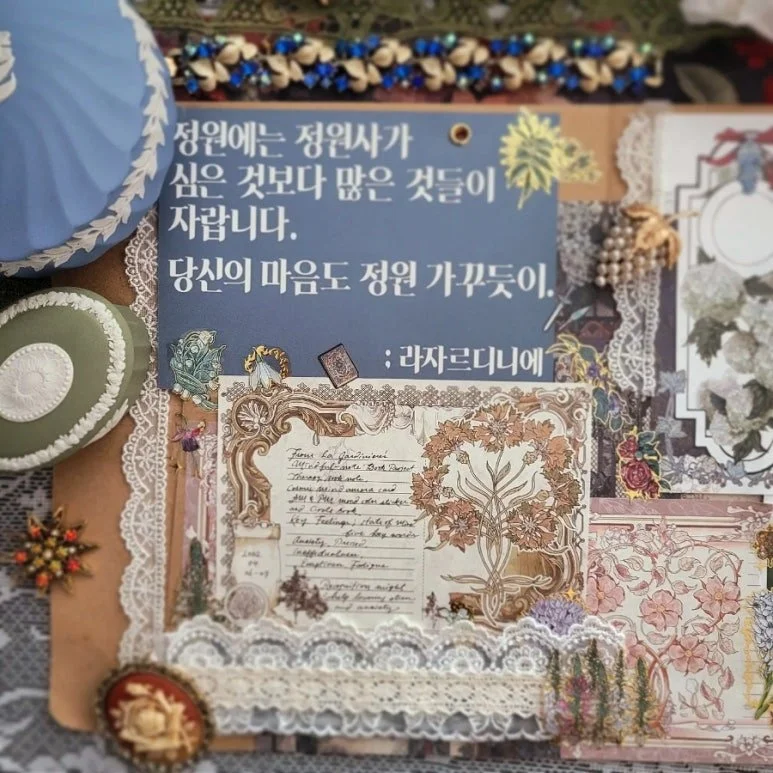
La Jardinière recommended their Therapy Book and Cosmic Circle Book, and I had the chance to try them. On the back of the instruction page for the Therapy Book is La Jardinière’s signature phrase:
“More things grow in a garden than the gardener planted.
Tend to your mind as you would tend to a garden.”
That sentence stayed with me.
While decorating an envelope around this postcard and my new work, Fragments of Spring — Cornflower Devotion, which I planned to upload the following week, I suddenly thought: I have to write about this in the next Flower Journal.
And so I began this entry again.
The Garden of Time
We may think that we understand time very well, but the concept of “time” has changed far more throughout history than we often imagine. Even the modern understanding of time is relatively recent. Studying history made me realize that ancient, medieval, modern, and contemporary societies did not necessarily understand time in the same way. Traces of the ancient conception of time still remain in expressions such as, “as the seasons come around again.” The seasons cycle endlessly. Even if this year’s lilacs fade, next year’s lilacs will bloom again. Nature appears to exist on a circular timeline.
In ancient agricultural societies, the advice of older people was valued not necessarily because it would help society confront a completely “new” future, but because their experience was useful for living through seasons that would repeat and return. Just as Greek and Roman mythology imagined gods of the seasons and gods embodied in natural phenomena, each stage of the natural cycle seemed capable of existing eternally, repeating itself within an endless loop.
This gives us some sense of how people in antiquity may have understood time.
With the arrival of modernity, however, something changes quite dramatically.
People begin to dream of progress.
Instead of hoping, “If life can simply remain like this, next year will be much the same,” people begin to imagine, “I want tomorrow to be different from today. The future will advance beyond the present.” In the medieval period, Augustine is often discussed as one of the earliest thinkers to articulate a particularly strong consciousness of time. We can see this clearly in his autobiographical work, Confessions. Christianity contains the concept of original sin. Whether one is Christian or not, academically speaking, Christianity understands human history through a narrative of sin and assumes that all human beings exist within that condition. In Confessions, Augustine looks back from his present position and recounts the history of his past sins. If the ancient self lived eternally within a repeating present, Augustine’s writing separates the present self who looks backward from the past self being remembered. Through this separation, the three temporal realms—past, present, and future—become more clearly distinguished.
If ancient time was an eternal cycle, the medieval Christian world increasingly imagined time as a straight line moving toward an end. Time no longer meant, “Even if this season’s harvest fails, another season will come.” The past became something that had already passed—something that would never return.
Modernity retained a linear model of time, but its destination changed. Rather than moving toward a religious end point, people increasingly imagined time as progressing toward something better. With rapid technological development, people created new things with the confidence that the future would be better than the present. The possibility of a worse future received far less attention than the expectation of endless development.
Scholars divide the beginning of the contemporary period differently, but the First and Second World Wars are often treated as decisive turning points. The World Wars shattered the modern conviction that the future would always be better than the present. The world was consumed by war. Entire peoples faced the possibility of extermination. Empires and colonies were violently reordered, and weapons appeared that seemed almost unimaginably destructive—including nuclear weapons. The future could no longer be viewed with uncomplicated optimism. Humanity was forced to confront the possibility that the future might actually be worse than the present.
Our conception of the timeline changed again. So did the relationship between past, present, and future. The spectrum of what the future might contain became far wider.
But why am I writing about all this?
This is supposed to be a journal about plants, yet here I am discussing time, ideas, and concepts. Perhaps by now you may no longer want to continue reading. Still, I wanted to explain why La Jardinière’s signature sentence affected me so deeply.
How do we think about the time of a garden?
We often apply different concepts of time to nature and to human beings. Nature is imagined as endlessly cyclical, while human societies rise and fall. But as I wrote in the previous entry about the disruption of natural order, nature no longer appears to return endlessly to precisely the same place. It is more like an old clock beginning to slow down and lose its rhythm. Even when we return to the same location, the flowers blooming there this year may not be the same ones that bloomed at the same time last year. The garden changes, just as human concepts of time have changed.
We trust in the cycles of nature. We sometimes believe that nature will somehow recover. Yet the supposedly eternal cycle of the garden has already been disrupted by countless variables, and it no longer seems certain that it can simply return to what it once was. I do not think this is solely the result of human activity. Birth and death are themselves principles of nature. If something has a beginning, the Earth too must one day have an end. Human activity may have accelerated that process, but it does not change the fact that an ending exists somewhere.
More Things Grow in a Garden Than the Gardener Planted
This sentence began to resonate with me in a new way. Some people believe that every element of a garden can be controlled. I sometimes think of this as a kind of scientific arrogance, and I imagine many people would agree. Science is a discipline of discovery. It is also a discipline whose conclusions may be overturned by what has not yet been discovered. We can never know with absolute certainty whether what we currently believe is the final truth. If we could, would that not make us something like gods? We assume that what has been discovered so far is likely to be true, and for practical purposes we agree to call it a scientific fact. But whether a “scientific fact” is ultimately identical to reality itself may remain unknowable.
There have been experiments known as Biosphere projects, attempts to create and completely control an enclosed ecosystem. Artificial natural environments were constructed inside enormous facilities, and researchers attempted to determine whether humans could live within them. These experiments were ultimately unsuccessful.
To me, this resembles the work of a gardener. No matter how carefully someone tries to control a garden, something will inevitably escape that control. Unexpected microorganisms arrive in the soil. Climate, temperature, humidity, and light can never be perfectly controlled. Each plant affects the others. Variables continually appear that the gardener never intended. A perfectly controlled garden—one that circulates eternally within a fixed cycle—cannot truly exist. Even if we wanted to build a garden governed by cyclical time, we would still experience countless pasts that, once gone, could never be retrieved.
The gardener’s responsibility, then, may not be to expect perfection. It may instead be to observe the garden of the present as carefully as possible—to diagnose its current state, recognize what has moved off course, and respond with whatever actions are available. Mindfulness may work in much the same way.
We try to recognize our emotions more accurately. We attempt to see them clearly. Then, within the circumstances we actually inhabit, we take whatever action we are capable of taking. The theory is simple. Practicing it is much more difficult. La Jardinière’s unusual stationery products function as small tools that help translate this theory into action.
I also tried using the Therapy Book, the Orbit Book, and several of their cards to identify and explore my own emotions. And I began to understand why people use La Jardinière’s stationery. I had mostly used their À Demain daily calendar. I kept an empty glass jar as a kind of “happiness bank.” At the end of the day, I would tear off that day’s calendar page, write down something good that had happened, fold the paper twice, and place it in the jar. Every now and then, I would take some of the notes out and read them again.
As I read the instructions for the other products and tried following them one by one, I realized how well the brand’s signature phrase expresses both its purpose and the way its products function. And the more I thought about the metaphor of the garden together with the idea of time, the more beautifully constructed that sentence seemed to me.
Tend to Your Mind as You Would Tend to a Garden
Earlier, I wrote about the modern timeline. Our contemporary sense of time is neither the ancient cycle, nor the medieval line moving toward an end, nor the modern optimistic line of endless progress. So if we can neither confidently hope for the future nor simply surrender to despair, what can we do? Perhaps one answer can be found in the second half of La Jardinière’s sentence:
“Tend to your mind as you would tend to a garden.”
When faced with a situation, recognize clearly what you can and cannot do—identify, distinguish, clarify—and then do what remains within your power. This is an idea that appeared even in ancient Greece. Even if we do not know what shape our timeline will ultimately take, searching for the best available action—or sometimes simply the least harmful one—can give us enough strength to quiet the anxiety of not knowing where everything will end.
When life appears meaningless, perhaps we can remember that even the natural garden, whose cycles have already been disturbed, continues to mutate, adapt, and evolve. It continues to do whatever it can within the circumstances it has been given.
Like tending a garden.
Like the garden itself.
I found myself liking this phrase because it offers one possible way for a contemporary person to live within contemporary time. If we continue in this way, then whether we are speaking of the history of an individual life or the history of the world, even if its final destination were destruction, we could not entirely deny that something meaningful had existed along the way.
Even if it never remains as a “historical fact.”
Even if no one else ever knows.
SALEIGN’S LAIR
Flower Journal #3
